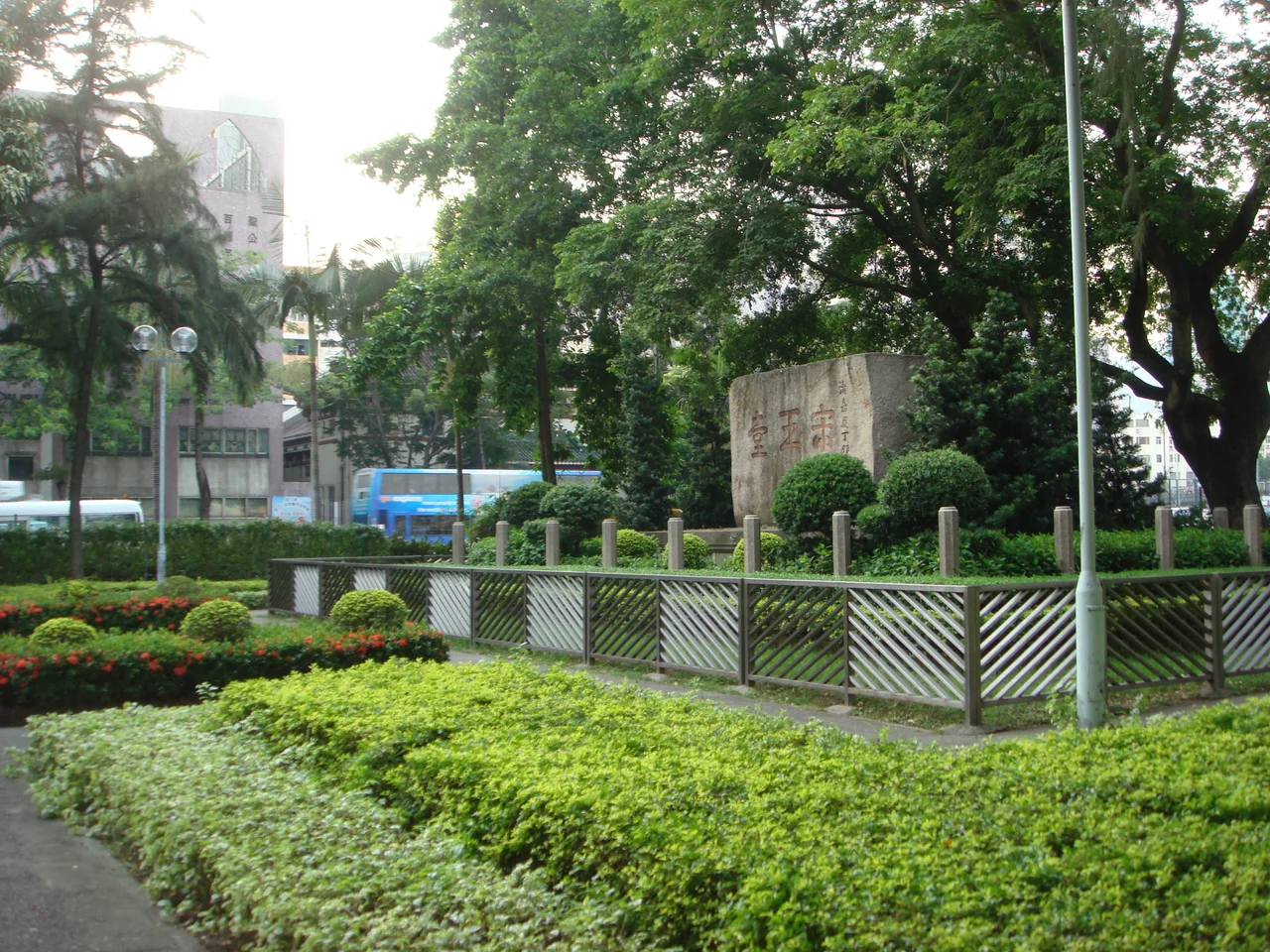

Sung Wong Toi
The words carved into the stone read 'Sung Wong Toi' — 'Terrace of the Song Kings.' But the character chosen for 'king' is deliberate and slightly subversive: local residents in the 13th century used the word for king rather than emperor, possibly to avoid angering the Yuan dynasty rulers who had just conquered the Song. The boulder has survived seven centuries, a Japanese airport expansion, and multiple rounds of urban redevelopment. Today a fragment of it sits in a small garden at the junction of Ma Tau Chung Road and Sung Wong Toi Road in Kowloon City — a quiet corner of the city where an entire dynastic tragedy is compressed into inscribed granite.
The Boy Emperors in Flight
The story begins in defeat. In the late 13th century, the Song dynasty was collapsing under Mongol pressure. The Yuan forces were advancing south, and the last Song emperors — children, both of them — fled with their court to the coast. Zhao Shi (Emperor Duanzong) and his younger brother Zhao Bing took refuge at Sacred Hill, a prominence above what is now Kowloon Bay, between 1277 and 1279. Zhao Shi died of illness while in Hong Kong. His brother Zhao Bing met an even harsher end: following the Song dynasty's final defeat at the naval Battle of Yamen in 1279, the loyalist minister Lu Xiufu put the young emperor on his shoulders and jumped from a cliff into the sea rather than surrender.
The inscribed boulder on Sacred Hill was, according to tradition, a memorial to these two child rulers — an act of remembrance by a local population that had witnessed the end of a dynasty.
Stone, Inscription, and Survival
The original boulder that bore the inscription stood 45 meters tall on top of Sacred Hill, overlooking Kowloon Bay. After the Song fell to the Yuan dynasty in 1279, local residents carved the three characters 'Sung Wong Toi' into this rock. In 1807, during the Qing dynasty, seven smaller characters were added to record renovation work done during the reign of the Jiaqing Emperor.
The boulder survived more than six centuries intact. Then came the Second World War. During the Japanese occupation of Hong Kong from 1941 to 1945, Sacred Hill was levelled to extend Kai Tak Airport. The blasting dislodged the boulder and shattered most of it. One portion — roughly a third of the original size, bearing the carved inscription — survived the destruction. It was this surviving fragment that became the focus of post-war efforts to preserve what remained of the memorial.
The Garden Built for a Stone
After the war, the surviving portion of the boulder was shaped into a rectangular block and moved to a small park constructed specifically to house it. The Sung Wong Toi Garden was completed in the winter of 1945, not far from the stone's original site, in what is now the Kowloon City District.
The name given to the surrounding streets and, eventually, the MTR station carries a telling detail. Where the carved stone uses the character for 'king,' the Hong Kong colonial government in 1959 chose to use the character for 'emperor' when naming the park, the road, and later the metro station. It recognized the deliberate ambiguity in the original inscription and opted for what it considered the more accurate historical designation. The stone says one thing; the street signs say another. Both are telling.
Memory in a Small Space
The Sung Wong Toi Garden is not large. It occupies a sliver of Kowloon City, surrounded by traffic and residential towers, without the grandeur one might expect for a site connected to the end of a dynasty. That compression — a massive historical event reduced to a fragment of stone in a corner park — gives the place a particular kind of weight.
Plans were developed to relocate the stone to the nearby Kai Tak Development area as part of a larger Sung Wong Toi Park, bringing it closer to the original Sacred Hill site. The full significance of those plans, and the degree to which they restore or complicate the stone's relationship to its origin, remains part of Hong Kong's ongoing negotiation between memory and modernization.
From the Air
Sung Wong Toi Garden is located at approximately 22.33°N, 114.19°E in the Ma Tau Chung neighborhood of Kowloon City. From the air at 2,000–3,000 feet, the garden is a small green space within the dense urban fabric of eastern Kowloon. The former Kai Tak Airport site — now the Kai Tak Development — lies immediately to the east and is a major visual reference from the air. Kowloon Bay is visible to the northeast. The nearest major airport is Hong Kong International Airport (ICAO: VHHH), approximately 30 km to the west on Lantau Island.
Nearby Stories
- Chapel of St. Francis Xavier 3.5 km away
- Cuiheng 4.1 km away
- 2015 Shenzhen Landslide 16 km away
- Shunde 31 km away
- Wanshan Archipelago 37 km away
- Nanxiong Formation 96 km away
- Heyuan 149 km away
- Checheng Fu'an Temple 629 km away