
Sutton Coldfield rail crash
The regular driver did not know the route. That was the first thing. The second thing was that the engine, an LMS Black Five numbered 45274, was riding so roughly that the regular driver had given up. At Burton-on-Trent a conducting driver who knew the diversion had climbed into the cab with him. Somewhere on the way south, the regular man left the footplate altogether, complaining that the shaking was exhausting him, and took a seat in the train. That left the conducting driver alone at the controls. The third thing was the curve at Sutton Coldfield station, a 15-chain radius tightening to 8.5 chains at a crossover, restricted to 30 mph and unmarked by any visible lineside sign. The fourth thing was that on the afternoon of 23 January 1955 the 12:15 from York to Bristol was running late, and somewhere in the cab of the locomotive a decision was made, or not made, to drive into that curve at sixty.
York to Bristol
The 12:15 from York to Bristol normally ran via Tamworth into Birmingham, a route the regular driver knew well. Engineering work that day had diverted it through Sutton Coldfield, a road he had never worked. Standard practice in such cases was for a conducting driver familiar with the diversion to join the train and pilot the regular driver through. That conducting driver climbed onto the footplate at Burton-on-Trent and rode south alongside him. The problem began when the regular driver complained about the violent ride of the locomotive, told his colleague he was being shaken to pieces, and walked back through the corridor connection to take a seat in a carriage. By every operating rule the senior man's responsibility for the safety of his train did not end when he left the footplate, and the inspector who later wrote up the accident said so in language that did not soften the point.
The Curve at 16:13
The train approached the station at 55 to 60 mph, almost exactly twice the permitted speed. At the start of the curve, the leading wheels of the locomotive lifted clear of the rails. The engine ploughed forward, struck the platform, and dragged ten carriages with it. The first carriage was crushed almost flat between the engine and the second carriage. The fourth carriage was lifted bodily into the air and dragged along the station roof, tearing the roof open as it went and damaging both platforms to either side. The fifth carriage was effectively destroyed. Seventeen people died in the wreck, including the conducting driver and the fireman, who were in the cab when it overturned. Twenty-five more were injured. The clock on the station building stopped at 16:13.
The Watches and the Detonators
Within minutes of the crash, two local people, names that survive only in a railway employees' report, ran up the line to flag down a goods train heading toward the wreckage. Two railwaymen at the station, one of them injured and shocked from the impact itself, telegraphed the alarm, threw the signals to danger, and laid detonators on the rails as a fail-safe warning. They were each given a gold watch by the railway company afterwards, a quiet reward for the simple act of preventing a second crash on top of the first. A mobile surgical unit raced up from Birmingham Accident Hospital. Forty ambulances came in from surrounding districts. RAF servicemen from Whitehouse Common arrived to help with the dead and the dying. The station roof and platforms were a tangle of carriages, steel, and brick.
What the Inspector Wrote
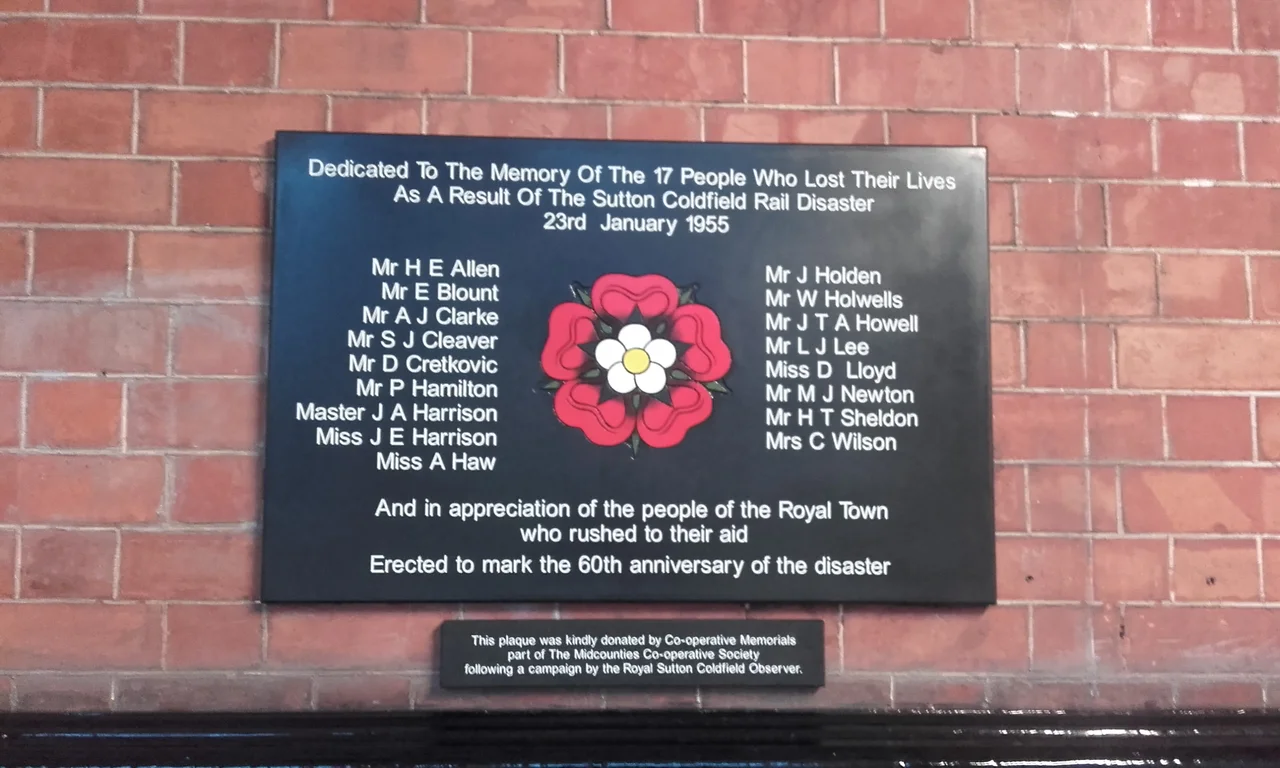
The inquiry could not explain the speed. The conducting driver knew the road. The engine, although rough, showed no mechanical failure. The accident happened in broad daylight. Investigators offered several possibilities. The train was running late and the cab might have been trying to make up time. The gradient beyond the station favoured taking the curve fast for the climb out. The locomotive carried no speedometer, as most steam engines did not. There were no lineside signs to remind anyone of the 30 mph limit, because British practice did not yet require them. Trains rarely passed Sutton Coldfield without stopping, so the restriction was easy to misjudge. The investigator's conclusion is the most consequential thing about the Sutton Coldfield crash: after January 1955, every speed restriction in Britain was marked by a lineside sign visible to the driver. The inspector also asked for speed recorders, the kind France had already adopted, but British Railways declined. A memorial to the seventeen dead was unveiled on the station platform on 23 January 2016, sixty-one years to the day after the accident, by the Lord Mayor of Birmingham, Councillor Ray Hassall.
From the Air
Sutton Coldfield railway station lies at 52.5653°N, 1.82444°W in the northern part of Birmingham, on the Cross-City Line. The crash site is now back in active service with the curve realigned to a smoother 15-chain radius throughout. From cruising altitude Sutton Coldfield appears as a leafy northern district of the Birmingham conurbation. Birmingham Airport (EGBB) sits 8 nm to the southeast and East Midlands (EGNX) 24 nm to the east-northeast. The railway line traces a clear northbound arc out of Birmingham toward Lichfield. Recommended viewing altitude 3,000-5,000 ft AGL in clear visibility.
Nearby Stories
- Coalbrookdale 2.3 km away
- Market Bosworth 2.5 km away
- Croxden Abbey 5.3 km away
- Bordesley Abbey 7.4 km away
- Nottingham Canal 9.9 km away
- Combermere Abbey 14 km away
- Ludlow 18 km away
- Althorp 30 km away