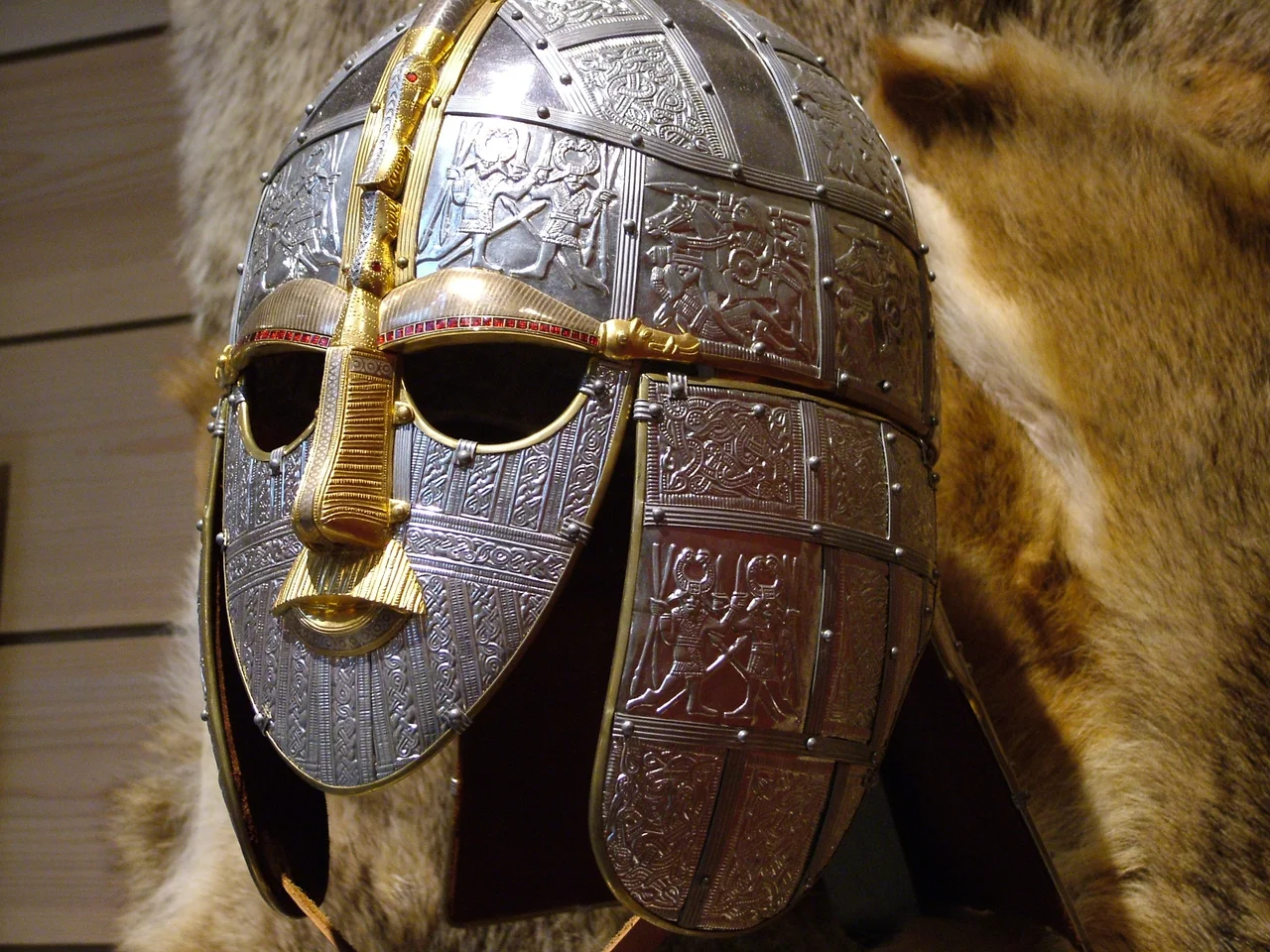

Sutton Hoo Helmet
Look at it long enough and it looks back. The face on the Sutton Hoo helmet is composed from functional parts — a nose piece, two eyebrows terminating in gilded boar heads, a moustache — but the whole assembly creates something more than a sum of parts. From the brow, two bronze-gilt eyebrows extend outward as wings. The dragon head at their junction faces upward, baring its teeth at the serpent-like creature flying down the iron crest. The face of the helmet is simultaneously the body of a dragon in flight. Whoever wore this into a hall wore something that would have seemed, in low light, to have only one eye — a deliberate allusion, scholars believe, to the one-eyed Germanic god Odin. The helmet was found in more than 500 pieces. It took two reconstructions, in 1945–46 and again in 1970–71, to bring it back to this.
What It Is Made Of
The helmet weighs an estimated 2.5 kilograms. Its core is iron — a cap beaten from a single piece of metal, unique among all known Anglo-Saxon helmets, with cheek guards, neck guard, and face mask attached. Over this iron foundation, sheets of tinned bronze were applied using the pressblech process: preformed dies stamp repeated designs into thin metal, allowing identical patterns to be produced across multiple panels. Five distinct designs cover the surface. Two depict figural scenes: warriors engaged in a spear dance associated with the cult of Odin, and a mounted rider trampling a fallen enemy. Two more show zoomorphic interlace, a single quadruped rendered in ribbon style. A fifth, incomplete design may have replaced a damaged panel. Gilded strips flank the crest. Garnet-eyed dragon heads terminate the eyebrows. Inlaid silver wires run the length of the iron crest, creating what one scholar described as 'a magnificent thing — an object of burnished silvery metal, set in a trelliswork of gold.'
The King It May Have Belonged To
The helmet was buried in a ship, beneath a mound of earth, sometime between 610 and 635 AD. The most likely occupant of Mound 1 at Sutton Hoo is King Rædwald of East Anglia, who may have died around 624. Rædwald was a complicated figure: he kept two altars, one pagan and one Christian, and was powerful enough to be listed among the handful of kings who had established dominance over all of England south of the Humber. The helmet reflects his in-between world. The burial is emphatically pagan — a ship-burial predating the Christian era in Britain. But three groups of objects within it carry Christian significance, including two silver spoons inscribed with the names PAULOS and SAULOS: both names used by Paul the Apostle, one before his conversion and one after. The attribution to Rædwald is probable but not certain. The British Museum says only 'a King of East Anglia.'
Found in Pieces, Twice
The helmet was found over three days in July and August 1939, near the end of the excavation season. When Basil Brown and the Cambridge team reached the burial chamber, no photographs were taken of the fragments in place, because their significance had not yet been grasped. The Daily Mail initially reported a 'gold helmet encrusted with precious stones.' The fragments were more accurately described as crushed, rusted, and sad — 'a jigsaw puzzle without any sort of picture on the lid of the box, and missing half its pieces.' The first reconstruction, published in 1947, was later found to be significantly incorrect. A second reconstruction in 1970–71, informed by comparative study of Scandinavian helmets at Valsgärde and Vendel, produced the version now on display at the British Museum. This was itself only made possible because researcher Rupert Bruce-Mitford spent six weeks in Sweden and was shown an unpublished Valsgärde helmet bearing an almost identical warrior dance scene — close enough that the artists may have worked from the same original die.
What It Has Become
Edith Pretty, the landowner who owned the mound and funded the excavation, donated the entire Sutton Hoo treasure to the British Museum within days of the 1939 inquest that awarded it to her. The helmet, along with the other artefacts, was stored through World War II in the tunnel connecting the Aldwych and Holborn tube stations. Today it is on permanent display in Room 41 at the British Museum, where it has become, as the museum puts it, a symbol 'of Archaeology in general' and of England itself. Its image appears on book covers, documentaries, and the 2021 Netflix film The Dig. Scholars continue to argue about who was buried beneath Mound 1. The helmet does not resolve the question. It only deepens it.
From the Air
The Sutton Hoo helmet itself is in London at the British Museum. The burial site where it was found is at Sutton Hoo near Woodbridge, Suffolk, at approximately 52.09°N, 1.34°E, overlooking the River Deben estuary. The mounds are visible from the air as gentle earthworks on the river bluff. Nearby airports include Norwich (EGSH), approximately 50 miles north, and Ipswich Airport (EGSE), approximately 9 miles southwest. The site is managed by the National Trust.
Nearby Stories
- Walton-on-the-Naze 2.7 km away
- Clare, Suffolk 9.5 km away
- RAF Lakenheath 10 km away
- RAF Hardwick 11 km away
- Beeleigh Abbey 13 km away
- Four Days' Battle 45 km away
- Southern Bight 75 km away
- Battle of Lowestoft 79 km away