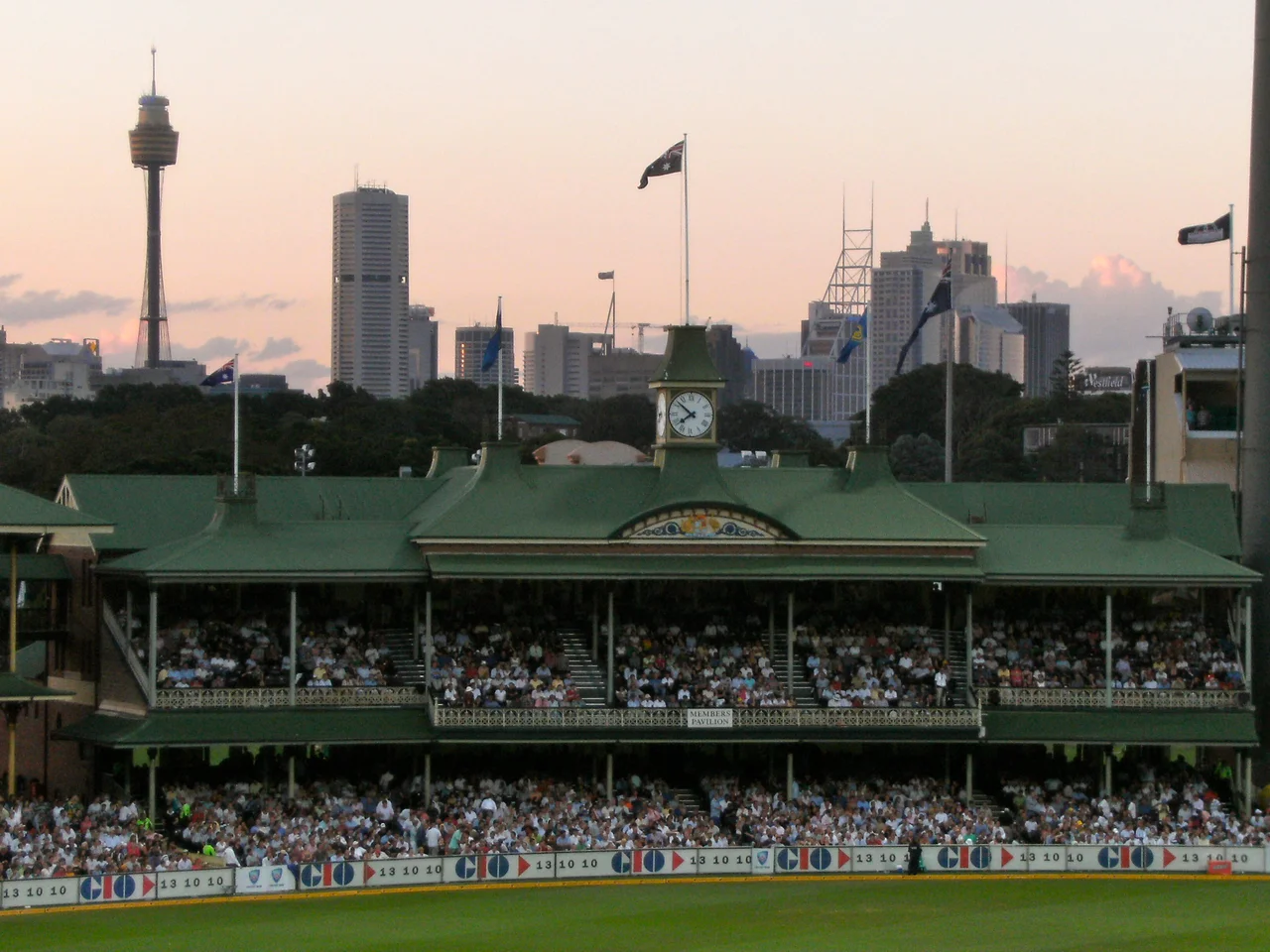

Sydney Cricket Ground
For three days in late November 2014, the whole of Australia held its breath over a patch of grass at Moore Park. A bouncer from Sean Abbott had struck Phillip Hughes on the neck, and the 25-year-old batsman never regained consciousness. He died on 27 November, two days short of his 26th birthday. Bats appeared on doorsteps across the country, propped up in a gesture that needed no explanation. That a single cricket ground could become the focus of a nation's grief tells you something about what the Sydney Cricket Ground means here. This is not just a venue. It is a place where Australians have gathered to celebrate, to argue, and occasionally to mourn, for a century and a half.
From Rubbish Dump to Hallowed Turf
The ground's beginnings were unglamorous. In the 1850s, this corner of the second Sydney Common was part sandhills, part swamp, and partly a rubbish dump. In 1851 a slice of it was handed to the British Army as a garden and cricket pitch for the soldiers of Victoria Barracks. The 11th North Devonshire Regiment flattened the southern end of their rifle range, and the soldiers formed themselves into the Garrison Club. When the ground opened in February 1854 it was simply the Garrison Ground. Over the next two decades it passed through a tangle of names and committees before the New South Wales Cricket Association took charge in the 1870s. It finally became the Sydney Cricket Ground in 1894. The pitch itself is laid on Bulli soil, trucked in from the town of Bulli down the coast, and it is that clay which has made the SCG the most spin-friendly Test wicket in Australia.
The Don and the Crowds He Drew
No name is woven more tightly into the SCG than Bradman. In the 1929 to 1930 season, Don Bradman scored 452 not out here for New South Wales against Queensland, the highest first-class innings then recorded anywhere on earth. The crowds came in numbers the ground has never seen since. On 15 December 1928, a record 58,446 packed in to watch Australia play England, a figure that will never be beaten now that seating has reduced the capacity. The gate money Bradman generated was poured back into the ground, funding the grand northern stand that bears his name. There is a quiet symmetry to the place, too. One of the carpenters who built the formwork for the old cycling track in 1896 was George Bradman, the great batsman's father.
The Hill and Its Voices
For most of its life the SCG had the Hill, a grassy bank with no seating where the cheapest tickets bought you a spot on the slope. It was the realm of the working-class fan, and above all of Stephen Harold Gascoigne, the rabbitoh and bottle-merchant remembered simply as Yabba. His bellowed heckles became part of the spectacle, and a bronze statue of him now sits among the seats of the Victor Trumper Stand, mid-shout for all eternity. The Hill could turn ugly. In 1971, English fast bowler John Snow was grabbed by a spectator and pelted with cans after felling a tailender, and the England captain marched his team off the field. The grass slope was finally seated over in 1991, but Yabba's voice still echoes in the ground's mythology.
Every Code, One Ground
Cricket built the SCG, but it has hosted nearly every game Australians play. More than 1,390 top-grade rugby league premiership matches have been staged here, more than any ground in the country, and between 1913 and 1987 the Sydney grand final was almost always played on this turf. In 1965, an official crowd of 78,056 crammed in to watch St George beat South Sydney in the grand final, with thousands more reportedly perched on grandstand roofs. Australian rules football arrived permanently in 1982 when South Melbourne relocated north to become the Sydney Swans, and in 2014 the ground even hosted the first Major League Baseball games ever played in Australia, the Dodgers sweeping the Diamondbacks. Through it all, the heritage-listed Members' and Ladies' pavilions, with their cast-iron and clock towers, have kept watch since the 1870s and 1890s.
From the Air
The Sydney Cricket Ground sits at roughly 33.89 degrees south, 151.22 degrees east in the Moore Park precinct, immediately south-east of the city centre and just inland from the harbour. From the air it reads as a bright green oval ringed by pale grandstands, with the heritage clock towers of the Members' Pavilion at the northern end and the larger Allianz Stadium directly alongside to the east. The Sydney Opera House, Harbour Bridge and CBD towers lie a few kilometres to the north-west for orientation. The nearest major airport is Sydney Kingsford Smith (YSSY), about 7 km to the south-south-west; Bankstown (YSBK) lies roughly 15 km to the south-west for general aviation. Sydney's coastal weather is generally clear, though summer afternoon sea breezes and occasional southerly busters can bring sudden cloud; best viewing is mid-morning in calm conditions.
Nearby Stories
- Royal National Park 28 km away
- Jervis Bay 107 km away
- Hive shipwreck 149 km away
- Apsley Falls 283 km away
- Smoky Cape Lighthouse 316 km away
- South West Rocks Pilot Station Complex 346 km away
- Roxy Theatre and Peters Greek Cafe Complex 413 km away
- 2003 Fiordland Earthquake 1774 km away