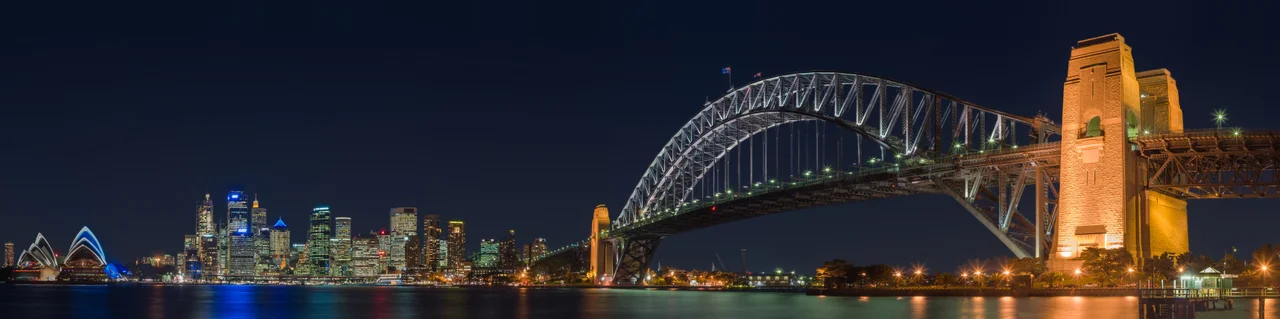

Sydney Harbour Bridge
On the day the bridge opened in March 1932, the Premier of New South Wales never got to cut the ribbon. As Jack Lang raised his scissors, a man in a military uniform spurred a horse forward, slashed the ribbon with his cavalry sword, and declared the bridge open "in the name of the decent citizens of New South Wales." His name was Francis de Groot, a member of a right-wing paramilitary group furious that no royal had been invited. He was arrested on the spot, the ribbon was hastily retied, and Lang opened the bridge a second time. It was a fittingly theatrical start for a structure Sydneysiders would come to call, with characteristic irreverence, the Coathanger.
A Bridge a Century in the Making
The idea was almost as old as the colony. As early as 1814, the convict architect Francis Greenway is said to have proposed a harbour crossing to Governor Macquarie, later writing that such a bridge would "reflect credit and glory on the colony and the Mother Country." Designs came and went for a hundred years, including a graceful steel cantilever that won a 1902 competition before an economic slump killed it. The man who finally willed the bridge into being was John Bradfield, appointed chief engineer in 1914. He championed the project for decades and lent his name to the Bradfield Highway that runs across the deck. The detailed design and construction fell to the British firm Dorman Long of Middlesbrough, whose engineers drew on their own recently built Tyne Bridge in north-east England.
Riveted, Not Welded
The arch is a single steel span of 504 metres, its summit rising 134 metres above the water, making it the tallest steel arch bridge in the world. On a hot Sydney day the steel expands enough to lift the crown of the arch by 18 centimetres. Holding it all together are roughly six million hand-driven rivets, the last hammered home on 21 January 1932. Riveting was the proven technique of the era; structural welding was not yet trusted for a job this size. The rivets were heated red-hot, dropped into place, and flattened with pneumatic guns, and the deafness many workers suffered in later life was blamed on that relentless noise. The four granite pylons are pure theatre, with no structural purpose at all. They were added only to reassure a nervous public that the great arch would not fall down.
The Men on the Steel
Building the bridge through the depths of the Great Depression was brutally dangerous work, and it came at a human cost. Sixteen men died during construction, though only two of them from falling off the bridge itself. Many more were injured handling the scorching rivets and working at heights without the safety equipment a modern site would demand. Some 800 families were displaced when an estimated 469 buildings on the north shore were demolished to clear the approaches, with little or no compensation paid. Far to the south, around 250 stonemasons and their families relocated to Moruya, where they quarried the granite for the pylons. Photographer Henri Mallard spent 1930 to 1932 documenting the riggers and ironworkers at close quarters, leaving a haunting record of ordinary men doing extraordinary, perilous work in desperate times.
An Icon Above the Harbour
The bridge was nicknamed the Iron Lung, because the work kept thousands of Depression-era labourers in jobs when little other work existed. Its full cost of 6.25 million Australian pounds was not paid off until 1988. Today it carries trains, cars, cyclists and walkers between Dawes Point in The Rocks and Milsons Point on the north shore, and since 1998 the company BridgeClimb has guided visitors up and over the eastern arch on three-and-a-half-hour climbs. The structure has become the canvas for the nation's grandest moments: the dazzling New Year's Eve fireworks that stream from its arch, the word "Eternity" spelled out across it at the millennium in tribute to the illiterate chalk-writer Arthur Stace, and the Walk for Reconciliation in May 2000, when somewhere between 200,000 and 300,000 people crossed it on foot.
From the Air
The Sydney Harbour Bridge spans Port Jackson at roughly 33.85 degrees south, 151.21 degrees east, linking Dawes Point on the southern shore to Milsons Point on the north. From the air it is unmistakable: a single grey steel arch 504 metres long with four pale granite pylons, the Sydney Opera House and its white sails immediately to the east at Bennelong Point, and the towers of the central business district crowding its southern end. The water of the harbour fans out east toward the Heads and the open Pacific. The nearest major airport is Sydney Kingsford Smith (YSSY), about 9 km to the south; Bankstown (YSBK) lies roughly 18 km to the south-west for general aviation. Note that the harbour and CBD sit beneath controlled airspace. Sydney generally offers clear coastal visibility, with best viewing in calm morning light before afternoon sea breezes build.
Nearby Stories
- Royal National Park 28 km away
- Jervis Bay 107 km away
- Hive shipwreck 149 km away
- Apsley Falls 283 km away
- Smoky Cape Lighthouse 316 km away
- South West Rocks Pilot Station Complex 346 km away
- Roxy Theatre and Peters Greek Cafe Complex 413 km away
- 2003 Fiordland Earthquake 1774 km away