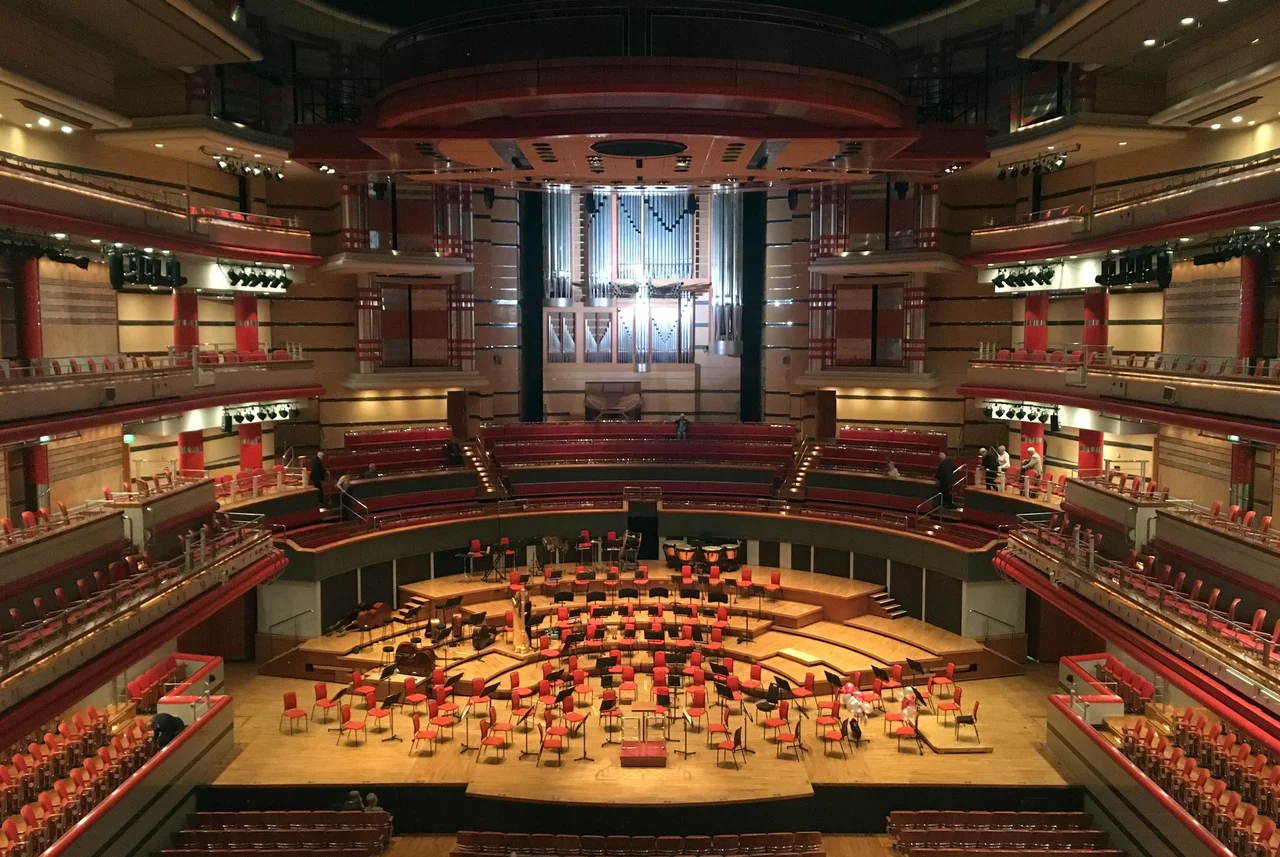

Symphony Hall, Birmingham
Drop a pin on the Symphony Hall stage and someone in the back row will hear it. That is not a marketing line - it was a finding from the acoustic test engineers ran before the hall opened in 1991. They actually dropped a pin. The sound carried. Symphony Hall sits on what used to be canal-side wasteland behind Centenary Square, a 2,262-seat box of 200-millimetre-thick concrete walls and a hidden reverberation chamber, modelled on the great shoebox auditoriums of Vienna and Amsterdam. When the American concert hall acoustics expert Leo Beranek published his global rankings in 2016, he placed Symphony Hall first in the United Kingdom and seventh in the world. For a city that had spent the 1960s and 70s tearing itself up for ring roads, the hall represented something almost defiant: an attempt to make Birmingham known for the way music sounds inside it.
A Hall That Can Tune Itself
The key feature is invisible from the audience. Behind the stage and high along the side walls, hidden behind massive doors, runs a U-shaped reverberation chamber with a volume of 12,700 cubic metres - enough extra space to add fifty percent to the volume of the room itself. The doors can be opened or closed by remote control. Open them all the way and the hall behaves like a cathedral, with the long, washing reverb that suits Bruckner or Mahler. Close them down and the acoustic tightens for chamber music, jazz, or amplified shows. Reverse fan walls at the rear provide additional reflections. Every surface that matters is poured concrete, two hundred millimetres thick, so the structure itself does not flex or absorb. The hall was designed by Russell Johnson of Artec, the American acoustician whose specifications were notoriously uncompromising. Birmingham gave him what he asked for.
Vienna and Amsterdam in the West Midlands
Johnson and his architectural partners, the Percy Thomas Partnership and Renton Howard Wood Levin, drew their proportions from two of the most celebrated halls in Europe. The Musikverein in Vienna, the home of the Vienna Philharmonic, is a long, narrow shoebox completed in 1870; the Concertgebouw in Amsterdam, finished in 1888, follows the same geometry. Both have the kind of acoustic that musicians describe in religious terms. Symphony Hall borrows their floor plan and their relationship between width, height, and length, then adds the modern flexibility of the reverberation chamber. The result is a hall that can do what the Musikverein and Concertgebouw do, but can also do other things they cannot - including amplified rock concerts, world music, and the spoken word, all of which sit comfortably in the programming.
A Home for the CBSO
The hall was designed first and foremost for the City of Birmingham Symphony Orchestra, an ensemble that had spent decades performing in the older Town Hall a few hundred metres away. In the 1980s, under the conductor Simon Rattle, the CBSO had grown into one of the most discussed orchestras in Europe. The city decided it deserved a hall to match. Construction was folded into the larger International Convention Centre project, with Symphony Hall as its acoustic centrepiece. The total cost was £30 million. Queen Elizabeth II opened the hall on 12 June 1991, though it had already been in use since 15 April that year. The CBSO have played there ever since. Around 270 events a year fill the calendar: classical concerts, jazz nights, organ recitals, comedy, conferences, school visits. The hall hosts roughly 12,000 young people and 6,000 adults each year through its education programme.
The Klais Organ
Above the rear of the stage sits an instrument that turns the hall into something else entirely. The four-manual organ was built by Johannes Klais Orgelbau of Bonn, a German firm with a five-generation history of building instruments for cathedrals and concert halls. The pipe array is large enough to dominate the visual field, and the organ has been described as one of the most important concert hall instruments built since the Second World War. When the full forces of the CBSO play against it - in the Saint-Saens Organ Symphony, say, or the closing movement of Mahler's Eighth - the room genuinely shakes. The 200-millimetre walls keep the energy inside. Audiences walk out afterwards with their ears ringing in the most pleasant way available.
Built for the Long Run
Twenty-five years after opening, the hall underwent a major refurbishment, with new public spaces and a refreshed exterior reopened in 2021. The reverberation chamber, the concrete walls, the geometry that made the acoustic work in the first place - all left alone. There is a particular discipline involved in not redoing what was already right. Symphony Hall is run by B:Music Limited, the same charity that runs Birmingham Town Hall a short walk away, and the two venues share programming and resources. Standing in the foyer before a concert, with the lights of Centenary Square outside and the murmur of an audience filing in, you are about to enter a room that engineers spent years tuning and that experts now rank with the best in the world. It still costs about the same as a cinema ticket. That, more than anything, is what the hall was built to do.
From the Air
Symphony Hall sits at 52.479 degrees north, 1.911 degrees west, in central Birmingham at roughly 140 metres elevation. Best viewed from 2,500 to 4,000 feet AGL, the venue is part of the International Convention Centre complex on the western edge of Centenary Square, immediately above the Worcester and Birmingham Canal basin. Birmingham Airport (EGBB) is about 7 nautical miles east-southeast. Look for the open public space of Centenary Square, the canal basin and Brindleyplace just to the west, and the Library of Birmingham's tiered metallic facade marking the north edge of the square.
Nearby Stories
- Shepshed 8.5 km away
- Battle of Evesham 11 km away
- Hixon rail crash 12 km away
- Battle of Cropredy Bridge 12 km away
- Wenlock Priory 15 km away
- RAF Shawbury 16 km away
- Market Bosworth 17 km away