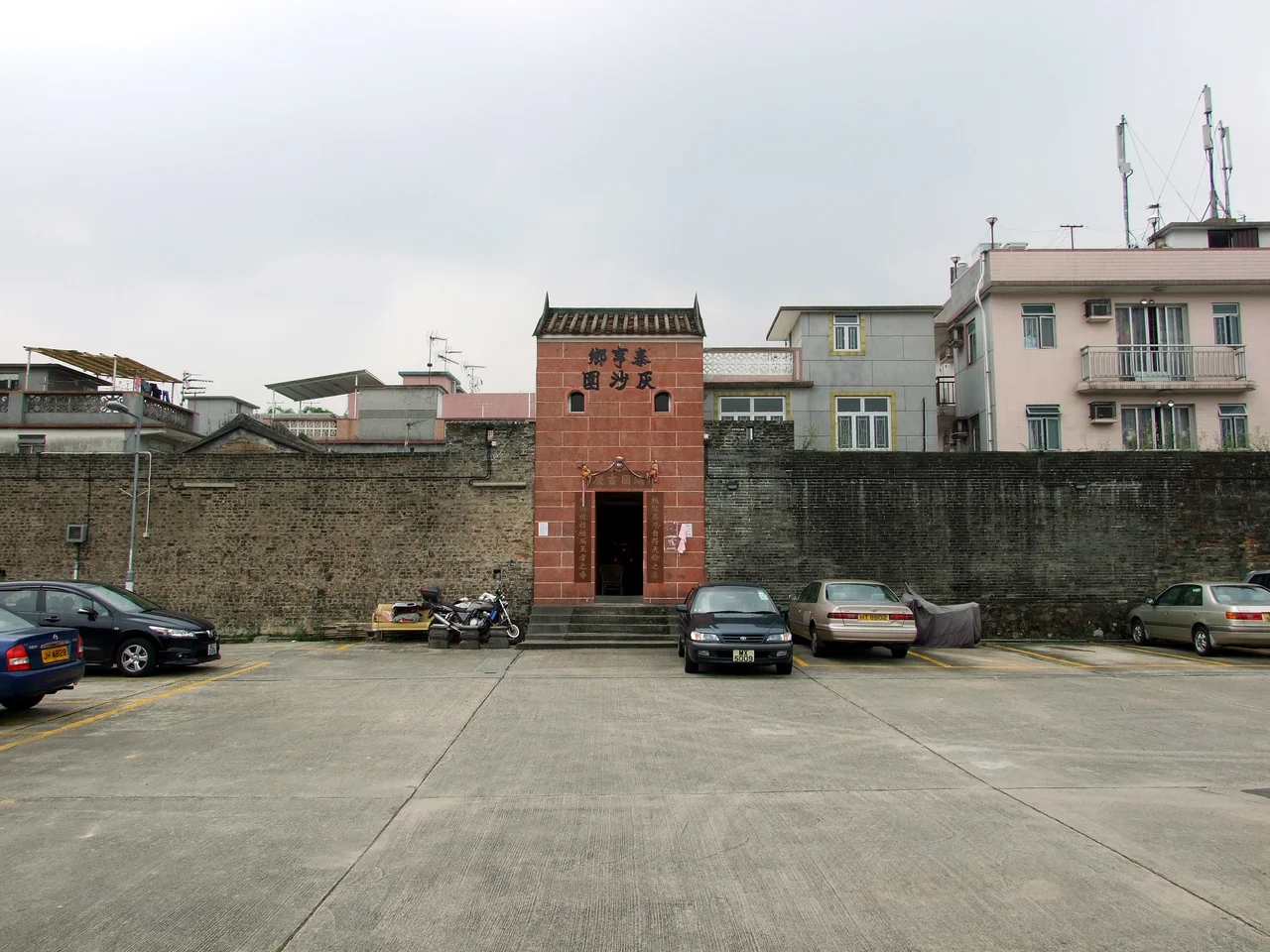

Tai Hang (Tai Po)
Wen Tianxiang refused to surrender. The Song dynasty scholar-general, captured by the Mongols in 1278, was offered his life and high office in the Yuan court if he would only submit. He declined, was imprisoned for three years, and was executed in 1283. His descendants ended up in Hong Kong. The Man clan of Tai Hang, a cluster of villages in the Tai Po District of the New Territories, traces its origins to Wen's family, who fled south during the Mongol invasion of the Song dynasty and eventually settled in what is now Hong Kong. In the hills above Tolo Harbour, that lineage has persisted — in walled villages, in Qing-dynasty school buildings, in temples, and in a statue of the ancestor himself standing in the village park.
The Ancestor Who Would Not Submit
Wen Tianxiang is one of the most revered figures in Chinese history, celebrated for his loyalty to the Song dynasty in its final years and for his refusal to serve the conquering Yuan. After capture, he is said to have written one of the most famous poems in Chinese literature — the 'Ballad of Righteousness' — while imprisoned in Beijing. His execution did not erase his influence; it amplified it. He became a symbol of moral courage that subsequent dynasties and political movements have claimed in various ways.
For the Man clan of Tai Hang, the connection is familial, not merely cultural. When the Mongols advanced south, relatives of Wen Tianxiang fled with the emperor's court. They settled first in Dongguan, then moved into the New Territories. The village they eventually built in what is now Tai Po carries that origin story in its bones — in the Man Shan Park with its statue of Wen Tianxiang, and in the inscription of his writing displayed there for villagers and visitors alike.
Two Wai, One Village
Tai Hang is not a single village but a cluster: the 'Two Wai One Village' configuration that encompasses the walled villages of Chung Sum Wai and Fui Sha Wai, plus the settlement of Tsz Tong Tsuen. Walled villages were a common form of defensive settlement in the New Territories, with enclosed walls protecting communities from banditry and inter-clan conflict. The enclosing walls of Fui Sha Wai have been recognized as Grade III historic buildings.
At the 1911 census, the population of Tai Hang Tsz Tong Tsuen was recorded at 77, with 29 males. These were small, tightly bound communities where kinship and proximity were inseparable. The walled structure made that proximity literal: shared walls, shared gates, shared identities.
Temples, Schools, and Hidden Sculpture
Three temples in the village date from the Qing dynasty: the Guanyin Temple, the Tin Hau Temple, and the Man Tai Temple. Several relics are still held within them. The temples are not simply historical artifacts — they remain part of the village's religious life.
The village also holds the largest concentration of traditional village schools in the Tai Po District. Four schools built during the Qing dynasty — their names translatable roughly as Ngai Yuen Study Hall, Sin Hing Study Hall, Cong Gui Study Hall, and Zheng Lun Study Hall — still have surviving remains in the village. Their existence reflects the Man clan's historical emphasis on scholarship, a value inseparable from their connection to Wen Tianxiang.
One detail from the landscape is easy to miss: old trees outside the temples have grown with double trunks, and between them is hidden a sculpture of the god of marriage. The trees and the hidden figure have become intertwined in local lore — a small, quiet expression of the relationship between the natural world and the village's spiritual life.
Five Years at a Time
The Da Jiu Festival is Tai Hang's most significant communal observance, held once every five years. A Taoist ritual of purification and thanksgiving, Da Jiu — also called the Jiao festival — is observed across the New Territories, though its specific form varies by clan and village. At Tai Hang, the festival expresses gratitude to the gods and asks for continued fortune. It is believed to have originated shortly after the founding of the village.
The most recent Da Jiu before the source material was recorded was held in 2020. The festival involves ritual opera performances, communal meals, and elaborate ceremony — a five-year cycle that compresses memory, gratitude, and communal identity into a concentrated observance. In a village whose lineage reaches back to the collapse of the Song dynasty, the Da Jiu is both celebration and continuity: a living thread connecting the present to an ancestor who refused to bend.
From the Air
Tai Hang in Tai Po is located at approximately 22.47°N, 114.15°E in the hills of the New Territories. From the air at 2,000–4,000 feet, the village cluster is visible in the Lam Tsuen Valley inland from Tolo Harbour. The Plover Cove Reservoir and Pat Sin Leng mountain range are prominent landmarks to the north and east. Tai Po Market and Tai Po New Town are visible to the south along the Tolo Harbour shore. The nearest major airport is Hong Kong International Airport (ICAO: VHHH), approximately 45 km to the southwest on Lantau Island.
Nearby Stories
- Chapel of St. Francis Xavier 3.5 km away
- Cuiheng 4.1 km away
- 2015 Shenzhen Landslide 16 km away
- Shunde 31 km away
- Wanshan Archipelago 37 km away
- Nanxiong Formation 96 km away
- Heyuan 149 km away
- Checheng Fu'an Temple 629 km away