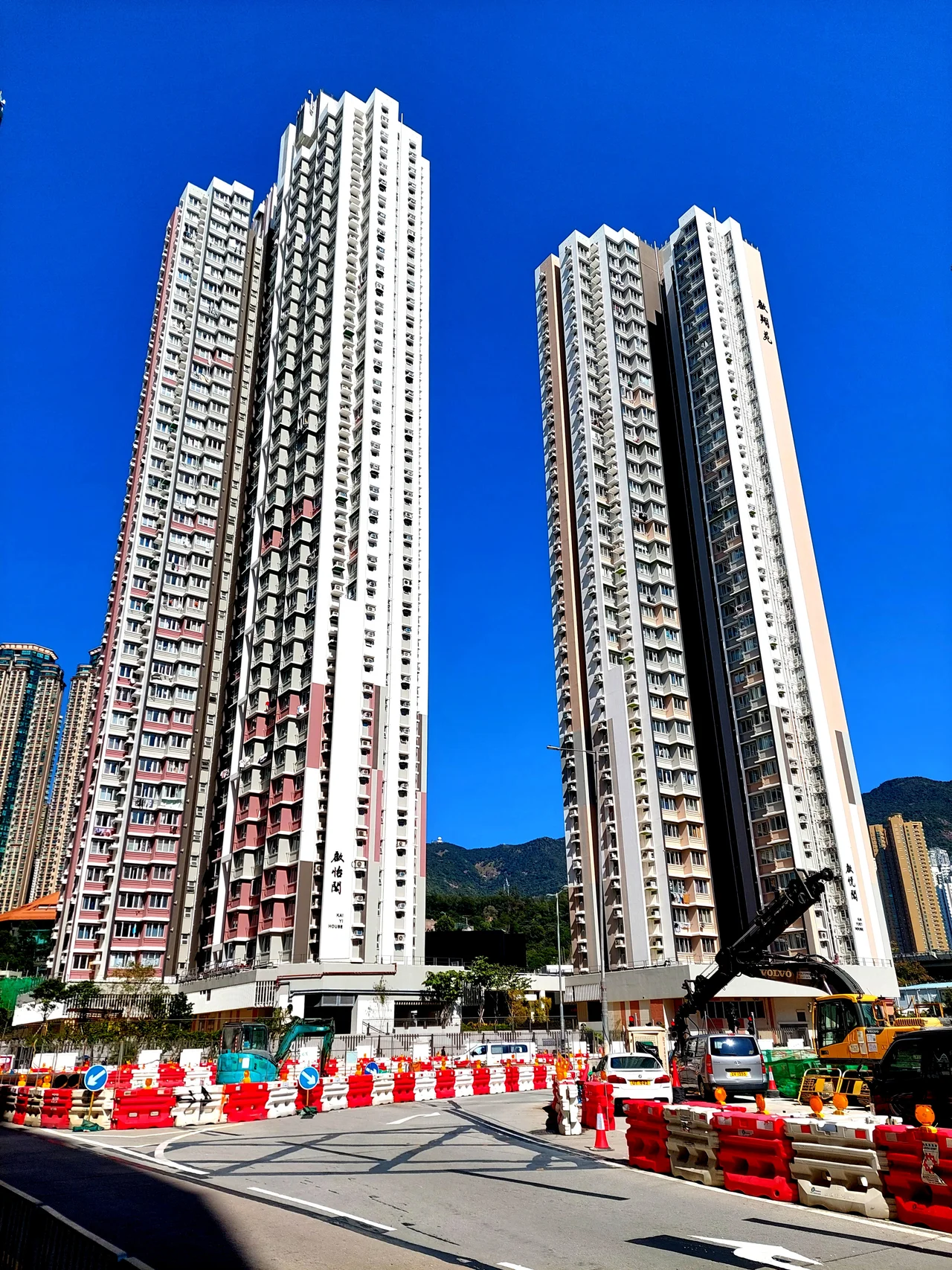

Tai Hom Village
Andy Lau grew up in a place that no longer exists. So did Roy Chiao and Nancy Sit. Before they became household names across Chinese-speaking Asia, they lived in Tai Hom Village — a sprawling squatter settlement in the Diamond Hill area of Kowloon where 35,000 people crowded into narrow lanes on land that had been lived on, fought over, and quietly endured for more than two and a half centuries. The village was demolished in 2001. What remained, at least for a while, was a single battered aircraft hangar — and a lot of stories.
Hakka Roots, Granite Hills
The first recorded resident of Tai Hom was Chu Yan Fung, a Hakka man who purchased land from the Qing government and settled on the slopes of Fei Ngo Shan — Moth Mountain — around 1740. The area was known for its granite, prized as building material throughout the region. His family's pedigree book marked the date carefully; the Zhu lineage had arrived. For nearly two centuries, the district remained relatively quiet, a granite-quarrying community on the fringes of what would become one of Asia's most densely populated cities.
By 1936, the colonial Hong Kong government moved to reclaim land rights across the district. The village became government land except for a privately held fifth. Population pressure transformed the area as the twentieth century progressed — the "squatter village" that would define the site in modern memory was not even located on the original Hakka settlement. It grew up instead at Nga Yiu Tau Chuen, a tract that had briefly served as part of Kai Tak Airport during the Japanese occupation.
A Hangar That Changed Hands
In 1934, a steel-framed aircraft hangar was erected at Kai Tak Airport as a civilian structure. The Japanese dismantled it when they rebuilt the airport's runway after occupying Hong Kong, then re-erected it at Tai Hom Village in 1943, where it housed A6M Zero fighters and served as training grounds for Japanese aircrew and technicians. After the war, British forces used it briefly before abandoning it in the 1970s.
What came next was improbable. The hangar became a warehouse for American relief commodities, then a food-packing facility operated jointly by the government and CARE, and eventually a site for producing animal feed. Somehow it survived all of it. The Former Royal Air Force Hangar is today the only surviving pre-war military aircraft hangar in Hong Kong, accorded Grade III historic status by the Antiquities and Monuments Office. It stands as one of the last physical traces of Kai Tak Airport's earliest years — a building that spent its life being moved, repurposed, and nearly forgotten.
The Village That Made Stars
In 1947, a businessman named Yang Shou-ren purchased land in the village and named his estate Tai Koon Yuen. Film studios followed. Daguan Motion Pictures established a presence, drawing a wave of celebrities and production workers into what had previously been a community of low-income laborers. Two-storied stone houses — several of them inspired, according to local lore, by the classical novel Dream of the Red Chamber — went up for artists and filmmakers.
The result was an unusual layering of lives: factory workers and movie stars, rats and cats (the village reportedly had so many cats because it had so many rats), no public toilets before 1999, no independent water supply before at least 1961. Roy Chiao, Nancy Sit, and Andy Lau all grew up in this compressed, improbable place before going on to careers that made them famous. The 2001 film Hollywood Hong Kong, directed by Fruit Chan, is set here — a last gesture to a neighborhood that had already started to disappear.
Demolition and What Came After
Plans to clear Tai Hom Village had been circulating since 1984, when a government announcement proposed housing 40,100 people on the 81-hectare site. The squatter population at that moment was estimated at 35,000. Actual demolition was completed in early 2001, and for years afterward the land sat vacant while competing visions — an environmental housing estate, a cinema-themed museum complex called the Theatre of the Orient, an MTR depot for the Sha Tin to Central Link — cycled through government committees and district council motions.
Public housing eventually won out. Kai Chuen Court Phase 1 was completed in 2021, Phase 2 in 2023. The historic structures — the RAF hangar, the stone houses — became points of contention, with architects and heritage advocates arguing that the MTR depot plan would, in one professor's memorable phrase, amount to "raping the heritage." Some structures survived. The hangar still stands, slightly improbable, on the edge of a neighborhood that has been entirely rebuilt around it.
The Shape of Memory
Diamond Hill MTR station sits a short walk from where the village gate once stood. From the platforms, nothing visible marks what was here — the squatter lanes, the film studios, the Zero-Sen hangar, the stone houses built in the image of a classical novel. The Galaxia private housing estate, with its five towers and 1,684 units connected to Plaza Hollywood shopping centre, occupies part of the former site.
The village's name persists on maps and bus routes. The Conservancy Association documented what it could before the demolition. An archaeological survey conducted in October 2009 went through the rubble systematically. What these efforts preserved, in the end, is the knowledge that 35,000 people once lived somewhere dense and complicated and now gone — that cats hunted rats in lanes where movie stars played as children, and that a hangar moved by the Japanese in 1943 is still standing while everything around it has changed several times over.
From the Air
Tai Hom Village occupied the Diamond Hill area of Kowloon at approximately 22.34°N, 114.20°E, around 15 km northeast of Hong Kong International Airport (VHHH). Flying into VHHH from the northeast, the urban grid of Kowloon extends below; the Diamond Hill cluster of towers marks the former village site at roughly 500 ft MSL terrain. The former Kai Tak Airport, whose history is inseparably linked to Tai Hom's RAF hangar, lies just 3 km to the southwest, now redeveloped as the Kai Tak Development Area along the waterfront. Recommended viewing altitude for this urban area is at least 2,000 ft to clear surrounding high-rises.
Nearby Stories
- Chapel of St. Francis Xavier 3.5 km away
- Cuiheng 4.1 km away
- 2015 Shenzhen Landslide 16 km away
- Shunde 31 km away
- Wanshan Archipelago 37 km away
- Nanxiong Formation 96 km away
- Heyuan 149 km away
- Checheng Fu'an Temple 629 km away