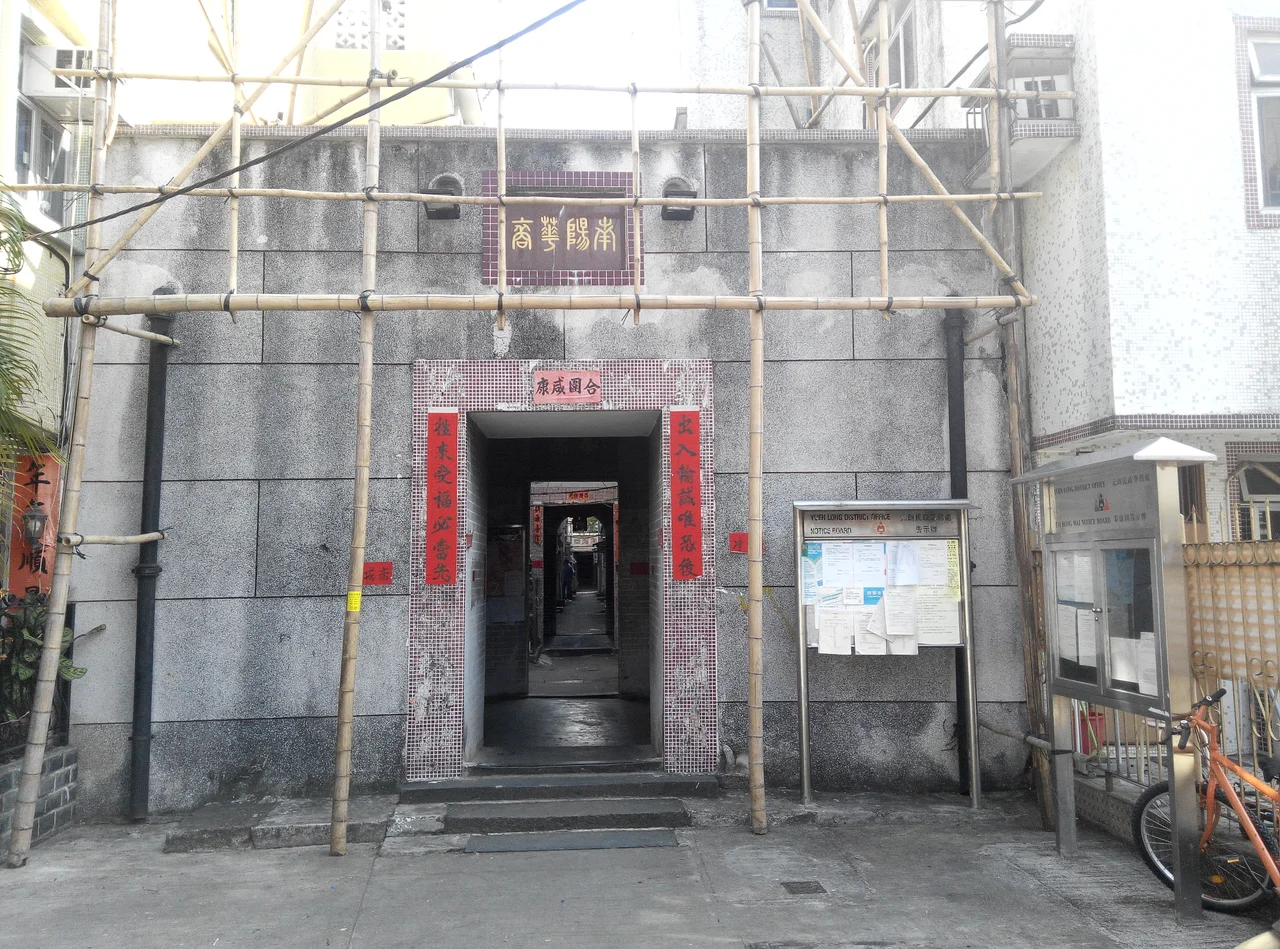

Tai Hong Wai
The wall came first. Before the school, before the roads, before the New Territories were ever leased to the British in 1898, the Tang clan built their villages in the Kam Tin plain with walls and watchtowers — defensive architecture that said, plainly, that what was inside was worth protecting. Tai Hong Wai is one of those villages, clustered with three neighbors — Kat Hing Wai, Wing Lung Wai, and Kam Hing Wai — on the flat agricultural land southwest of the mountains that separate Kowloon from the New Territories. All four were built around the same time. All four still stand.
What the Walls Were For
Walled villages were not decorative. In the Pearl River Delta region, where clan rivalries and periodic banditry made the countryside genuinely dangerous, earthen or brick perimeter walls with corner watchtowers were practical investments. The Tang clan, who settled Kam Tin and became one of the dominant lineages in the New Territories, built several of these fortified settlements across the plain.
Tai Hong Wai's entrance gate and its northwest watchtower at No. 9F have both been assessed by Hong Kong's Antiquities Advisory Board and documented as historically significant structures. The watchtower still overlooks the surrounding fields. The main shrine inside the village walls has served the community for generations. These are not museum exhibits — people live in Tai Hong Wai today, under the protections of the New Territories Small House Policy, which recognizes the village as a legitimate rural settlement with special land rights.
The Well Outside the Wall
Water mattered almost as much as walls. The well outside Tai Hong Wai's perimeter is a working piece of history — a reminder that village life in the Kam Tin plain organized itself around practical necessities long before piped water arrived. The placement is not accidental: the well sits beyond the wall, accessible during ritual ceremonies that begin precisely there.
The Jiao Festival, which Tai Hong Wai holds on a seven-year cycle, incorporates a "water extraction" ceremony performed at this well before anything else can begin. The last full cycle was held in 2014. To observe it would have meant watching villagers carry local deities from the inner shrine hall to a ceremonial field, erect the single Jiao pole at the intersection in front of the fence, and begin two days of ritual that mixed the sacred and communal in ways that have been carried out for centuries. The structure of the ceremony — hero sacrifice, water extraction, altar-raising, morning classes, cremation of the King of Tuas — has not been simplified away.
Seven Years, Then Again
What the people of Tai Hong Wai call their "reward for the gods and clothes" ceremony is, technically, a condensed version of the Jiao Festival — a purification and thanksgiving ritual common across southern China and Hong Kong. That it happens every seven years rather than the more common three or five is one of the village's particular customs. Ten "fate leaders" are selected at the start of the year from the Qingfu Hall of the inner shrine, drawing a cup of fate to determine who will bear ceremonial responsibility.
The two days of public ritual are highly structured. Villagers carry the King of Tuas — a deity associated with the ceremony — around the village perimeter before the image is cremated. Peace charms are distributed to each household afterward, to be taken home and displayed. What Tai Hong Wai specifically does not do is the "walking charms" house-to-house circuit that characterizes some other villages' observances. The absence is as deliberate as the practices retained. This is a community that knows exactly what its traditions are, and which variations belong to it.
Village Life in the 21st Century
Tung Tak School (通德學校) sits adjacent to the village walls. It is one of the aided schools in the Primary One Admission School Net 74, which serves the broader Kam Tin area including Yuen Long Government Primary School. Children from Tai Hong Wai and the surrounding villages have attended these schools for generations — the educational infrastructure grew up around the settlement patterns that the walls originally defined.
The Kam Tin plain looks different now than it did when the Tang clan first enclosed their settlements. Yuen Long New Town spreads across what was agricultural land. The West Rail Line passes nearby. But from the air, the walled villages of Kam Tin are still visible as distinct rectangular enclosures set into the urban fabric — their walls and watchtowers marking a territorial logic that predates the colony, the handover, and the megacity that grew up around them.
From the Air
Tai Hong Wai sits at approximately 22.44°N, 114.07°E in the Kam Tin area of Yuen Long District, about 25 km northwest of Hong Kong International Airport (VHHH) and roughly 8 km northeast of VHHH's runway threshold. The flat Kam Tin plain is clearly visible from low altitude; the walled village enclosures appear as small rectangular features among the suburban development north of the mountains. Shek Kong Airfield (VHSK), a military airfield, lies approximately 3 km to the northeast. Approach paths into VHHH from the northeast pass over this region at low altitude — check current NOTAMs and ATC instructions before descending below 2,000 ft in this area.
Nearby Stories
- Chapel of St. Francis Xavier 3.5 km away
- Cuiheng 4.1 km away
- 2015 Shenzhen Landslide 16 km away
- Shunde 31 km away
- Wanshan Archipelago 37 km away
- Nanxiong Formation 96 km away
- Heyuan 149 km away
- Checheng Fu'an Temple 629 km away