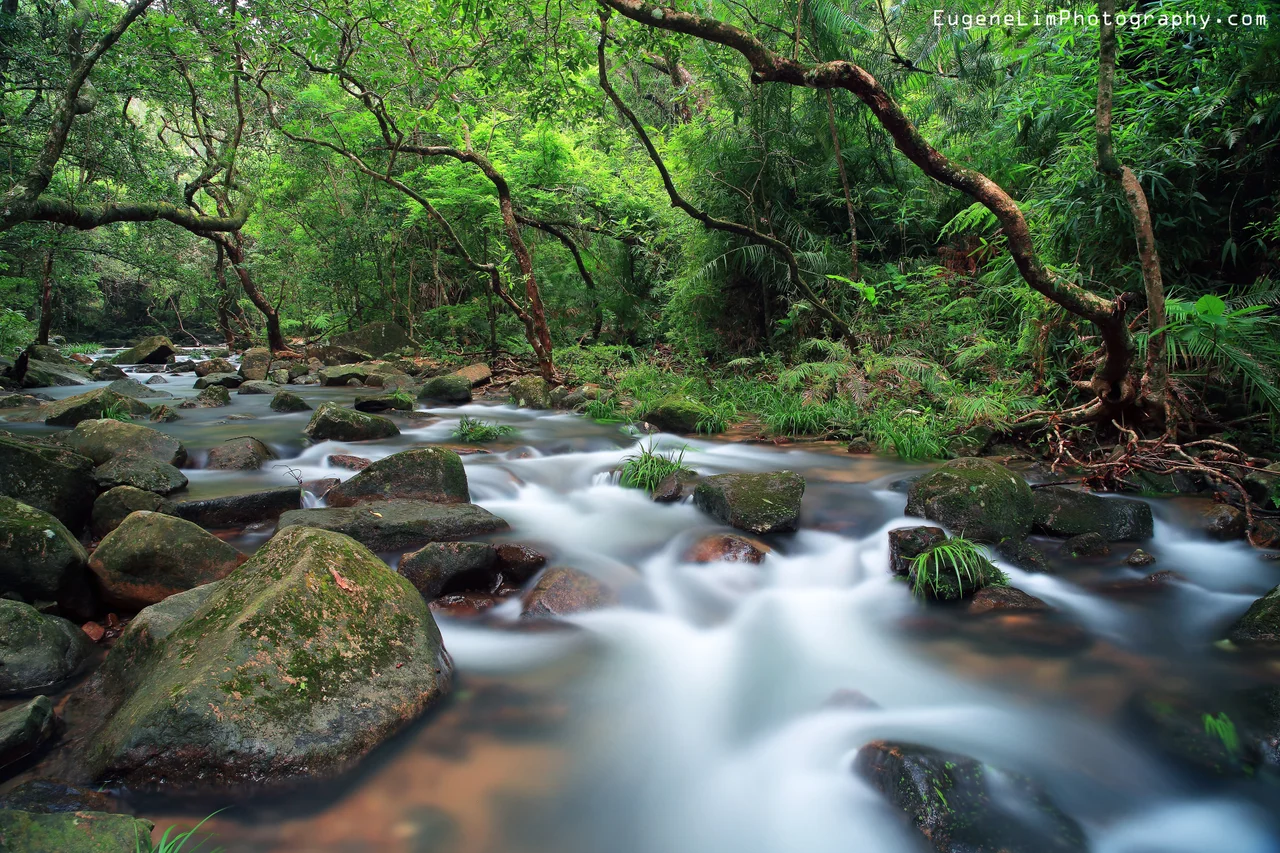

Tai Po Kau Nature Reserve
Look closely at the hillsides above Tolo Harbour and you see something unusual for one of the world's most densely settled cities: a canopy so thick it hides the sky. Tai Po Kau Nature Reserve — 460 hectares of mature subtropical forest draped across hilly terrain in Hong Kong's New Territories — is not a pristine wilderness. A century ago these slopes were nearly bare, stripped of trees through generations of fuel-gathering and farming. What grows here today is the result of a deliberate act of faith: a government planting programme begun in 1926, and nearly a hundred years of patience.
From Bare Hillside to Living Canopy
In 1926, foresters planted the denuded slopes of Tai Po Kau with what they had — mostly pines, supplemented over the following decades by Taiwan acacia, paperbark, camphor, and Brisbane box. The intention was simply to stabilise soil and restore green cover. What happened next was not planned. As the planted trees matured, native species crept in around them: sweet gum, litsea cubeba, and dozens of other plants that had been waiting in the soil and in the forest fragments nearby. Slowly, the plantation softened into something more complex. By the time the government designated the area a Special Nature Reserve in 1977, native trees were already succeeding the pioneer stock. The hillsides that plantation workers had walked bare were thickening into something approaching genuine forest — layered, shaded, and teeming with life.
The List That Never Stops Growing
The reserve now supports 160 species of birds, 102 species of butterflies, and more than 50 species of dragonflies. That count doesn't begin to cover the reptiles — snakes in particular — or the mammals that move through the understorey after dark. Rare Chinese pangolins shuffle through the leaf litter on foraging runs; masked palm civets slip between tree trunks at night. Among the birds, the reserve is especially celebrated: the Hong Kong Bird Watching Society rates it one of the best sites in the city for forest species. Crested bulbuls call from the mid-canopy, chestnut-winged cuckoos announce themselves in spring, and collared scops owls handle the overnight shift. Black drongos dart after insects in the clearings; spotted doves murmur along the stream banks. The reason for this richness is not mystery — it is age. Mature forest supports complexity in ways that young woodland cannot, and Tai Po Kau is the largest mature secondary subtropical forest in Hong Kong.
A Note About Tigers
Villagers in the early twentieth century reported South China tigers in the hills around Tai Po Kau. The stories are not dismissed entirely — tigers persisted in parts of Guangdong into the mid-twentieth century, and the New Territories border with the mainland was porous. Whether the animals that frightened villagers here were genuinely South China tigers, or large cats passing through from Guangdong, or something lost in the telling, nobody can say with certainty. What is certain is that the forest capable of sheltering a tiger — dense, hilly, threaded with streams — is the same forest that shelters pangolins and civets today. The ecosystem rebuilt itself quietly, while no one was looking.
Streams, Trails, and What to Expect
Four colour-coded hiking trails cross the reserve, ranging from short loops to longer routes that climb into the hills and descend to the streams. The streams themselves are part of the experience: clear, running water is rare in Hong Kong's built-up lowlands, and the streams of Tai Po Kau attract dragonflies, birds, and hikers alike. The best birding comes in the early morning, when the forest is noisiest and the light filtering through the canopy is still soft. The reserve has no entrance fee and no official visitor centre — it is, in that respect, refreshingly uncommercialized. What you get is a forest that took a century to grow, and an hour or two to walk through.
From the Air
Tai Po Kau Nature Reserve sits at approximately 22.43°N, 114.18°E, on forested hillsides north of Tolo Harbour in Hong Kong's New Territories. From the air, the reserve stands out clearly as a continuous dark-green canopy contrasting with the surrounding developed areas of Tai Po and Sha Tin. Viewing is best from 2,000 to 4,000 feet, where the extent of forest cover and the drainage pattern of Tolo Harbour are both visible. The nearest major airport is Hong Kong International Airport (VHHH), approximately 30 kilometres to the west-southwest. Sha Tin and Tai Po MTR stations lie at the southern and northern edges of the forest respectively, useful navigation references.
Nearby Stories
- Chapel of St. Francis Xavier 3.5 km away
- Cuiheng 4.1 km away
- 2015 Shenzhen Landslide 16 km away
- Shunde 31 km away
- Wanshan Archipelago 37 km away
- Nanxiong Formation 96 km away
- Heyuan 149 km away
- Checheng Fu'an Temple 629 km away