
Tai Po
The name Tai Po has been debated for centuries. According to Hong Kong sinologist Jao Tsung-I, the character Po should be understood as meaning port or seaside — a reading that fits, since Tai Po began as a seashore community oriented toward the tidal waters of what was then called Tai Po Hoi. A Yuan dynasty text from 1304 noted that pearls were a product of the Tai Po sea. An alternative urban legend says the name means something closer to Big Step — a reference, supposedly, to a wild animal that once roamed the area. Neither origin fully displaces the other. Tai Po has always carried more than one story at once.
Pearls, Clams, and the Deep Past
Human settlement at Tai Po reaches back to the Neolithic. Archaeological work at Yuen Chau Tsai uncovered stone axes and pottery from that era, placing people here long before any recorded history. By at least AD 963, the inhabitants of Tai Po were living from the sea — clamming and pearl farming in Tolo Harbour, which the Ming dynasty maps called Tai Po Hoi and described as sheltered enough from typhoons to be a reliable anchorage. The Tang clan, one of the great lineages of the New Territories, arrived during the Song dynasty, migrating south from the areas north of modern Hong Kong's border. A branch established at Tai Po Tau, on the northern bank of the Lam Tsuen River, and along with the Lung Yeuk Tau branch, founded the first Tai Po Hui market town — the original commercial heart of the area.
Two Markets, One Town
The founding of the first Tai Po Hui by the Tang clan set in motion a social division that would define the area for centuries. Non-Tang villages were formally excluded from trading at the Tang market by Qing dynasty decree. Their response was practical and collective: they organized an alliance, the Tai Po Tsat Yeuk — the Seven Alliances of Tai Po — and established a rival market on the south bank of the Lam Tsuen River. This second market, Tai Wo Shi, eventually eclipsed the original. When the Kowloon–Canton Railway arrived and opened its British Section in 1910, the new Tai Po Market station sat near Tai Wo Shi rather than the Tang clan's original market. The original market lost its name as well as its precedence: it became Tai Po Old Market, or Tai Po Kau Hui, while the newcomer took the name Tai Po Hui. Divided by a river and a century of rivalry, the two market towns are now both absorbed into a single new town that barely remembers the distinction.
Colonial Institutions on a New Landscape
British colonial rule brought new infrastructure to Tai Po: a District Office, a police station, two railway stations, and the roads that connected them to Kowloon. Most of these facilities clustered near the market towns, close to the existing population. The Tai Po Kau station served the community near the bay; the Tai Po Market station served the larger commercial area further inland. King Law Ka Shuk, the ancestral hall of the Tang clan Tai Po Tau branch and historically a study hall, survives today as a declared monument — one of the few physical links to the Tang clan's long presence in Tai Po. Village schools opened in the early twentieth century with government subsidies; secondary schools followed in the 1920s and 1930s. The colonial administration built on an existing society rather than creating one from scratch, which meant that Tai Po's institutions layered colonial and indigenous structures in ways that are still visible.
New Town, New Sea
In 1974, the government built Tai Po Industrial Estate on reclaimed land in the former Tai Po Hoi — the bay that had once produced pearls and sustained generations of fishing families. Tai Po was formally designated a new town site in 1979. The process involved more reclamation: the river mouth and the shallow coastal areas of Tolo Harbour were filled to create land for housing, industry, and roads. The first public housing estate, Tai Yuen Estate, was completed in 1980. The Tolo Highway connected the new town to the urban areas of Sha Tin and Kowloon. The population grew to 320,000. The market towns that had defined Tai Po for centuries became neighbourhoods within a much larger urban structure — still distinct in texture, still carrying their old names, but surrounded by a city that the people who built those original markets could not have imagined.
Tai Po Today
Tai Po now contains multitudes in the geographical sense: the original market area, the new town, the industrial estate, the university campuses, and the Tai Po District that extends beyond all of them into the Lam Tsuen Valley and the northern New Territories. Its boundaries are multiple and sometimes contradictory — the police district boundary, the school net, the election constituency, and the planning zone are not the same shape. This is not unusual for Hong Kong, where administrative geographies overlap and compete. What remains consistent is the physical setting: the forested hills on three sides, the Lam Tsuen River running through the middle, and Tolo Harbour opening to the east — the same harbour from which the earliest settlers harvested pearls over a thousand years ago.
From the Air
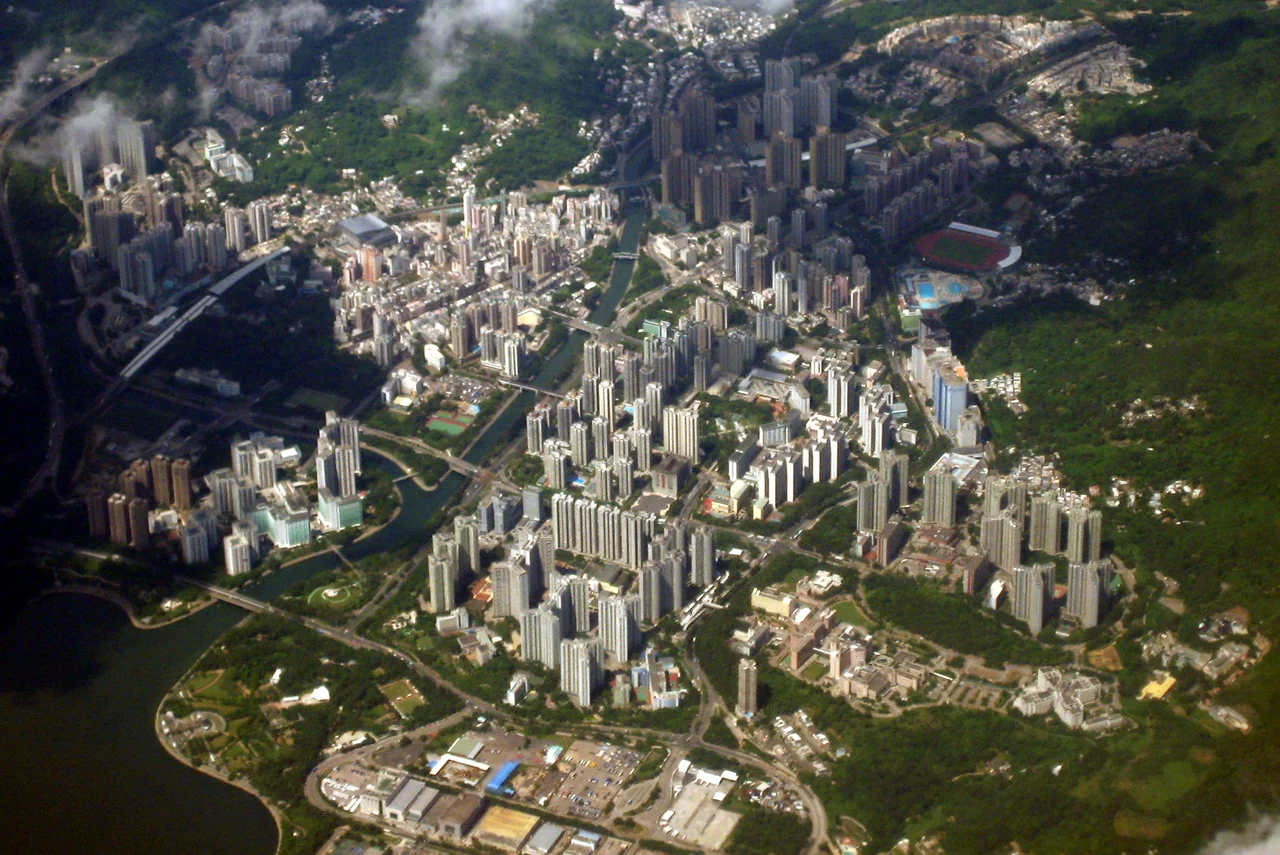
Tai Po sits at approximately 22.45°N, 114.17°E at the western head of Tolo Harbour, in Hong Kong's New Territories north of Sha Tin. From the air, the town is recognizable by the broad sweep of Tolo Harbour to the east, the Lam Tsuen River valley running southwest, and the dense forest of Tai Po Kau on the hillsides to the south. At 4,000 to 6,000 feet, the extent of reclaimed land around the harbour is clearly visible — the former tidal bay now occupied by the industrial estate and residential precincts of the new town. The nearest major airport is Hong Kong International Airport (VHHH), approximately 32 kilometres to the west-southwest. The East Rail Line runs through the centre of the town; Tai Po Market and University MTR stations are useful ground references.
Nearby Stories
- Chapel of St. Francis Xavier 3.5 km away
- Cuiheng 4.1 km away
- 2015 Shenzhen Landslide 16 km away
- Shunde 31 km away
- Wanshan Archipelago 37 km away
- Nanxiong Formation 96 km away
- Heyuan 149 km away
- Checheng Fu'an Temple 629 km away