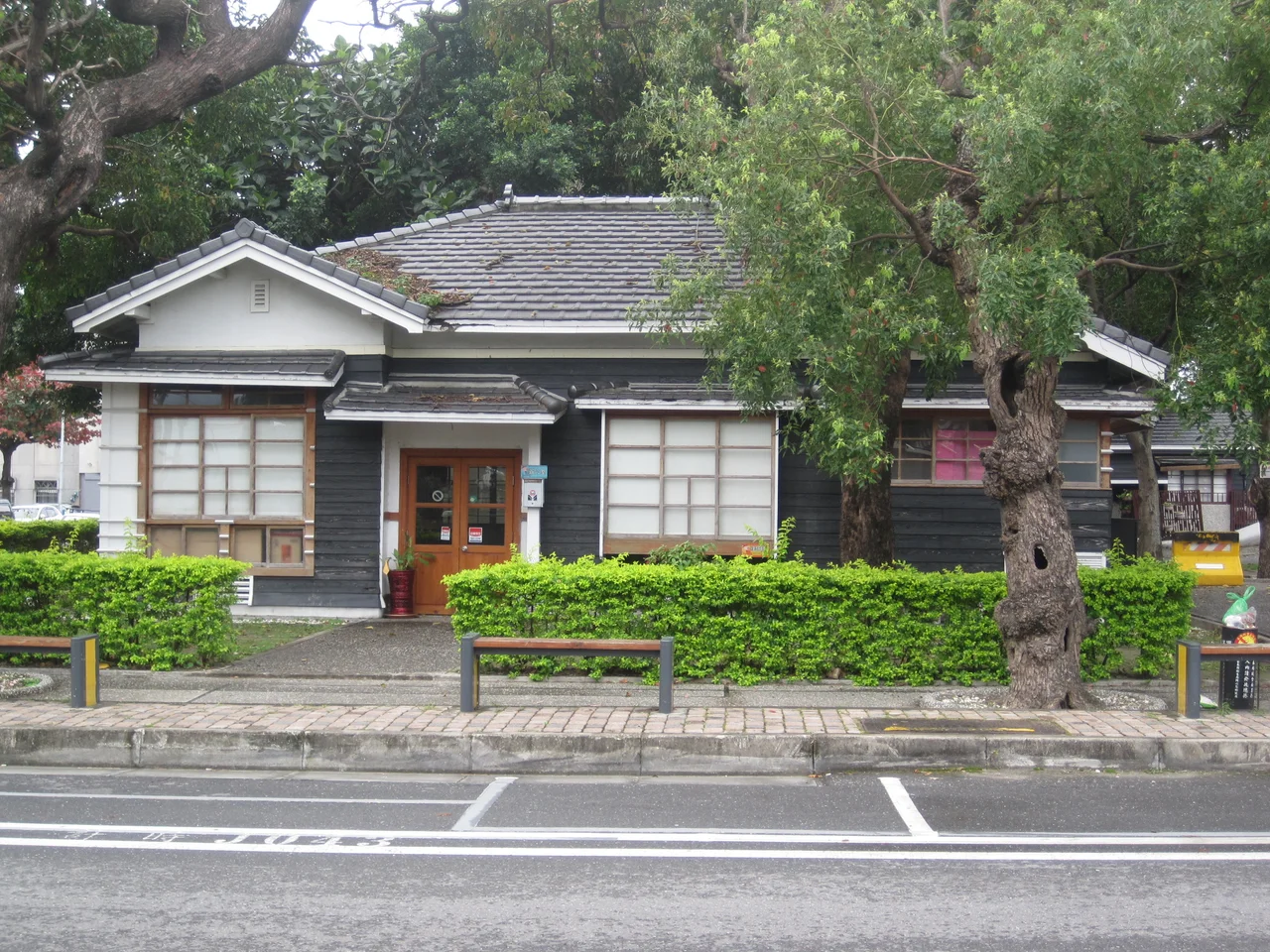

Taitung Children's Story House
The building has housed government workers and children's stories, and the second use suits it better. Built in 1937 during Japan's colonial administration of Taiwan as a dormitory and reception room for employees of the Taiwan Tobacco and Liquor Corporation, it spent decades as functional institutional housing — comfortable, well-made in the Japanese architectural style that defined civic construction in that era, and largely unremarkable to anyone outside the corporation. Then the corporation gave it away. And Taitung turned it into something else entirely.
From Dormitory to Story House
The Taiwan Tobacco and Liquor Corporation held the property until 2003, when it transferred the building and its surrounding grounds to the Taitung County Government at no cost. The county government spent two years on repairs and restoration, working with the Japanese-style structure rather than against it — preserving the architectural character of a building that had survived more than six decades in a subtropical climate prone to typhoons. In 2007, the restored complex opened as the Taitung Children's Story House, a public space designed to bring children into contact with stories, play, and the natural world. The transition from corporate dormitory to children's venue took seventy years of institutional ownership and two years of patient restoration, but the result found its audience quickly.
A Building That Earns Its Style
Japanese colonial architecture in Taiwan followed patterns developed over the Meiji and Taisho periods — wooden construction, low horizontal lines, deep eaves, rooms that breathe. The main building of the Children's Story House retains these characteristics. It is not a grand structure by institutional standards, but it has the quality that good domestic Japanese architecture consistently achieves: a sense that the building belongs to its site rather than dominating it. The surrounding grounds extend the experience outward. A tree house rises above the lawn, offering the particular magic that elevated perspectives give children — a place to look down at the adult world and feel briefly sovereign over it. A cat trail winds through the property. Slides and open lawn complete the outdoor spaces, creating the kind of unstructured play environment that Japanese-style gardens, with their emphasis on circulation and discovery, naturally encourage.
Changing Hands, Staying Put
After its opening in 2007, the Children's Story House passed between several managing bodies. The Taitung County Family Education Center took it on first, then in 2011 the Taitung Story House Association assumed management — a nonprofit arrangement that aligned the institution's governance with its community purpose. This kind of transition, from government entity to local association, is not uncommon for heritage buildings repurposed as cultural venues in Taiwan, and it tends to produce more responsive, locally-rooted programming. The association's name itself carries the institution's intention forward: story is not a decoration here but the organizing principle, the thing around which the building's second life is built.
Small Place, Particular Pleasure
Taitung Children's Story House sits in a city that has grown comfortable with unexpected uses for old buildings. Taitung City, long considered one of Taiwan's more relaxed and unhurried urban centers, has a relationship to its own history that allows spaces like this to exist without apology for their smallness or their simplicity. The building does not try to be a major museum or an architectural landmark. It is a 1937 dormitory with a treehouse and good shade and the kind of quiet that children, given enough of it, will fill with their own imagination. That is precisely what its founders seemed to intend. The building spent its first seven decades housing people who worked for the state. It spends its second life housing stories, which turns out to be a better use for the kind of architecture that was made to be lived in.
From the Air
The Taitung Children's Story House is located in Taitung City at approximately 22.752°N, 121.154°E, within the central city grid. The nearest airport is RCFN (Taitung Airport), approximately 3 km to the northeast. Taitung City sits at the southern end of the Huatung Valley, with the Pacific coast a short distance to the east and the mountains of the southern Central Range visible to the west. From the air, the urban grid of Taitung City is compact and clearly bounded by the Beinan River to the south. Recommended viewing altitude: 2,000–3,000 feet for city-level detail. The Japanese-era building cluster near the city center is part of a broader heritage landscape that includes several preserved colonial-era structures.
Nearby Stories
- Jiadong 8.7 km away
- Bunun Cultural Museum 10 km away
- Liudui Hakka Cultural Park 12 km away
- Yujing District 16 km away
- Shouka Mountain Pass 40 km away
- 1951 East Rift Valley Earthquakes 97 km away
- Mavulis Island 157 km away
- 2021 Hualien Train Derailment 162 km away