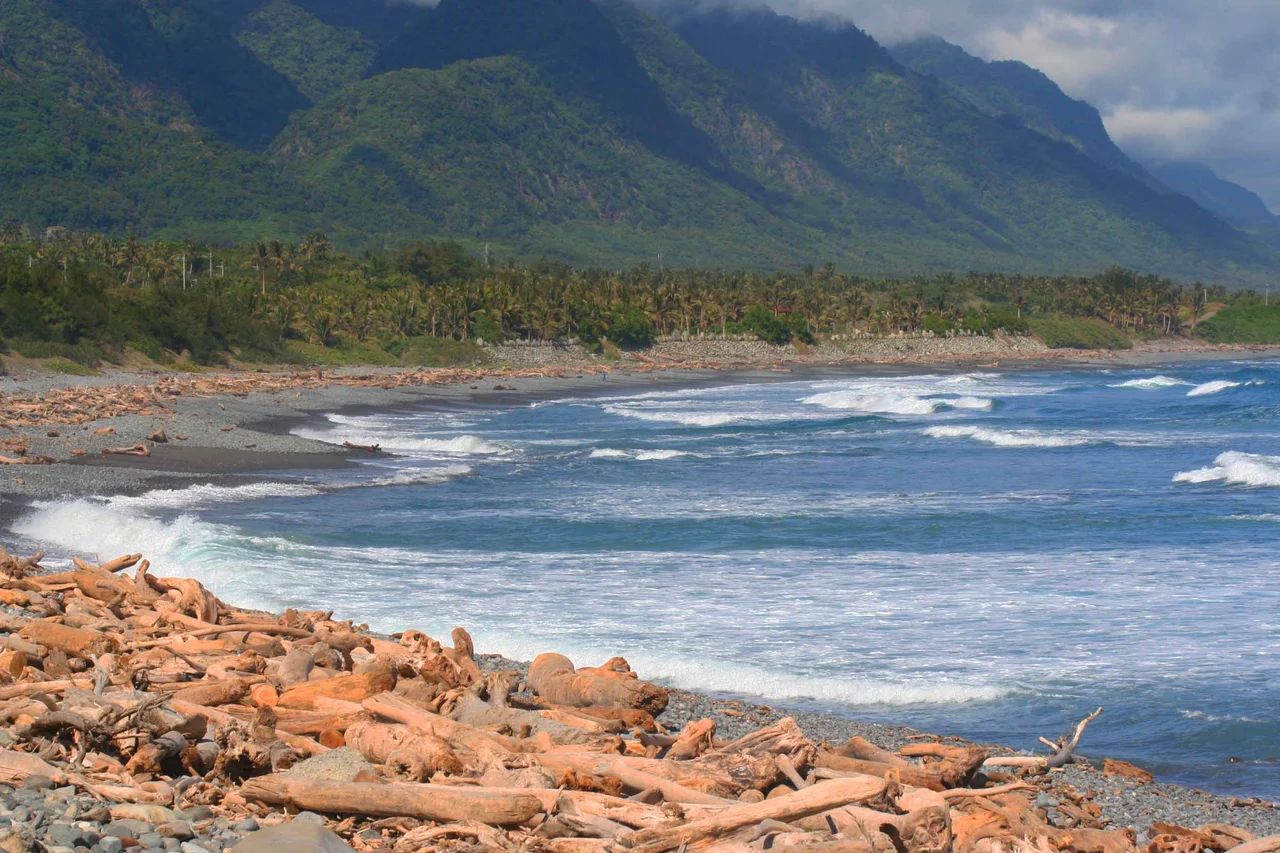

Taitung Miramar Resort
The building has stood empty on the beach at Shanyuan Bay for years, its five stories facing the Pacific, its doors never opened to a paying guest. The Taitung Miramar Resort — known in Mandarin as 美麗灣, Měilìwān, Beautiful Bay — spent more than fifteen years at the center of Taiwan's most protracted environmental and indigenous-rights dispute. Courts invalidated its environmental impact assessments. Academics by the hundreds petitioned for its demolition. Indigenous Amis people, whose community holds ancestral ties to this stretch of southeastern coastline, rallied alongside musicians and lawyers from across Taiwan. And yet the structure stands. The story of how it got there — and what it means that it remains — touches nearly every contested question in modern Taiwanese governance: land rights, corporate influence, coastal conservation, and what indigenous communities are owed when development encroaches on their traditional territories.
A Bay with Deep Roots
The beach at Shanyuan, also called Fudafudak, is not simply a scenic stretch of sand. The area sits within nationally designated traditional territory of the Amis people, one of Taiwan's 16 officially recognized indigenous ethnic groups. As Austronesian peoples, the Amis and their ancestors inhabited Taiwan roughly 5,000 years before the arrival of Han Chinese settlers. In Taitung County today, indigenous peoples make up around 35.7 percent of the population — many times higher than the national average of about 2.35 percent.
The Tse-tung buluo, an Amis village community named for the Erythrina tree, has long used Fudafudak's sheltered coral reef bay as a food-gathering ground, a training site for youth in fishing, diving, and boating, and the setting for the annual ocean worship festival Palaylay — a summer ceremony tied to the sea's rhythms and the community's cultural continuity. Significant archaeological sites in the surrounding area date to the Neolithic period, approximately 2,000 to 4,000 years ago. When developers arrived, they arrived on land with a long memory.
How the Deal Was Made
In 2003, the Taitung County Government received central government approval to use the Build-Operate-Transfer (BOT) model to redevelop Shanyuan — demolishing existing camping facilities and replacing them with a theme restaurant and beach amenities in partnership with a private company. BOT arrangements are typically reserved for major infrastructure projects such as subway systems; applying the model to a beachside tourist development was, by most accounts, unusual.
The project was classified as a 'General' rather than an 'International Tourism' development — a distinction that mattered enormously, because it kept regulatory control with the county government rather than the central government in Taipei. Companies were invited to tender. In early 2004, Durban Development Company, a subsidiary of the Huang family's Miramar Group, entered the bidding. The scope expanded: what began as a restaurant and changing rooms grew to an 80-room hotel. In December 2004, then-County Magistrate Hsu Ching-yuan signed the contract. Construction began on March 28, 2005.
The Legal Battle: Fifteen Years in Court
Environmental groups and indigenous advocates raised alarms almost immediately. Two early critics — writer Hsu Lan-hsiang and investigative journalist Lin Yunko — noticed construction activity at the peaceful bay and began organizing. In April 2007, the Taiwan Environmental Protection Union (TEPU) partnered with Wild at Heart, a volunteer environmental law organization, to mount a legal challenge. Their core argument: Miramar had begun construction without completing a legally required Environmental Impact Assessment (EIA).
The Kaohsiung Administrative High Court agreed. On January 23, 2008, it ruled the building permit invalid because no EIA had been conducted before construction. The ruling ordered a construction halt. The Taitung Government and Miramar interpreted this not as a demolition order but as an invitation to conduct the EIA retroactively — and proceeded to do so, with a panel whose composition was later challenged in court. Critics, including a professor who had served on the original 2007 assessment, stated publicly that members who had expressed concern were removed and replaced with county officials and engineering academics.
The legal proceedings spanned eight court losses for the county government and developer. More than 600 academics signed a petition demanding demolition. Concerts and rallies on the beach drew crowds of around 1,000 people. A march connected Amis, Bunun, and other indigenous communities with supporters in Hualien, Ilan, and Taipei. Through each ruling, the structure remained.
Voices From Both Sides
The dispute surfaced sharp disagreements that deserve to be reported as such, not collapsed into a single verdict. Supporters of the development, including some members of the local Tse-tung buluo, performed traditional songs at a rally in favor of the project outside County Hall in December 2012 — a reminder that indigenous communities themselves were not monolithic in their opposition.
County Magistrate Justin Huang argued that once the main structure was complete, demolition was impractical and financially ruinous: the county faced potential compensation liabilities exceeding NT$1 billion, and a precedent from a mothballed incinerator project loomed. Huang proposed converting the building into an office block or international conference venue. Activists including Lin Shu-ling, one of 14 plaintiffs in a citizen lawsuit, described the repeated appeals as 'a waste of public money' and urged the county to act on the courts' repeated rulings.
Environmental lawyer Thomas Chan, who represented plaintiffs throughout the case, argued that because developers had violated the law by beginning construction before applying for EIA approval, any compensation claim was void under the terms of the original contract.
What Remains
In October 2020, an arbitration tribunal ordered the Taitung County Government to pay NT$629 million — roughly US$21.75 million — to Miramar Resort, with ownership of the buildings and facilities transferring to the county. No criminal investigation into the construction process has been opened.
The fate of the structure itself remains unresolved. Environmental groups, including the Hualien-Taitung branch of Citizens of the Earth, have called for the arbitration proceedings to be made public and for the building to be demolished. County officials have leaned toward converting the property into a public leisure park or meeting venue. The Amis community's annual Palaylay ceremony continues to be held on the beach nearby.
Shanyuan Bay remains, by most accounts, the last significant undeveloped stretch of Taiwan's rugged southeastern coastline. Whether the building that stands at its edge represents the beginning of development or an anomaly that will eventually be removed is a question that Taiwan's courts, governments, and communities have yet to fully answer.
From the Air
Shanyuan Bay (Fudafudak) lies at approximately 22.831°N, 121.185°E on Taiwan's southeastern coast, roughly 10 km north of Taitung Airport (RCFN). From approach altitudes into RCFN, the bay is visible as a curved arc of white sand and coral-tinted water tucked against the base of the Central Mountain Range foothills. The Pacific stretches east to the horizon; on clear days Green Island (Lyudao) is visible about 33 km offshore. Recommended viewing altitude: 2,000–4,000 feet on the coastal southbound approach. The contrast between the undeveloped shoreline and the solitary resort structure — situated unusually close to the waterline — is visible from the air.
Nearby Stories
- Jiadong 8.7 km away
- Bunun Cultural Museum 10 km away
- Liudui Hakka Cultural Park 12 km away
- Yujing District 16 km away
- Shouka Mountain Pass 40 km away
- 1951 East Rift Valley Earthquakes 97 km away
- Mavulis Island 157 km away
- 2021 Hualien Train Derailment 162 km away