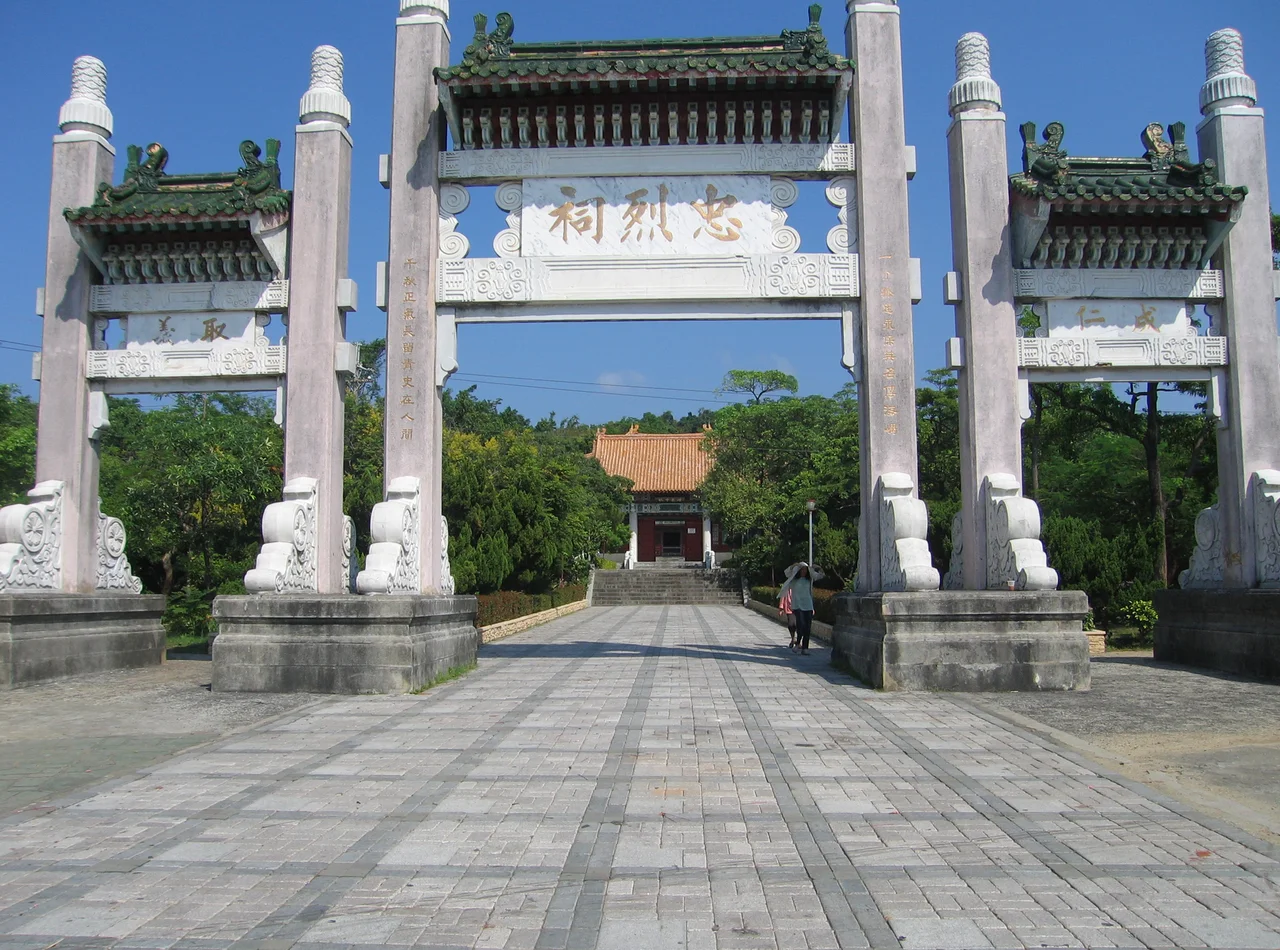

Takao Shrine
There is a particular kind of historical site that carries two histories simultaneously, neither one fully erasing the other. The hill on Shoushan's lower flank where the Takao Shrine once stood is that kind of place. In 1910, a small Shinto shrine was established at the foot of what was then called Kotobuki Hill — part of Japan's broader practice of building religious infrastructure across its colonial territories as a statement of permanence and cultural authority. The shrine grew, moved uphill, received a formal ranking in the imperial religious hierarchy, and served the Japanese community and colonial administration of Takao for thirty-five years. Then 1945 arrived, and the world the shrine was built for ceased to exist.
Built for a City Named Takao
Japan took control of Taiwan in 1895, and over the following decades it transformed the island's southern port city — then a modest harbor town — into an industrial hub it called Takao. Religious sites came with the transformation. In 1910, the Takao Kotohira Shrine was established at the base of Kotobuki Hill, a modest beginning for what would grow into the city's principal Shinto institution. Kotohira shrines across Japan are typically dedicated to Ōmononushi no Mikoto, the deity associated with maritime safety — an appropriate patron for a city whose economy depended on the sea. By 1920 the shrine had been renamed the Takao Shrine, and in 1928 it was relocated to the hillside above, where it could preside over the city with greater visibility. The deities enshrined within included Prince Yoshihisa and Emperor Sutoku alongside Ōmononushi, the combination reflecting the shrine's elevated civic status.
Kensha Rank and Colonial Purpose
In 1932, the Takao Shrine received the kensha designation — the rank of a prefectural shrine in the imperial Shinto hierarchy. This was not merely an honorific. Kensha status placed the shrine within the formal administrative structure of State Shinto, making it an institution with official standing, government maintenance, and an explicit role in the religious life of the prefecture. Shrines of this rank were expected to host civic ceremonies and to serve as focal points for the kind of collective ritual that colonial administrations relied on to build community coherence — or at least the appearance of it. The Takao Shrine occupied this role for over a decade, until the war's end.
After 1945: A New Purpose on the Same Hill
When the Republic of China government took control of Taiwan after Japan's 1945 defeat, it faced thousands of Japanese-era institutions requiring reinterpretation or replacement. Shinto shrines posed a particular challenge: they were religious sites built for a foreign state religion, standing on land that now needed to serve a different national narrative. The Takao Shrine's solution was conversion. The site became the Kaohsiung Martyrs' Shrine — zhōngliècí in Mandarin — dedicated to honoring those who died in service to the Republic of China. Such martyrs' shrines were established across Taiwan in the postwar period, repurposing the physical locations if not the spiritual architecture. At Takao, most of the Japanese structures were demolished in the 1970s, and the site was rebuilt in Chinese temple style. The transformation was thorough and deliberate.
What Remains and What Was Made
The Kaohsiung Martyrs' Shrine that stands on Shoushan today is a functioning religious and civic site, distinct in form and purpose from the shrine that preceded it. The Chinese architectural vocabulary — curved rooftiles, painted timber, the formal symmetry of a temple compound — replaced what the Japanese colonial administration had built. The hill itself remains, and the views from it remain: Kaohsiung's harbor and cityscape spread out below, the same panorama that would have been visible from the Shinto precinct above. For visitors who come knowing the site's layered history, the location raises questions that the current architecture doesn't quite answer — about whose memory a place carries, and how those memories coexist when one has been physically built over the other. The shrine's history was designated for preservation by heritage authorities, even as the structures that embodied it were replaced.
Reading the Hillside
Shoushan is a long ridge running north-south along Kaohsiung's western edge, and the Martyrs' Shrine sits on a portion of that ridge that offers some of the most commanding views in the city. The hill is a nature park as well as a heritage site, and the mixture of uses — forested trails, viewpoints, the shrine compound — gives it a quality different from urban monuments at ground level. You reach it by climbing, which creates a natural transition from the city below. The site asks something of visitors in terms of effort, and that effort changes the experience of arrival. Whatever the era, whatever the name above the gate, this hillside has been understood as a place set apart from the ordinary — elevated, quite literally, above the working city that surrounds it on three sides.
From the Air
The Takao Shrine site — now the Kaohsiung Martyrs' Shrine — is located at approximately 22.626°N, 120.274°E on the southern slopes of Shoushan, the prominent forested ridge running along Kaohsiung's western edge. From the air, Shoushan is the most visually distinctive feature of the Kaohsiung cityscape: a green limestone ridge rising abruptly from the urban grid, with the Gushan District at its foot and Sizihwan Bay to the west. The shrine compound is visible on the lower hillside in clear conditions. Nearest airport is Kaohsiung International (RCKH), approximately 8 km southeast. Recommended viewing altitude for Shoushan as a whole is 3,000–4,000 feet, from which the ridge's relationship to the harbor and city becomes clear.
Nearby Stories
- Taimali 7.2 km away
- Meinong East Gate Tower 15 km away
- Kunci Temple 20 km away
- Checheng Fu'an Temple 42 km away
- Dongji Island 49 km away
- Orchid Island 69 km away
- South Penghu Marine National Park 77 km away
- Hong Kong 12 549 km away