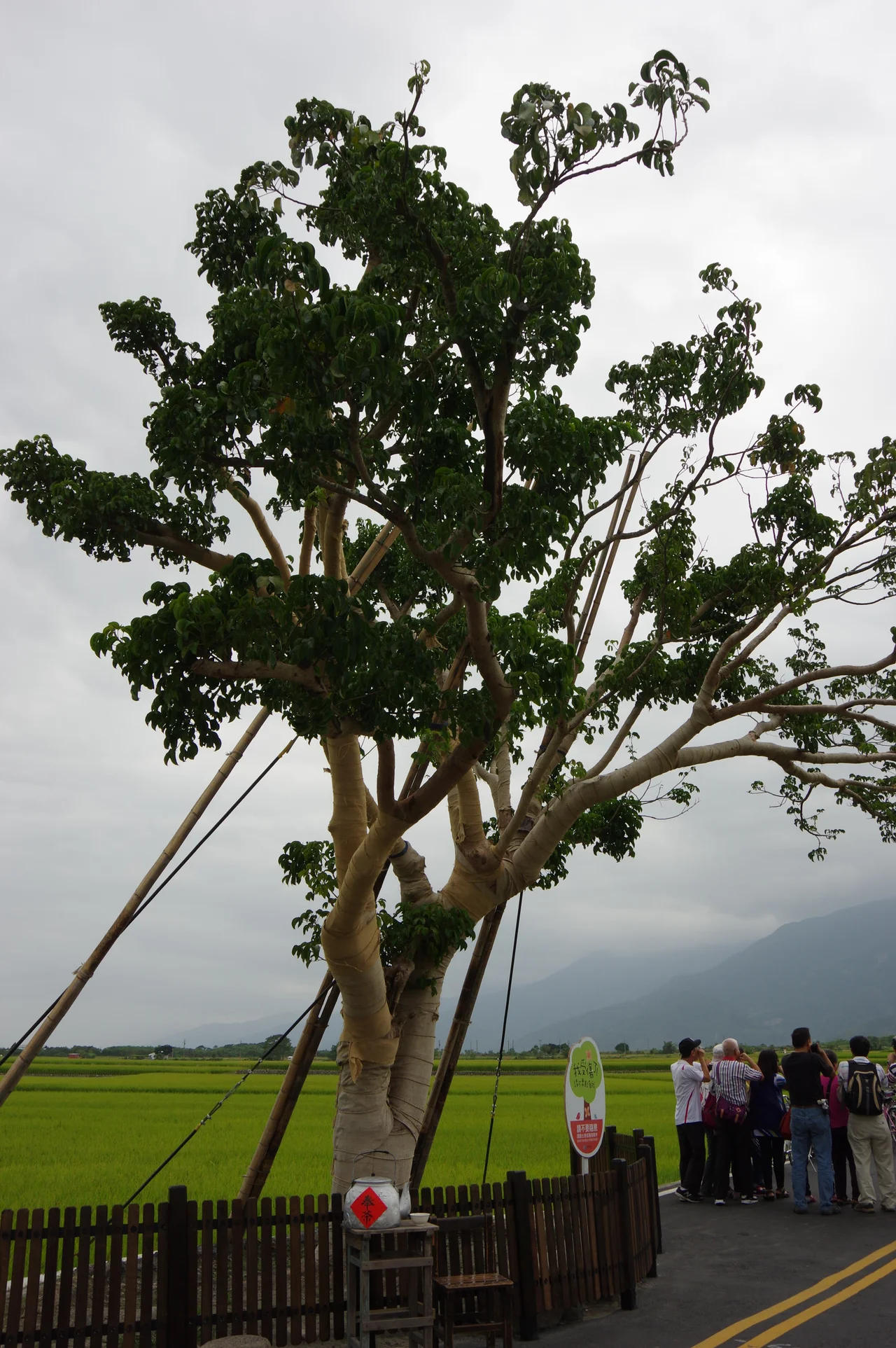

Takeshi Kaneshiro Tree
In June 2013, EVA Air filmed an advertisement in the rice paddies of Chishang, Taiwan. The commercial featured actor Takeshi Kaneshiro standing under a lone bishop wood tree surrounded by green paddy fields and the mountains of the East Rift Valley. The advertisement aired, and something unexpected happened: people came. Not a few people. Hundreds of thousands of people, from across Taiwan and from Japan and South Korea, making the journey to a specific tree in a specific field in a small agricultural township in eastern Taiwan. The tree had been there all along. The paddies had been there longer. But the combination, caught on video at the right moment, unlocked something — a longing for that particular light, that particular quiet.
The Road Where It Stands
Mr. Brown Avenue is not a grand name, and the road does not pretend to be a grand thing. It is a flat, paved agricultural lane running through the rice paddies south of Chishang, flanked by fields and framed by the Central Mountain Range to the west and the Coastal Range to the east. The name comes from a canned coffee brand — Mr. Brown Coffee — that filmed its own advertisement along this road years before EVA Air arrived. Cyclists discovered it first, then photographers, then the general public. The light in the East Rift Valley has a quality that photographers describe in specific terms: the air is clear, the mountains are close, and the green of the paddies in growing season takes on an intensity that seems almost unnatural. The Takeshi Kaneshiro Tree stands along this road, a bishop wood — Bischofia javanica, a species common in Taiwan's lower elevations — growing at the edge of a paddy field, its canopy spreading wide against the sky.
Celebrity, Pilgrimage, and a Community's Frustration
The scale of the response caught everyone off guard. An estimated NT$500 million per year in tourism value flowed into the Chishang area in the years following the commercial — a staggering figure for a small agricultural township. But tourism at that volume, focused on a single point in an active farming area, is not straightforward to absorb. Visitors came in buses, in cars, on bicycles. Many were respectful. Some were not: crops were trampled, litter accumulated, the paddy field margins were walked down to mud. Local farmers — the people who had been cultivating these fields long before a famous actor stood under a tree in them — found their work disrupted by visitors who did not understand or did not care that this was a working agricultural landscape, not a park. The frustration reached the point where some farmers called for the tree to be cut down. That this did not happen reflects the complexity of balancing a community's economic interests against its members' right to farm in peace.
Typhoon Matmo and a Difficult Recovery
On July 23, 2014, Typhoon Matmo made landfall in Taiwan with winds strong enough to topple trees across the island. The Takeshi Kaneshiro Tree fell. The news moved quickly through social media in Taiwan and Japan — the tree had become famous enough that its collapse was reported as a significant event. Arborists from both Japan and Taiwan were brought in to assess the situation. The tree was re-erected, staked, and placed under careful observation as its root system reestablished itself in the paddy-field soil. A photograph taken on October 11, 2014 — less than three months after the typhoon — shows the tree back upright, visibly recovering. The process was slow and uncertain, but the tree survived. That survival, in the logic that had already made this tree famous, only added to the story: the lone tree in the paddies that a typhoon could not finish.
A Tree in the Right Landscape
What the Takeshi Kaneshiro Tree actually offers, once the celebrity history is set aside for a moment, is access to one of the more quietly spectacular views in Taiwan. Standing near the tree in the morning, when the light comes over the Coastal Range from the east and the mist is still burning off the paddies, the scene is as good as any landscape photograph suggests. The mountains are very close. The fields are enormous, the green of them in growing season almost aggressive in its vitality. The sky above the Central Range to the west carries the clouds that form around altitude, slow and white against blue. It is the kind of view that makes the impulse to come here, even for a tree, feel less absurd than it might otherwise seem. The tree is a landmark, a focal point — a reason to stand still long enough to actually see where you are.
From the Air
The Takeshi Kaneshiro Tree stands at 23.097°N, 121.204°E in the rice paddies along Mr. Brown Avenue, Chishang Township. From the air at 2,000–4,000 feet, it is a single tree visible in the flat agricultural plain of the East Rift Valley, south of Chishang town. The paddy grid of the valley floor, with Dapo Pond to the northeast and the twin mountain ranges framing the scene on both sides, makes this one of the most photogenic valleys in Taiwan from altitude. The nearest airport is Taitung Airport (RCFN), approximately 25 km to the south.
Nearby Stories
- Peinan Site Park 6.4 km away
- 1941 Chungpu Earthquake 11 km away
- Yujing District 12 km away
- Fo Guang Shan Buddha Museum 18 km away
- Yushan 19 km away
- 1951 East Rift Valley Earthquakes 58 km away
- 2021 Hualien Train Derailment 123 km away
- Mavulis Island 196 km away