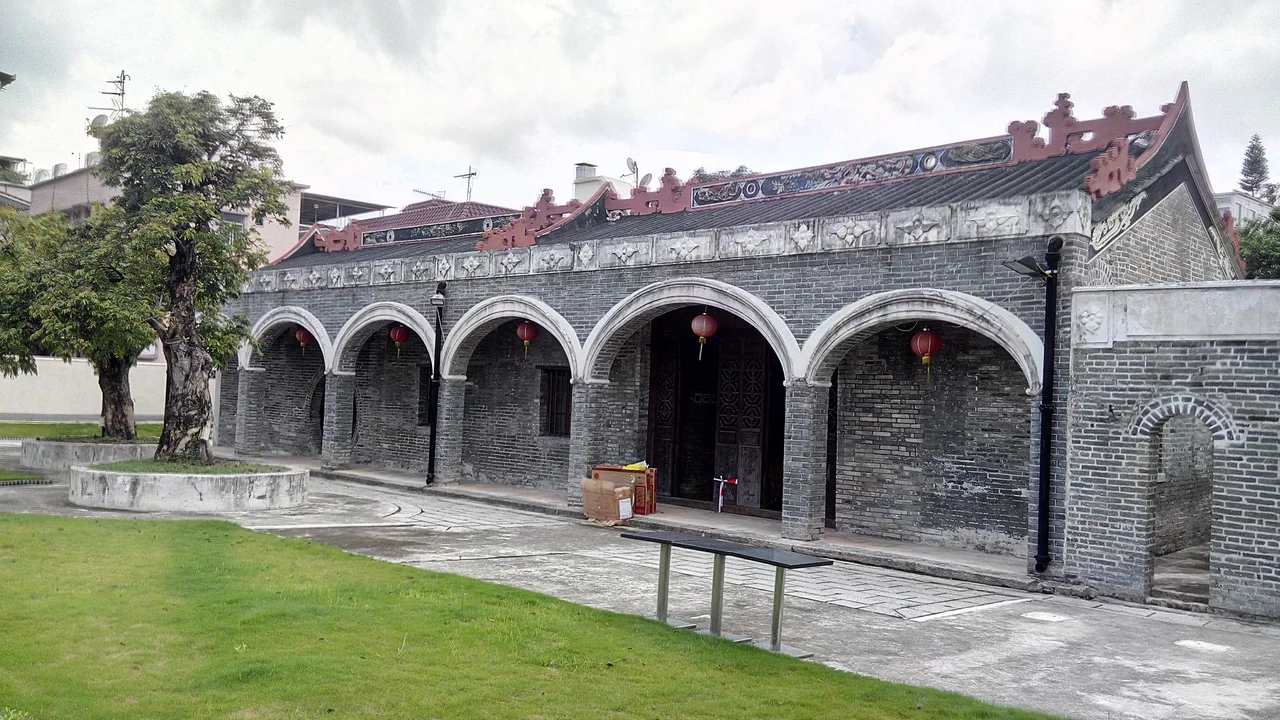

Tang Ancestral Hall (Ha Tsuen)
It took the Tang Clan of Ha Tsuen one year to build. Construction began in 1749 and was finished in 1750, and the hall they raised — also known as Yau Kung Tong — has stood in Ha Tsuen Shi ever since, an act of remembrance in brick and timber for two men who shaped everything that came after them. The Hong Kong government now recognises the building as a declared monument, but the Tang clan knew its significance long before any government label arrived.
Two Ancestors, One Hall
The Tang Ancestral Hall at Ha Tsuen was built to commemorate two founding figures: Tang Hung-chi and Tang Hung-wai. These were the men credited with establishing the Tang clan's village settlements in Ha Tsuen — the low-lying area of the Yuen Long plain in what is now Hong Kong's northwestern New Territories. Ancestral halls in southern Chinese tradition are not simply places of worship; they are the institutional heart of a clan, where the tablets of the dead are housed, where the living gather to mark the passage of time, and where the chain of descent from particular ancestors is made visible and honoured. To build a hall is to assert that the line continues, that the founding act of settlement was meaningful, and that it will not be forgotten.
Ha Tsuen and the Tang Lowlands
Ha Tsuen — "lower countryside" — occupies the southwestern part of the Yuen Long plain, a broad, flat agricultural landscape that the Tang clan came to dominate across multiple villages over several centuries. The Hall sits in Ha Tsuen Shi, the market village at the centre of Ha Tsuen. The Tang clan's presence in the Yuen Long area is extensive: other Tang halls stand at Ping Shan and at Lung Yeuk Tau in Fanling, and each reflects a different branch of the wider Tang lineage that spread across the New Territories from the Song dynasty onward. The Ha Tsuen branch traces its local origins specifically to Tang Hung-chi and Tang Hung-wai, the pair commemorated in this hall.
Declared Monument
The Antiquities and Monuments Office of Hong Kong has declared the Tang Ancestral Hall at Ha Tsuen a monument — the highest level of statutory heritage protection available in the territory. The designation places the hall in the same category as the city's most significant surviving historic structures. Attached to the hall compound is the Yau Kung School, named after the hall's formal designation Yau Kung Tong, a reminder that clan ancestral halls traditionally served educational functions as well as ceremonial ones. The hall, the school name, and the monument status together reflect the breadth of what a well-maintained ancestral hall meant to the community that built it.
A Living Piece of the Landscape
Ha Tsuen remains a part of the New Territories where the agricultural and clan-village landscape survived Hong Kong's twentieth-century development more intact than in many areas. The Tang Ancestral Hall sits amid that landscape, in a district of fish ponds, fields, and village houses that surrounds the Yuen Long urban core without being absorbed by it. Unlike some declared monuments that have become museums or visitor attractions, the Tang Ancestral Hall at Ha Tsuen is a clan hall in a living village, still connected to the families whose founders it honours. Visiting it means entering Ha Tsuen Shi on the Yuen Long plain, where the scale and pace are different from the city to the south — and where the eighteenth-century hall sits, low and solid, in the midst of it.
From the Air
The Tang Ancestral Hall at Ha Tsuen is located at approximately 22.447°N, 113.993°E in the flat Yuen Long lowlands of northwestern Hong Kong. The Yuen Long plain extends broadly to the east and south; the coastline of Deep Bay lies to the north and northwest, visible from altitude. Hong Kong International Airport (VHHH) is approximately 8 km to the south on Lantau Island, making this one of the closest declared monuments to the airport — aircraft on approach to VHHH's northern runway frequently fly almost directly overhead. From the air at 2,000 feet, the grid of Ha Tsuen Shi's village buildings is visible amid fish ponds and agricultural land. The Yuen Long light rail system provides orientation lines running northeast.
Nearby Stories
- Chapel of St. Francis Xavier 3.5 km away
- Cuiheng 4.1 km away
- 2015 Shenzhen Landslide 16 km away
- Shunde 31 km away
- Wanshan Archipelago 37 km away
- Nanxiong Formation 96 km away
- Heyuan 149 km away
- Checheng Fu'an Temple 629 km away