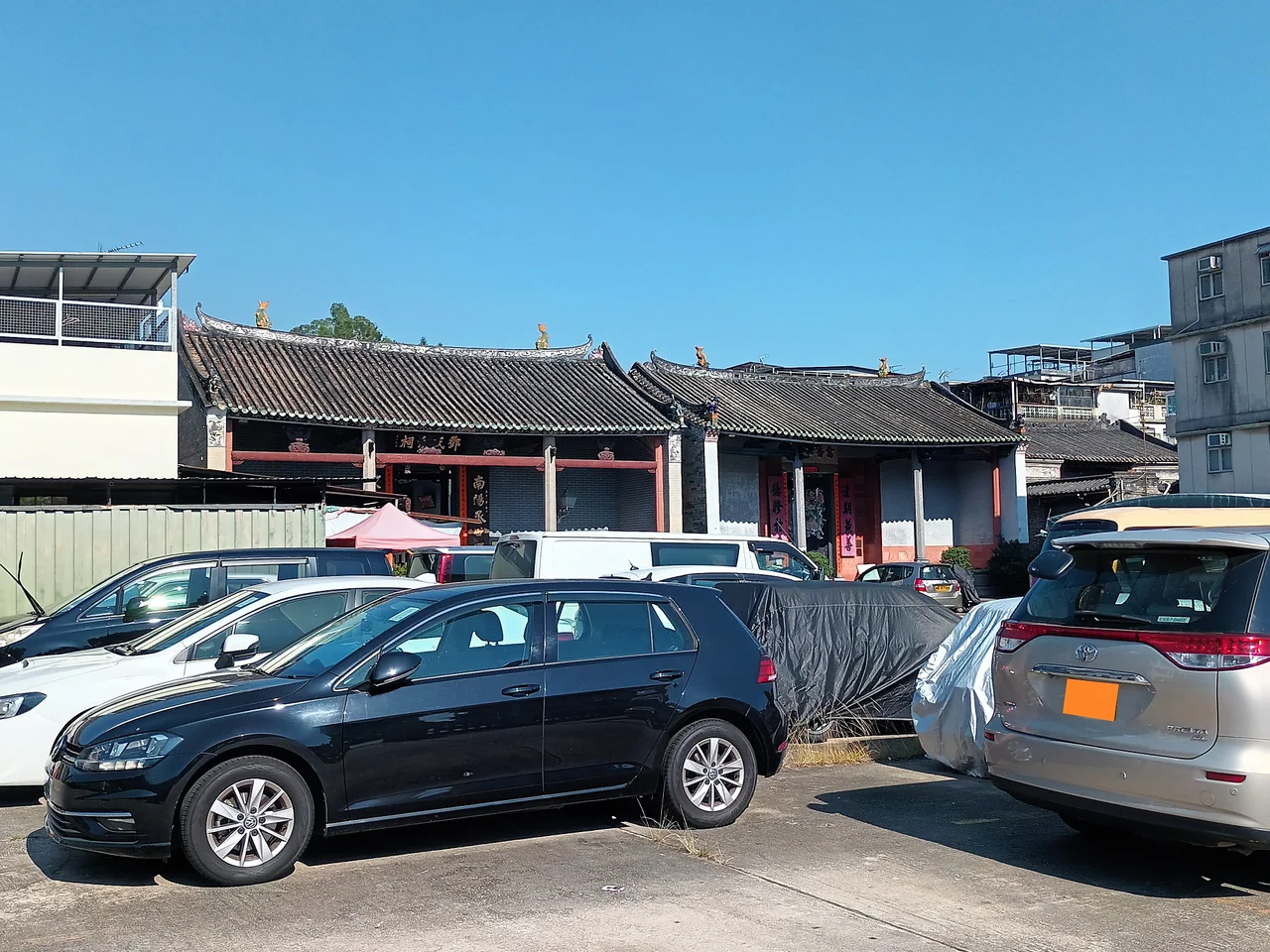

Tang Ancestral Hall (Ping Shan)
Approximately 700 years ago, the fifth-generation ancestor of the Tang clan at Ping Shan decided his lineage needed a hall worthy of what they had built in the New Territories lowlands. Tang Fung-shun raised a three-hall structure between the villages of Hang Mei Tsuen and Hang Tau Tsuen that grew into one of the largest ancestral halls in Hong Kong. It is still used. Clan members still gather there for worship, for traditional festivals, for the ceremonies that mark births, deaths, and the turning of the year. The Hong Kong government declared it a monument in 2001. The clan was using it long before that.
What Three Halls Contain
The Tang Ancestral Hall at Ping Shan is a three-hall structure arranged across two internal courtyards — a classic layout for a major southern Chinese ancestral hall, with the courtyards allowing light into the interior and creating processional space for ceremonies. The wooden brackets and beams of each hall are carved with auspicious Chinese motifs: bats for luck, peaches for longevity, fish for abundance. On the main ridges and rooftops, pottery decorations in Shiwan ware depict dragon-fish and unicorns — ceramic figures produced in the kilns of Shiwan, near Foshan in Guangdong, that have been finishing the rooflines of Cantonese temples and halls for centuries. In the rear hall, ancestral tablets stand at the altar. These tablets are the point of the whole structure: named markers for the dead who remain part of the living clan.
Tang Fung-shun and Seven Hundred Years
Tang Fung-shun was the fifth-generation ancestor of the Ping Shan Tang branch — which means he was living and building in roughly the early fourteenth century, during the transition between the Song and Yuan dynasties. The Tang clan arrived in the Yuen Long area during the Song period and became one of the most powerful lineages in the New Territories, establishing a network of villages, markets, and institutions across the lowland plains. Ping Shan — "flat mountain," a low ridge rising from the flats of Yuen Long — was one of their principal settlements. Tang Fung-shun's hall was the physical assertion of that position: a statement in architecture that the clan's presence here was permanent, organized, and worthy of ceremonial space.
The Ping Shan Heritage Trail
The Tang Ancestral Hall anchors the Ping Shan Heritage Trail, a walking route established by the Hong Kong government that links the hall to other historic structures in the Ping Shan area. These include the Tsui Sing Lau Pagoda — the only surviving ancient pagoda in Hong Kong — and several other Tang clan buildings: the Hung Shing Temple, the Kun Ting Study Hall, and smaller clan halls. Walking the trail is an hour-long encounter with a landscape the Tang clan shaped over seven centuries. The hall received its declared monument status in 2001, which placed it under statutory protection, but its significance to the Tang community predates any government recognition by the length of that heritage trail and more.
Alive in the Present Tense
What distinguishes the Tang Ancestral Hall at Ping Shan from a preserved relic is that it continues to function as intended. The clan gathers here for traditional festivals and seasonal ceremonies. Marriages, coming-of-age rites, and memorial observances bring Tang clan members from across Ping Shan and the wider New Territories to the three halls and their courtyards. The hall is the meeting point for the clan as a social institution, not simply a monument to its past. In a territory where rapid development has demolished or displaced so much of the material culture that made it distinctive, the Ping Shan hall survives as both a building and a practice — the structure intact, the ceremonies inside it intact.
From the Air
The Tang Ancestral Hall at Ping Shan is located at approximately 22.445°N, 114.008°E in the Yuen Long lowlands, between Hang Mei Tsuen and Hang Tau Tsuen. Ping Shan sits on a low ridge above the flat agricultural plain of Yuen Long, and the hall is visible from the air amid the surrounding village buildings. Hong Kong International Airport (VHHH) lies approximately 10 km to the southwest on Lantau Island. The straight lines of the Yuen Long light rail routes provide useful orientation grids from altitude. Deep Bay and the Shenzhen coast are visible to the north in clear conditions. Recommended viewing altitude: 1,500–2,500 feet gives good context of the hall's setting within the broader Yuen Long landscape.
Nearby Stories
- Chapel of St. Francis Xavier 3.5 km away
- Cuiheng 4.1 km away
- 2015 Shenzhen Landslide 16 km away
- Shunde 31 km away
- Wanshan Archipelago 37 km away
- Nanxiong Formation 96 km away
- Heyuan 149 km away
- Checheng Fu'an Temple 629 km away