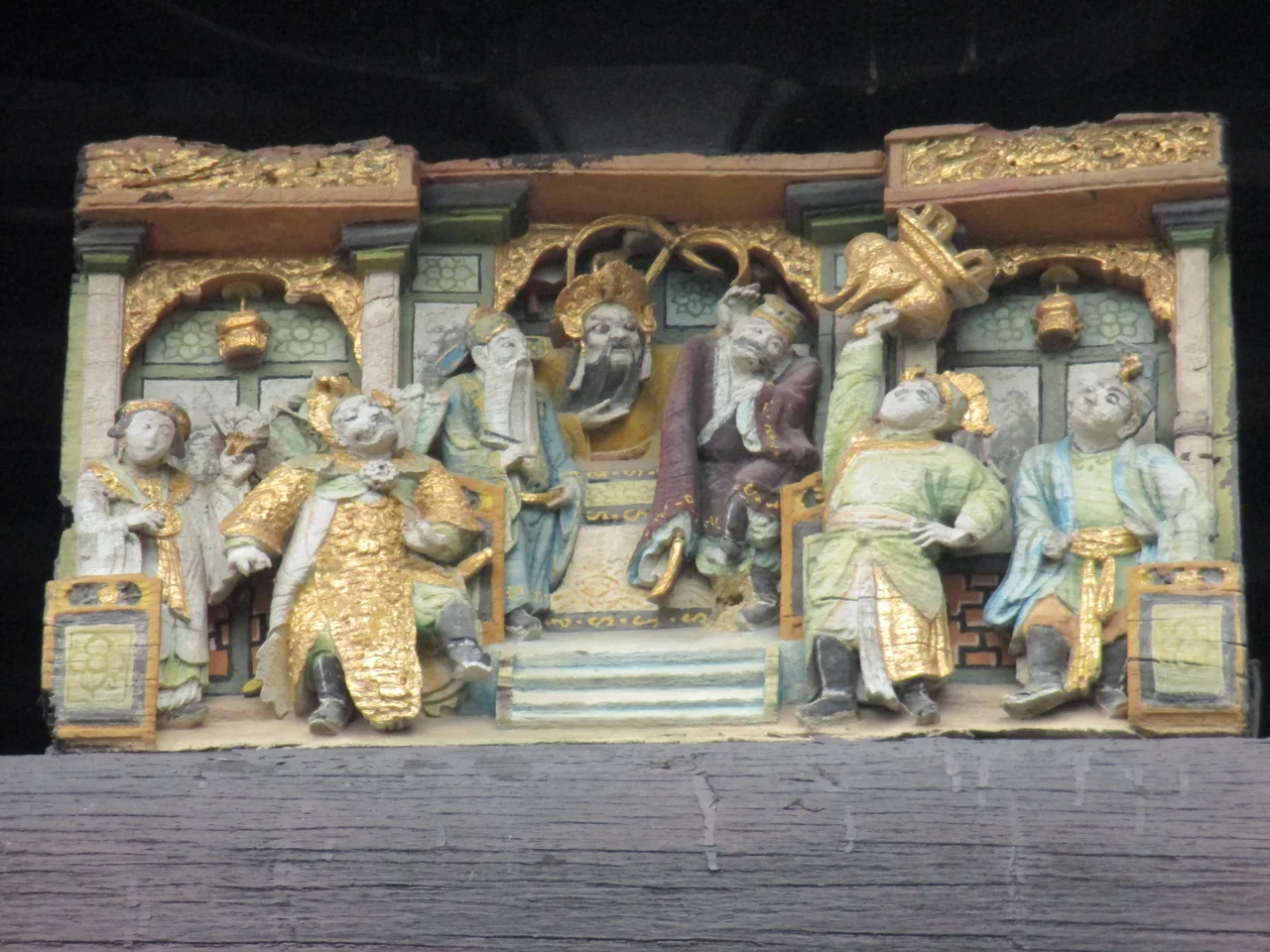

Tang Chung Ling Ancestral Hall
Tang Chung Ling lived from 1303 to 1387. He never saw the hall that bears his name — it was built in 1525, nearly 140 years after his death, by descendants who wanted his memory to endure. That gap between life and commemoration says something about how the Tang Clan of Lung Yeuk Tau understood time: not as a line running from past to present, but as a living thread connecting the dead to those still breathing. Five centuries later, the hall still stands between the villages of Lo Wai and Tsz Tong Tsuen in Fanling's New Territories. Clan members still gather here for festivals and ceremonies, using the same rooms their ancestors used to settle disputes and mark milestones.
A Hall Built for the Dead — and the Living
The structure itself is a three-hall building organised around two spacious internal courtyards, a layout typical of Lingnan-style ancestral architecture. The rear hall is the most carefully calibrated space in the building. Three chambers divide its floor plan by moral category rather than by family rank alone. The central chamber holds ancestral tablets for the most prominent forebears, including those of a Song dynasty princess and her husband, Tang Wai-Kap, whose tablets are carved with dragon heads to mark their imperial connection. Such carvings were not decorative choices — they were statements of genealogical prestige in a system where lineage was legal currency.
The left chamber honours ancestors who achieved high rank in the imperial court or made significant contributions to the clan. The right chamber holds a different kind of hero: those recognised for righteousness. It is here that Tang Si-meng is venerated, a servant whose story the hall preserves with the weight of legend.
The Loyal Servant Who Chose the Sea
Tang Si-meng's story comes from the late 16th century, when kidnappings for ransom were not uncommon in the region. He was seized along with his master. To secure his master's release, Tang Si-meng told the kidnappers he was the master's son — knowing that a son would command higher ransom and therefore buy more time. His master departed to raise the money. Tang Si-meng, facing an impossible situation once the deception might be discovered, jumped into the sea. He did not survive.
The clan awarded him the posthumous title of Loyal Servant. His tablet sits in the chamber reserved for the righteous, not because of rank or achievement, but because of what he chose to do. The hall makes no attempt to dramatise his story beyond these bare facts. The facts are enough.
Wood, Plaster, and the Weight of Centuries
Walk through the hall today and what strikes you first is the density of decoration. Fine wood carvings cover structural elements throughout the building. Polychrome plaster mouldings — made in the raised, coloured style associated with Guangdong craftsmanship — line walls and eaves. Murals carry auspicious motifs: bats for good fortune, peonies for prosperity, cranes for longevity. These are not merely ornamental. In a Confucian ritual space, the visual language reinforces the moral order the building embodies.
The hall has been renovated multiple times without substantially changing its structure. A significant renovation took place in 1921. A major restoration followed between 1990 and 1992. Hong Kong declared the Tang Chung Ling Ancestral Hall a monument in November 1997, and it sits along the Lung Yeuk Tau Heritage Trail, which connects several of the area's historic sites. Until the mid-1990s, women were traditionally not permitted to enter — a restriction the community itself eventually set aside.
Lung Yeuk Tau and the Tang Presence
The Tang Clan arrived in the New Territories during the Song dynasty and established themselves across multiple villages in the Lung Yeuk Tau area. This ancestral hall is the primary one for the Lung Yeuk Tau branch, but it is part of a broader network — the Tang Ancestral Hall at Ha Tsuen and the one at Ping Shan are both also declared monuments, reflecting how extensively the clan shaped the landscape of what is now Hong Kong's northern reaches.
Lung Yeuk Tau itself translates roughly as 'the head of the dragon's claw leap,' a name rooted in feng shui geography. The site of the ancestral hall was chosen to align with the natural contours of the land — the hall's orientation was not arbitrary but carefully calculated to maximise auspicious energies. Whether or not one accepts feng shui as a discipline, the result is a building that feels deliberately placed, anchored, as though it intends to outlast whatever comes next.
Still in Use
What distinguishes this hall from a museum is that it functions. Clan members gather here during traditional festivals, performing rites that their ancestors performed in the same rooms. The hall also serves as a meeting place for clan affairs — decisions made within its walls carry the implicit weight of ancestral approval. The dual role, ritual and practical, is not a contradiction. In the Confucian tradition that shaped this building, the two were never separate.
The annex on the eastern side still serves as a kitchen, used when large ceremonies require communal meals. The 'dong chung' — a ritual object placed in the central hall — remains in position. Visiting the Tang Chung Ling Ancestral Hall is not like visiting a ruin or a preserved specimen. It is like walking into a room where people still have things to do.
From the Air
The Tang Chung Ling Ancestral Hall sits at approximately 22.4978°N, 114.153°E in Lung Yeuk Tau, Fanling, in Hong Kong's North District. Viewing altitude of 1,000–2,000 feet offers good visibility of the traditional three-hall roofline set among the village structures of Lo Wai and Tsz Tong Tsuen. The Lung Yeuk Tau area is recognisable from the air by its cluster of walled villages and the open agricultural land of the northern New Territories. Nearest airport is Hong Kong International (VHHH), approximately 35 km to the southwest. Shek Kong Airfield (VHSK) is closer, roughly 12 km to the west-southwest. The border with mainland China runs just a few kilometres to the north, making this airspace sensitive — remain aware of proximity to the Shenzhen boundary.
Nearby Stories
- Chapel of St. Francis Xavier 3.5 km away
- Cuiheng 4.1 km away
- 2015 Shenzhen Landslide 16 km away
- Shunde 31 km away
- Wanshan Archipelago 37 km away
- Nanxiong Formation 96 km away
- Heyuan 149 km away
- Checheng Fu'an Temple 629 km away