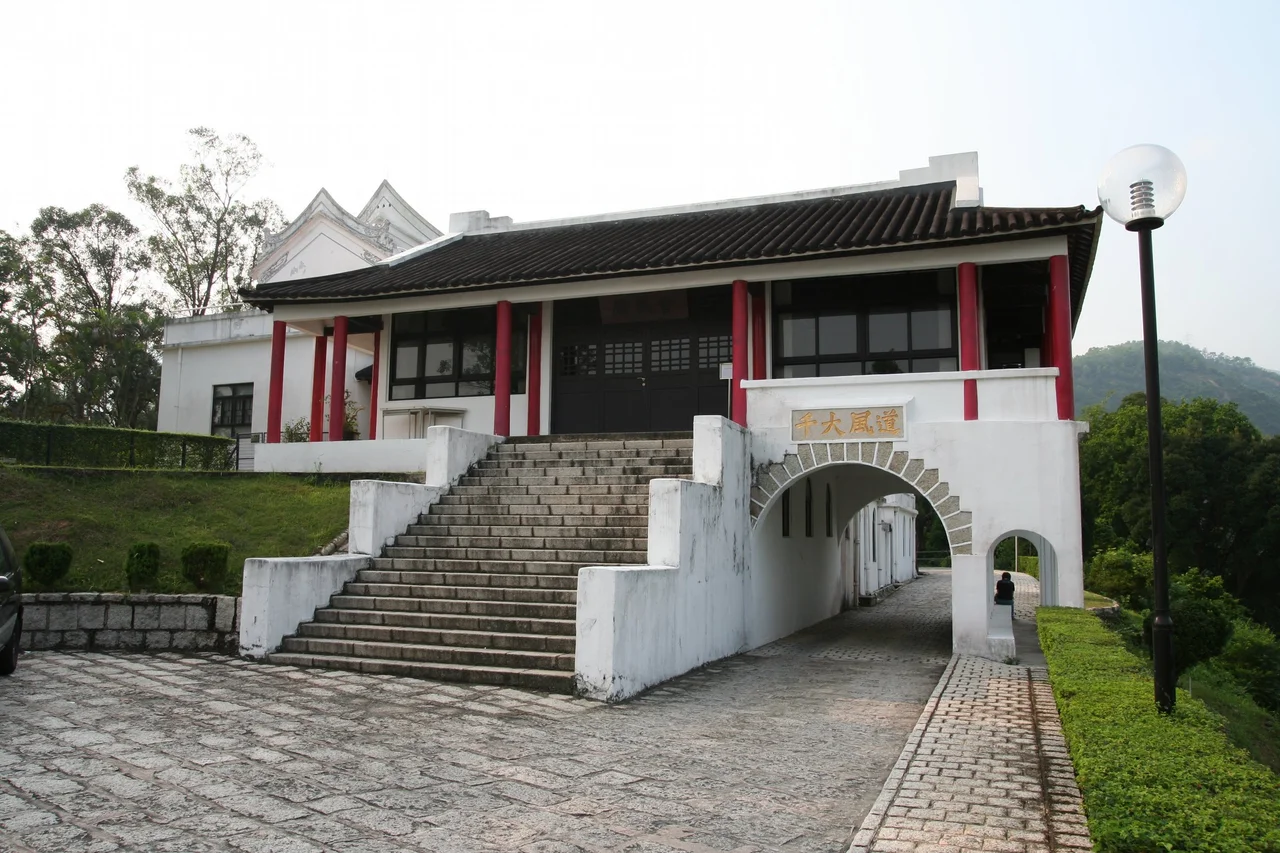

Tao Fong Shan
In 1904, a young Norwegian missionary named Karl Ludvig Reichelt arrived in Hunan province with a Bible and an unusual conviction: that the best way to share the Christian gospel with Chinese Buddhists was to learn their language, inhabit their symbols, and meet them on their own ground. He spent decades working out what that meant in practice. By the mid-1920s, he had established a centre in Nanjing. Then the Chinese Civil War came: Nationalist forces destroyed the Nanjing centre in 1927, and Nanjing was no place to rebuild. In 1930, Reichelt moved his work to a 130-metre hill above the market town of Sha Tin in Hong Kong's New Territories, engaged a Danish architect named Johannes Prip-Moller to design the buildings, and began again. The result is Tao Fong Shan: a Christian retreat centre built in the architectural idiom of a Buddhist monastery, looking out over a valley that was then farmland and is now one of the most densely populated areas in Hong Kong.
A Missionary's Unusual Idea
Reichelt's approach was unusual enough in his own time that it drew both admiration and suspicion. He believed that Buddhism and Christianity shared deep spiritual currents, and that a Chinese Buddhist encountering Christianity through its Western institutional forms would see only foreignness. What he wanted to build at Tao Fong Shan was a space where the encounter could happen differently — where a Buddhist monk or pilgrim might feel at home in the architecture, the atmosphere, and the rhythms of daily life, and only gradually encounter Christian teaching within that frame.
Prip-Moller's buildings embodied this idea. Tao Fong Shan's structures draw on the forms of southern Chinese Buddhist temple architecture: curved eaves, pavilions, courtyards, stone paths, a lotus pond. The Christ Temple — the octagonal chapel at the centre of the compound — borrows its form from Chinese sacred architecture while serving Christian worship. A 12-metre cross faces out toward Sha Tin, but even this landmark is set within a visual vocabulary more monastery than mission station. The result is distinctive enough that Hong Kong's government later classified the buildings as Grade II historic structures.
The Buildings That Remained
Reichelt died on 13 March 1952 and was buried in the cemetery on the hill where he had spent the last two decades of his life. His buildings outlasted him. The compound gradually expanded and evolved, though the core structures Prip-Moller designed still define the place. Extensive restoration took place between 2009 and 2011, funded partly through Hong Kong's government Financial Assistance for Maintenance Scheme, which brought the buildings back from the wear of decades without fundamentally changing their character.
The facilities today spread across the hillside. Pilgrim's Hall, patterned after the 'Cloud and Water Halls' found at Buddhist pilgrimage sites in mainland China, offers accommodation for up to 40 people in 18 double rooms — a detail that speaks directly to Reichelt's original intent: this was never just a place to visit, but a place to stay and be changed by. A dining hall and lounge can accommodate 100 people. The Conference Hall, built in traditional Chinese style, seats 60.
What the Summit Holds
The compound fills the hilltop without crowding it. A labyrinth sits next to a lotus pond, used for walking prayer and contemplation — another synthesis of Christian practice and Chinese garden tradition. The art shop and library occupy one of the main buildings, and the centre maintains an online shop. A shuttle bus runs a few times daily between the centre and Sha Tin for staff and guests.
The chapel — known as the Christ Temple — is an octagonal structure offering Sunday worship. Its geometry is unusual among Christian buildings, derived from the eight-sided forms that appear frequently in Chinese sacred architecture, from pagoda plans to temple pavilions. Whether or not visitors come for religious reasons, the building rewards attention. Its proportions are careful; its setting, on a hilltop with views across the Sha Tin valley, is deliberate.
The 12-metre cross is the most visible landmark from below, a white vertical form against the green hillside that visitors and commuters on the East Rail line can see from the valley floor. It serves as a gathering point for outdoor events and has become, whatever its theological meaning, a fixture of the Sha Tin skyline.
The Hill and the City Below
When Reichelt arrived at this hilltop in 1930, Sha Tin was a quiet market town in the agricultural New Territories, separated from Kowloon by hills and accessible mainly by the Kowloon-Canton Railway. The valley below held paddy fields and a tidal mudflat. What followed over the next few decades was one of the most dramatic urban transformations in the world: Sha Tin became a New Town, the mudflat was reclaimed, and what had been farmland became home to hundreds of thousands of people.
The hill changed less. Tao Fong Shan became a statutory foundation in February 2010 under the name Tao Fong Shan Service Foundation Limited, formalising its institutional status. The centre is open daily from 9:00 am to 5:00 pm. From the East Rail line's Sha Tin station, a hiking trail reaches the centre in about 20 minutes. From Tai Wai, a taxi costs approximately HK$25. The hill is not far. It is simply higher, quieter, and older than almost everything visible from its summit.
From the Air
Tao Fong Shan sits at approximately 22.3842°N, 114.182°E, rising 130 metres above the Sha Tin valley in the New Territories. From the air, look for the hilltop compound with its distinctive cross facing southwest toward the urban valley below. The 12-metre white cross is visible in clear conditions. Recommended viewing altitude is 1,500–3,000 feet to clear terrain safely, as Tao Fong Shan is surrounded by higher hills — Lion Rock (495 m) lies to the west and Tate's Cairn (583 m) to the northeast. Nearest airport is Hong Kong International (VHHH), approximately 30 km to the southwest. The East Rail line corridor and Sha Tin New Town are clearly visible below. Maintain situational awareness of terrain; the Sha Tin valley channels weather systems from the northeast.
Nearby Stories
- Chapel of St. Francis Xavier 3.5 km away
- Cuiheng 4.1 km away
- 2015 Shenzhen Landslide 16 km away
- Shunde 31 km away
- Wanshan Archipelago 37 km away
- Nanxiong Formation 96 km away
- Heyuan 149 km away
- Checheng Fu'an Temple 629 km away