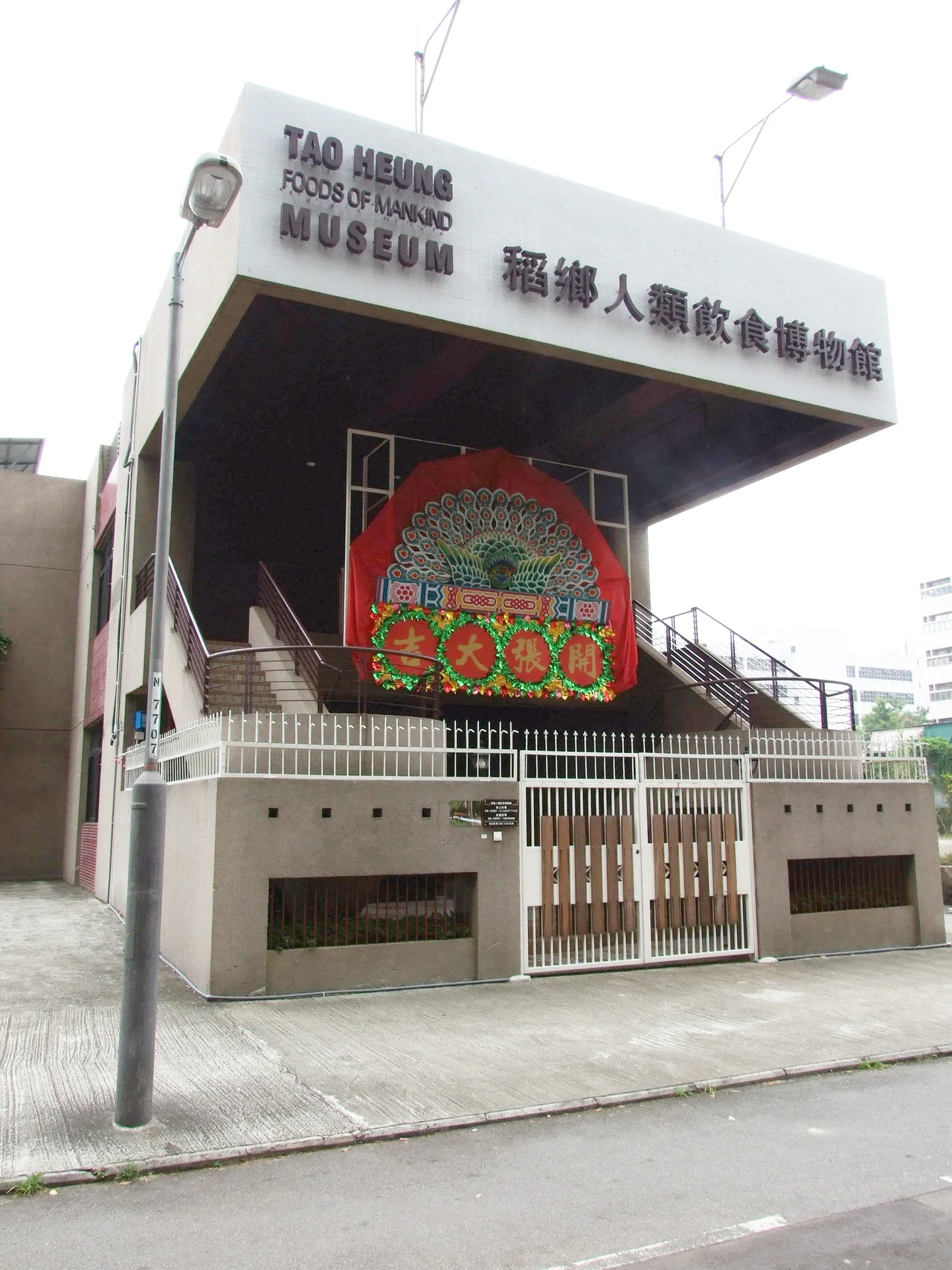

Tao Heung Foods of Mankind Museum
Most museums in Hong Kong are run and funded by the government. The Tao Heung Foods of Mankind Museum is not, and never has been. Since its founding it has operated independently, which partly explains both its idiosyncratic energy and its turbulent history: it closed in 2005, reopened later that same year, and eventually relocated from its original home in Fanling to the Sha Tin District neighbourhood of Fo Tan in 2008. What kept it going through closures and moves was the underlying premise, which turns out to be genuinely compelling once you sit with it: food is not just sustenance. It is culture, history, technology, trade, ritual, and memory — and almost no one has built a museum specifically around that idea in Hong Kong.
From Fanling to Fo Tan
The museum began in a two-floored building at 1 Lok Tin Street in On Lok Tsuen, Fanling, in Hong Kong's North District. Its founding mission was to trace the food cultures of different countries across time — from the earliest human use of fire for cooking through the development of agriculture, trade, and cuisine as cultural expression. The ambition was broad, the budget modest, and the enterprise cheerfully hands-on: visitors could handle most of the nearly 1,000 exhibits on display.
Financial pressure forced the museum to close in 2005. Its reopening on 15 October 2005 was followed by the move to Fo Tan in 2008. Fo Tan, in Sha Tin District, is a mixed industrial and residential neighbourhood that has become home to a cluster of artist studios and creative spaces — a somewhat fitting environment for an independent museum operating outside the mainstream cultural infrastructure of Hong Kong.
The Exhibits: Ancient Egypt to Spaghetti Machines
The original Fanling exhibition laid out human food history thematically across the ground floor: Egyptian, tea, coffee, and wine sections occupied the main hall. The Egyptian section examined the containers that ancient Egyptians used to carry water — a detail that grounds the global premise in a very specific material question. The tea, coffee, and wine sections gathered tools, vessels, and artefacts associated with each drink, tracing the cultural weight that beverages carry across different societies.
Three smaller exhibition rooms addressed particular moments in culinary history. A reconstructed French restaurant display detailed formal European table settings — the arrangement of knives, forks, spoons, plates, and cups, with explanations of their function at different courses. Another room reproduced the kitchen of a Chinese ethnic community. A third focused on the early human use of fire for cooking, the technological leap that changed human biology and social structure simultaneously.
The first floor ran workshops and group activities. A spaghetti-making machine, a sausage-making machine, and a cane juice machine allowed visitors to engage with food production directly. The chocolate-making workshop was among the more popular offerings. The museum's approach throughout was tactile rather than theoretical — a conviction that understanding food culture means working with it, not just reading about it.
Nearly 1,000 Things to Handle
The collection's character came from its range: herbs, food samples, cutlery, kitchen tools, stoves, and model kitchens from around the world, assembled into a single space where visitors were actively encouraged to touch things. This is rarer than it should be. Most museum objects are protected behind glass or mounted behind barriers, approached through signage. The Foods of Mankind Museum took the opposite position — that food culture is best understood through the hands, through the weight of a tool and the texture of a grain.
Nearly 1,000 exhibits is a significant number for a two-floor building, and the density was presumably part of the point. The goal was not to present a curated selection of highlights but to convey abundance — the sheer variety of ways that human beings across cultures and centuries have grown, processed, prepared, preserved, and eaten food. Covering all of human history through objects is an impossible task, but the attempt itself carries meaning.
Independent, Persistent, Specific
The museum's sponsor and current name-bearer, Tao Heung, is one of Hong Kong's larger restaurant groups — a company that built its reputation on Cantonese dim sum and Chinese banquet dining. The connection between a restaurant business and a food culture museum is not coincidental: Tao Heung's involvement represents a form of institutional support that allows the museum to exist outside both government funding and the pressures of pure commercial operation.
The museum's survival through closure, reopening, and relocation reflects something stubborn in its purpose. Hong Kong has world-class museums of art, history, space, and science. A museum dedicated specifically to the history and culture of what people eat occupies a different niche — one that engages with something universally human rather than geographically or disciplinarily specific. The fact that it is one of the few such institutions in the city is worth noting. Food defines culture. Someone should be keeping records.
From the Air
The Tao Heung Foods of Mankind Museum is located in Fo Tan, Sha Tin District, at approximately 22.3977°N, 114.198°E. The Fo Tan area sits in the eastern part of the Sha Tin valley, recognisable from the air by the mix of industrial buildings and the East Rail line running through the valley below. From altitude, the Sha Tin New Town is one of the most densely developed urban areas visible in the New Territories. Recommended viewing altitude is 2,000–4,000 feet for the Sha Tin valley context. Nearest airport is Hong Kong International (VHHH), approximately 28 km to the southwest. The East Rail line's Fo Tan station lies close by. Terrain rises quickly to the north and east, so maintain awareness of ridgelines when descending below 3,000 feet in this area.
Nearby Stories
- Chapel of St. Francis Xavier 3.5 km away
- Cuiheng 4.1 km away
- 2015 Shenzhen Landslide 16 km away
- Shunde 31 km away
- Wanshan Archipelago 37 km away
- Nanxiong Formation 96 km away
- Heyuan 149 km away
- Checheng Fu'an Temple 629 km away