
Tate Britain
Before the Tate, there was a prison. Millbank Penitentiary opened in 1816 as Britain's largest jail - a six-pointed star of brick covering eighteen acres on the marshy north bank of the Thames, where prisoners awaited transportation to Australia. They walked down the steps now called Convict Steps and were rowed out to ships moored in midstream. Cholera killed more inmates than the courts did. The prison was demolished in 1890. On the cleared site, in 1893, a sugar refiner named Henry Tate began funding a new building. He had made his fortune patenting the sugar cube. He had collected British paintings as a hobby. He wanted Britain to have a national gallery dedicated to its own artists. On 21 July 1897, the gallery opened as the National Gallery of British Art. From the start, everybody just called it the Tate.
Sugar, Stone, and a Domed Portico
Sidney R. J. Smith designed the front facade with a classical portico and a low dome behind it, a polite Beaux-Arts pile that does not pretend to be a Greek temple but cannot quite help itself. John Russell Pope - the American architect who later designed Washington's Jefferson Memorial and the National Gallery of Art - designed the central sculpture gallery. The construction firm was Higgs and Hill. The opening collection was small: Henry Tate's own gift of 65 paintings plus a few acquisitions. In 1932 the gallery formally changed its name to the Tate. Before 2000 it housed both British and international modern art, but the opening of Tate Modern in the converted Bankside power station that year split the collection. The Millbank gallery became Tate Britain. The Bankside one became Tate Modern. Together with Tate Liverpool and Tate St Ives they form the network of Tate galleries. A river bus, decorated with spots based on Damien Hirst paintings, ferries visitors between the two London sites along the Thames - lit by an artwork by Angela Bulloch.
Turner's Bequest
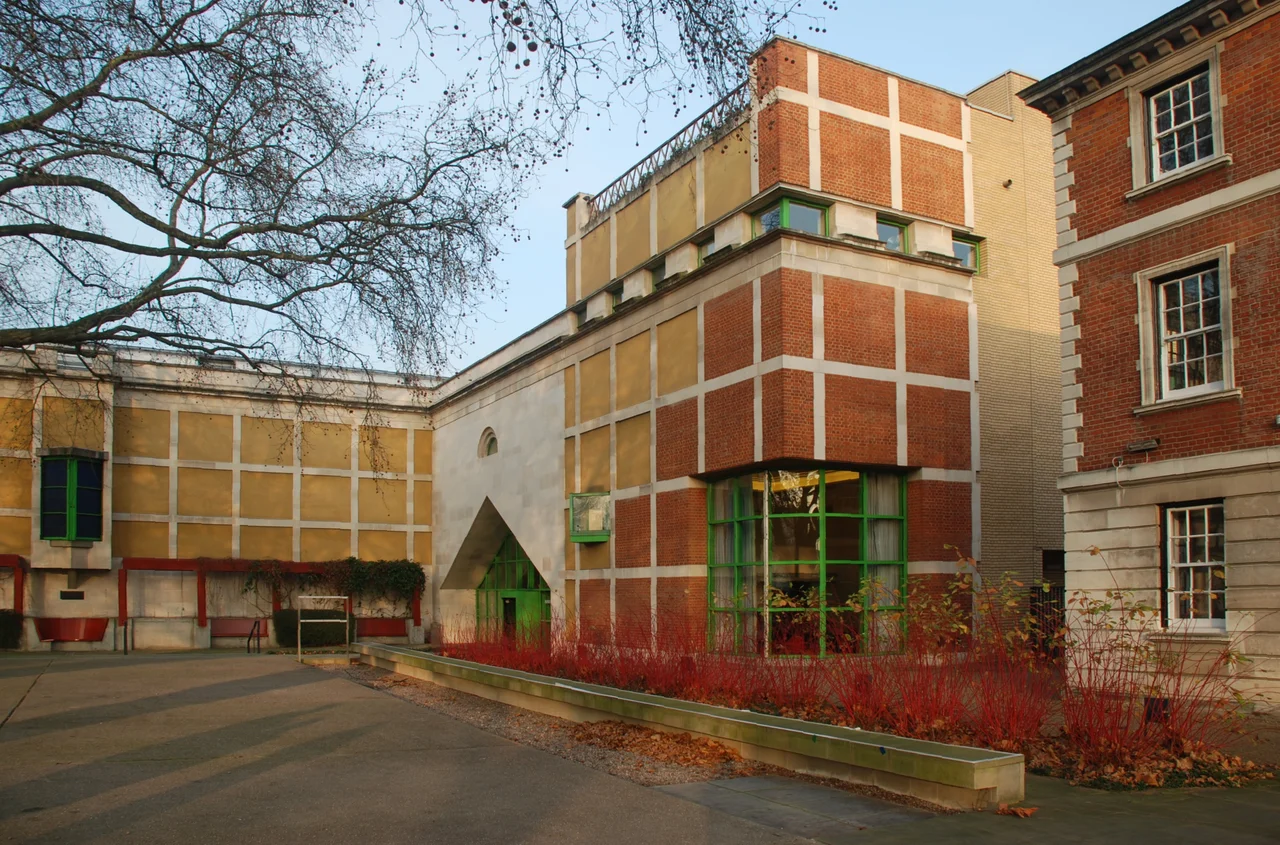
When J. M. W. Turner died in 1851 he left a will of extraordinary generosity and equally extraordinary vagueness. He wanted the nation to have all the work he still owned at his death - about 180 oil paintings, 19,000 drawings and watercolours, dozens of notebooks. The family contested it. The lawyers fought for years. Eventually, in 1856, the bequest was settled. The works became national property. They sat for over a century in various institutions until in 1987 the Clore Gallery opened at Tate Britain - a postmodern addition designed by James Stirling specifically to house the Turner bequest. The 6 million pounds for construction came from the Jewish philanthropist Charles Clore and his daughter Vivien Duffield; the British government added 1.8 million pounds. Stirling's design quotes the buildings around it deliberately - portico from one neighbour, brick from another - making the new wing a kind of architectural collage. Inside, late Turner watercolours of indeterminate sky and water hang at human scale. Norham Castle, Sunrise. The Golden Bough. Snow Storm: Steamboat off a Harbour's Mouth. Paintings that anticipated Impressionism by half a century, made by a man who tied himself to a ship's mast in a storm to see what wind looked like, are now reachable by tube on the Victoria line.
What's on the Walls
Tate Britain holds the most comprehensive collection of British art in the world. Only the Yale Center for British Art rivals it in breadth, and Yale cannot match the depth. Walk the rooms chronologically and you walk five centuries: the anonymous seventeenth-century Cholmondeley Ladies, twin sisters holding swaddled babies, painted by a hand whose name nobody now knows. Hogarth's Painter and his Pug, smug and self-aware. Gainsborough's Giovanna Baccelli. Constable's Flatford Mill. Millais's Ophelia, the model floating in a bath until she caught pneumonia. Rossetti's Ecce Ancilla Domini! and Beata Beatrix. Henry Wallis's Death of Chatterton, the young poet self-poisoned in a Holborn garret. Stanley Spencer's vast Resurrection, Cookham, parishioners climbing from graves in a Berkshire churchyard. Bacon's Three Studies for Figures at the Base of a Crucifixion, screaming under hot orange. David Hockney's swimming pools. Tracey Emin's bed - though that one is at Tate Modern now. The gallery rotates the collection constantly, dedicating entire rooms to single artists in sequence.
Floods, Bombs, and Boycotts
The gallery has had crises. In 1928 the Thames broke its banks and flooded the basement, damaging paintings. During the Second World War most of the collection was secretly evacuated - more than 700 artworks transported to Muncaster Castle in Cumbria on 24 August 1939, just before war was declared. A Stanley Spencer painting too large to move had a protective brick wall built in front of it. The Blitz damaged the building itself; the collection survived. In 2012 a 45 million pound renovation refreshed the galleries, funded by lottery money and Tate members. The Rex Whistler mural in the restaurant - The Expedition in Pursuit of Rare Meats, painted in 1927 - depicts the enslavement of Black children and stereotyped Chinese figures; protests over its racism led to the restaurant being closed indefinitely while the gallery considered what to do with it. BP sponsored Tate Britain for nearly three decades. Climate activists protested. In 2017 the relationship ended quietly. The annual Turner Prize exhibition - the most controversial contemporary art award in Britain - still takes place at Tate Britain in most years, picketed since 2000 by the Stuckists, an anti-conceptualist movement that despises everything the prize represents. The arguments are part of what the gallery does. The arguments are what makes it British.
From the Air
Located at 51.491°N, 0.1278°W on Millbank, City of Westminster, on the north bank of the Thames between Vauxhall Bridge and Lambeth Bridge. Recommended viewing altitude 2,000-2,500 feet. London City (EGLC) lies 6 nm east, Heathrow (EGLL) 13 nm west. The gallery is identifiable by its classical portico and low dome facing the river, with Millbank Tower's slim 1960s skyscraper as the immediate north-east landmark.
Nearby Stories
- Battle of Britain, Northfleet 1.1 km away
- Bayham Old Abbey 5.4 km away
- Catharine Macaulay 6.4 km away
- Hatfield rail crash 8.8 km away
- Chequers 8.9 km away
- Chelmsford Cathedral 10 km away
- Queen Victoria Hospital 13 km away
- Fishbourne Roman Palace 36 km away