.jpg)
Temple of Athena Alea
When the Temple of Athena Alea burned to the ground in 394 BC, Tegea did not simply rebuild it — they called in the greatest sculptor of the age. Skopas of Paros, whose marble figures were said to tremble with inner life, designed a new sanctuary so spectacular that the ancient travel writer Pausanias declared it the most beautiful temple in all the Peloponnese. Two and a half millennia later, the footprint of those columns still lies in the Arcadian plain outside the village of Alea, quiet now under a Greek sky that was once thick with the smoke of sacrificial fires.
A Goddess With Two Names
The deity worshipped here was a fusion, a theological seam where the pan-Greek Olympian Athena was stitched together with Alea, an older local goddess whose name and nature were already growing obscure by the classical period. By the time Pausanias visited in the second century AD, the original traditions of Alea had faded so thoroughly that the Tegeans had invented a founding hero, Aleus, son of Apheidas, to explain why the temple carried her name at all. Scholars now read this as a common pattern: when a local cult loses its independent memory, a genealogical hero is conjured to fill the gap.
The sanctuary's roots go back at least to the tenth century BC. Herodotus, writing in the fifth century, recorded that the temple already held iron chains — trophies from a Spartan attack on Tegea that failed. Those chains were said to be the very shackles the Spartans had brought to bind the Tegeans they expected to conquer. Instead the Tegeans hung them on the walls of Athena's house as a standing insult to Laconian ambition.
What Skopas Built
The second temple, the one Skopas raised after the fire, was extraordinary by any standard of antiquity. Doric columns formed the outer colonnade, Corinthian columns rose inside, and Ionic columns completed the interior arrangement — an unusual triple-order design that functioned as an architectural manifesto, declaring that this temple was not provincial but addressed the entire Greek world.
The sculptural program made the same argument in stone. On the east pediment, the Calydonian Boar Hunt played out in marble, a myth that belonged to Tegea through the Arcadian heroine Atalanta, who drew first blood. On the west, the local hero Telephos — son of Heracles and Auge, the first priestess of Athena Alea in mythological tradition — fought Achilles on the plain of the Caycus. By placing these particular battles on the outside of the building, the Tegeans were not just decorating a temple; they were making a political claim about their city's standing among the Greeks.
The ivory cult statue inside was the work of Endoeus, a sculptor active before Skopas's time. Augustus Caesar later removed it to adorn his Forum in Rome. He also took the boar's tusks. The hide of the Calydonian boar, Pausanias noted, was already decayed by the time Augustus came — but it had been there.
Sanctuary of Last Resort
Greek temples routinely served as places of asylum, but Athena Alea's sanctuary at Tegea acquired a particular reputation for sheltering the powerful. The names recorded there read like a catalog of the famous and the desperate. Chrysis, the Argive priestess who had accidentally burned the Temple of Hera at Argos, took refuge here. The Spartan king Leotychides fled here after a corruption scandal. Most strikingly, the Spartan general Pausanias — the same who commanded the Greek forces at Plataea and helped defeat Persia — eventually sought sanctuary here after falling out with his own city.
The temple also honored specifically female heroism. The shield of Marpessa, who rallied the women of Tegea to defend the city against the Spartans on at least one occasion, was displayed here. This defense gave rise to a cult of Ares Gynaecothoenas, a title meaning Ares honored by women, unique to Tegean territory. The priest of the temple, in a detail that surprises, was always a boy — a child who served only until he reached puberty.
Centuries of Excavation
The temple had the unusual fortune of being rediscovered by an art-minded traveler. In 1806, the Irish painter and author Edward Dodwell found the ruins by following Pausanias's text, the same guide that had been the only map of the ancient site for fifteen centuries. Formal excavation began in the 1870s under a German team whose findings appeared in the journal Mitteilungen des Archäologischen Institutes in Athen in 1880. The French followed in the early 1900s.
Given the temple's layered history, it was fitting that a later excavation should overturn an earlier interpretation. When Norwegian archaeologist Erik Østby took over site direction in the 1990s, he identified remains that French publications had classified as an Early Christian or Byzantine church. They were in fact the foundations of the earlier, pre-394 BC temple. Norwegian teams continued excavations through 2004, mapping the sanctuary's full chronological depth and revealing a site occupied continuously from the Early Iron Age through the Hellenistic period.
What Remains in the Plain
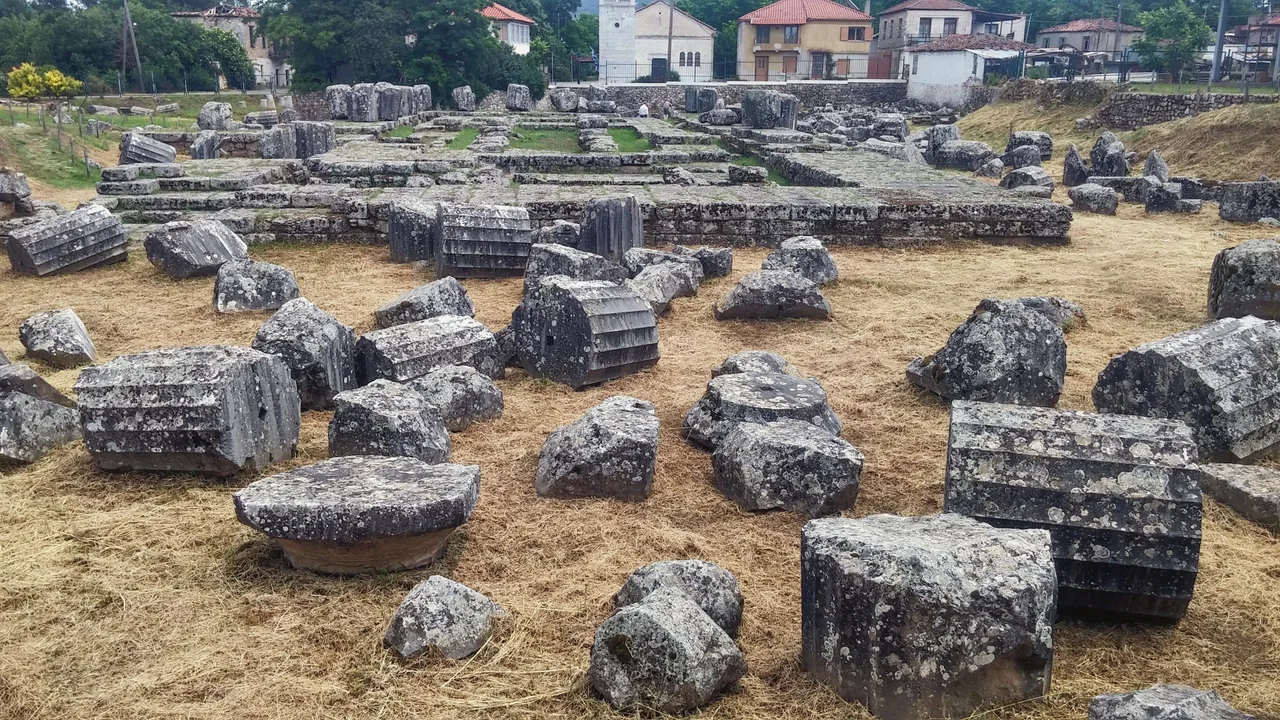
The village of Alea sits among olive groves and low farmland roughly ten kilometers southeast of modern Tripoli. The temple's footprint is visible — stone drums, scattered column bases, the outlines of walls — in a landscape that has changed far less than the civilization that built it. The Archaeological Museum in Tripoli holds finds from the Tegea excavations, including sculpture fragments that preserve something of the intense, almost anguished expression that ancient critics associated with Skopas's style.
That style — passionate, straining, distinctly un-serene — was recognized in antiquity as a departure from the calm idealism of earlier Greek sculpture. Skopas worked at Tegea, at Halikarnassos, at Samothrace. That the most celebrated of his documented temple commissions is here, in the Arcadian plateau, is one of the quieter surprises of Greek art history. The plain outside Alea holds the site of what was, by ancient testimony, the finest temple in the Peloponnese.
From the Air
The temple site lies at 37.4555°N, 22.4204°E on the Arcadian plateau, roughly 650 meters above sea level, approximately 10 km southeast of Tripoli. From the air, the broad Tripoli basin is easily identified — the flat agricultural plain stretching across central Arcadia. The scattered ruins of Tegea are visible near the village of Alea as low stone outlines in the farmland. Nearest major airport is LGKL (Kalamata International Airport), approximately 85 km to the southwest. Flying northeast from Kalamata at 5,000–7,000 feet, the Mainalo mountain range to the west and Mount Parnon to the east frame the open basin where the temple stands.
Nearby Stories
- Araklovon Castle 4.8 km away
- Pellana 6.6 km away
- Arkadiko Bridge 10 km away
- Siege of Corinth (1463) 11 km away
- Leonidio 11 km away
- Kyparissia 11 km away
- Pheneus 14 km away
- Santameri Castle 29 km away