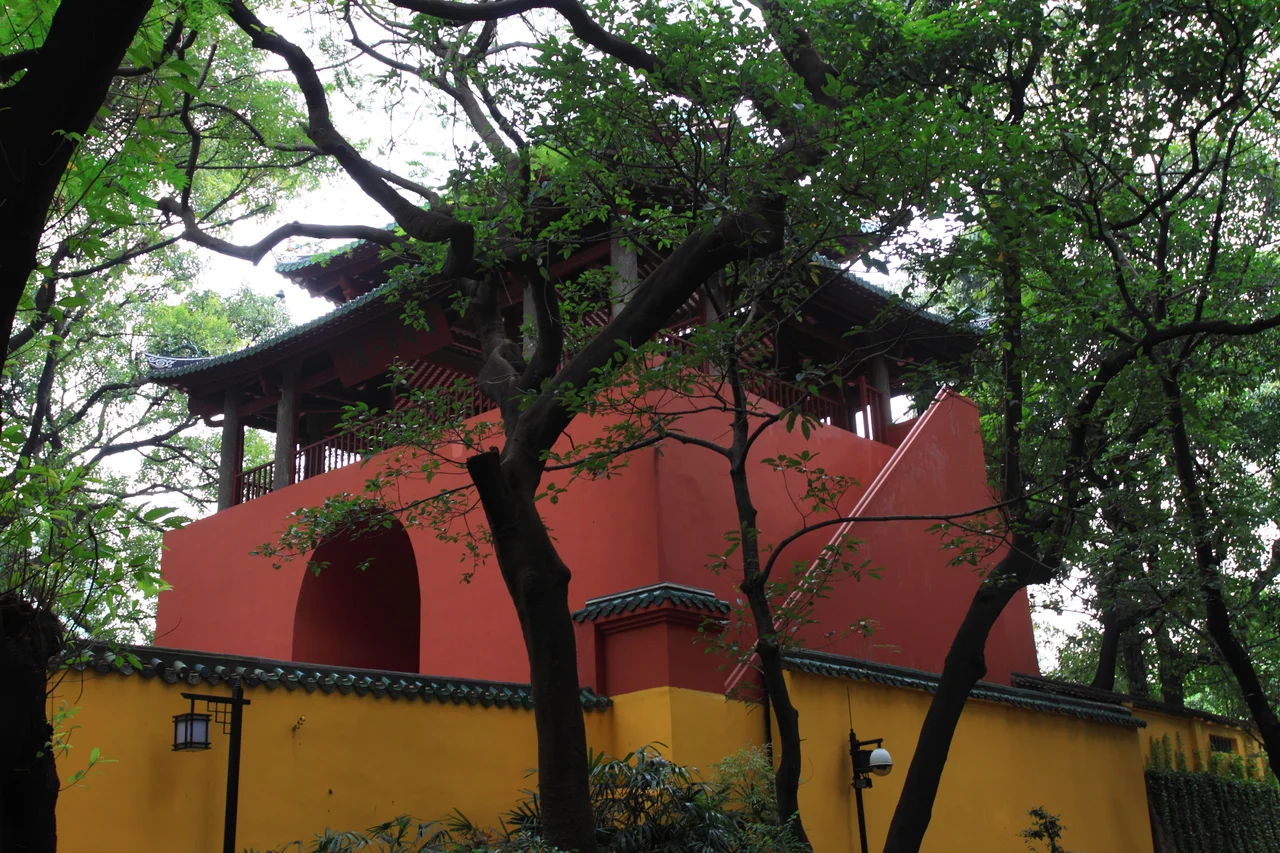

Temple of the Five Immortals (Guangzhou)
The bell weighs five tons and stands three meters tall. It was installed in 1378. And it has never once been rung. Shortly after the bell went up, plague swept through Guangzhou. The city decided the bell was cursed. The "Forbidden Bell" has sat in its tower ever since, silent through Ming and Qing dynasties, through wars and revolutions, through the industrialization of a city that now surrounds it with twenty-first-century towers. That silence is the most vivid thing about the Temple of the Five Immortals — a place whose whole existence rests on a story of celestial abundance, yet which is defined, for those who visit, by an object that cannot be touched.
The Goats, the Grain, and the City's Beginning
The story goes like this: five immortals descended on five rams, each animal carrying a stalk of grain in its mouth. They delivered the grain to the people of Guangzhou — a gift of food security and prosperity — and then ascended back to the heavens, leaving only their rams behind, which turned to stone. This founding legend is the reason Guangzhou has been called the City of Rams and the City of Five Rams. The temple commemorates that descent. Its present statues depict the immortals as three men and two women, all seated astride their rams, and a pond to the east of the main hall holds a large foot-shaped depression pressed into red sandstone — said to be the mark left by one of the immortals. Whether that depression is natural or carved, it has been venerated for centuries as tangible proof of a divine visit.
Built, Burned, and Built Again
The original temple stood on Great Market Street and burned down in 1368, the same year the Ming dynasty replaced the Yuan. A replacement was raised in 1377, in the tenth year of the Hongwu era. The main hall was dedicated to the five immortals, and the enormous bell was installed the following year. The Ming-era bell tower still stands today, and the main hall before it remains in the Ming architectural style — wide eaves, heavy beams, proportions that recall an era when Guangzhou was a walled imperial city. Behind the main hall, stylized Ming-era sculptures occupy a rear courtyard. Centuries-old guardian lions flank the entrance. A back room holds something unexpected: a large 1907 map of Guangzhou that shows a city still substantially rural, most of its current urban density not yet imagined.
Sold, Seized, and Repurposed
By 1923, the temple grounds covered 4,600 square meters. That year, Sun Yat-sen ordered seven local temples — this one among them — to be auctioned to raise revenue for the Nationalist war effort against the Beiyang government in the north. The temple was purchased by a local club, which removed the Taoist priests who had maintained it. The municipal government gave the site special protection, which likely saved it from being demolished outright; instead it was converted into a school. This story — religious site sold under political pressure, repurposed, protected only by bureaucratic designation — repeated itself across China many times in the twentieth century. When China's opening-up policy brought restoration funding in the 1980s, the temple was renovated. But it does not operate as a Taoist temple today. The priests are gone, replaced by visitors and the accumulated silence of a bell that has been waiting, for over six hundred years, for someone to decide the bad luck has run its course.
The Ritual of the Lions
In the nineteenth century, the stone guardian lions at the temple's entrance were visited by women hoping to conceive sons. The practice involved touching or otherwise venerating the lions. That form of popular prayer has faded, but the lions remain at the gate, worn by generations of hands. The temple grounds today are quiet by Guangzhou standards — a small refuge from the commercial noise of Yuexiu District. Visitors come for the Ming architecture, the legendary footprint in red sandstone, and inevitably for the bell tower, where the massive Forbidden Bell hangs in its frame looking entirely capable of producing sound. It does not. The whole place feels like it is waiting — not with dread, but with the particular patience of somewhere that has been set aside by the modern world and found that arrangement perfectly acceptable.
From the Air
The Temple of the Five Immortals sits at approximately 23.123°N, 113.255°E in Guangzhou's Yuexiu District, about 29 kilometers southeast of Guangzhou Baiyun International Airport (ZGGG). The temple grounds are modest in scale and not visible as an isolated structure from altitude, but the surrounding historic district of Yuexiu is identifiable by its lower-rise fabric amid the city's high-rise clusters. Best viewed at 2,000 feet or below in clear conditions. The Pearl River lies approximately 1.5 kilometers to the south.
Nearby Stories
- Shunde 12 km away
- 2015 Shenzhen Landslide 15 km away
- Mount Luofu 23 km away
- Qingyuan Maglev Tourist Line 32 km away
- Kaiping 56 km away
- Heyuan 90 km away
- Chikan, Kaiping 92 km away
- Erlitou Site Museum of the Xia Capital 1257 km away