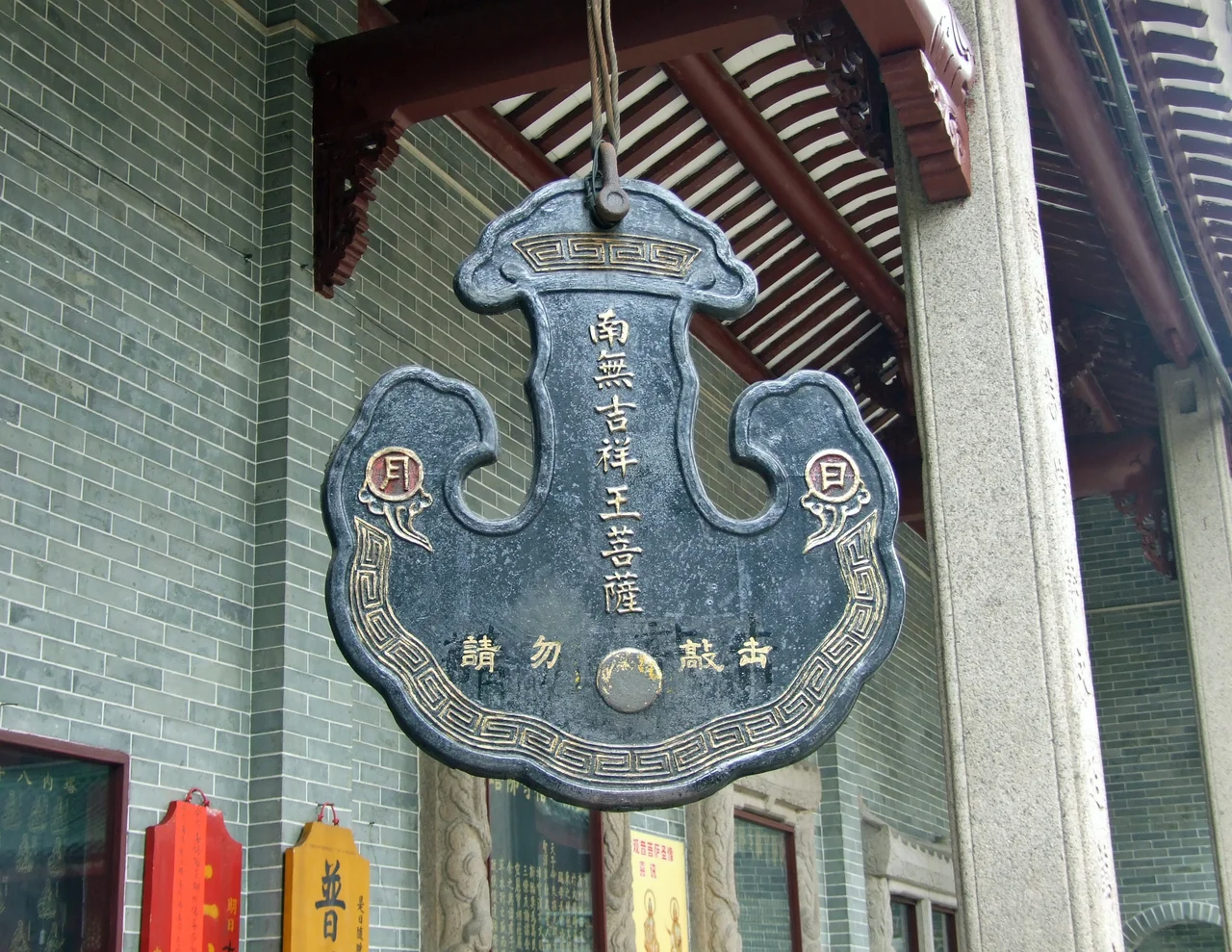

Temple of the Six Banyan Trees
Su Shi was one of the greatest poets of the Song dynasty. When he visited a temple in Guangzhou, he looked around the courtyard, saw six banyan trees, and wrote a poem. He called it "Six Banyans" — Liu Rong in Chinese. The temple, which had been known by other names for over five centuries, took his poem as its new identity. It has been the Temple of the Six Banyan Trees ever since — named not for its founders, not for a deity, not for a historical event, but for a poet who was moved by the specific sight of six trees in a specific courtyard sometime in the eleventh century. The trees are long gone. The name remains.
Relics from the Edge of the Known World
The temple's origin story reaches across the width of Asia. In AD 537, during the Liang dynasty, Emperor Wu ordered a monk named Tanyu to construct a place of worship in what was then called Panyu — the settlement that would eventually become Guangzhou. The purpose was specific: the new temple would house Buddhist relics brought from Cambodia, sacred objects that had traveled along the maritime trade routes connecting southern China to the kingdoms of Southeast Asia. The original name was Baozhuangyan Temple. From the beginning, this was a place of international religious exchange, not a local shrine but a node in the Buddhist world's broader geography. The monk built it, the relics arrived, and the temple became part of the spiritual life of a city that was already, in the sixth century, deeply connected to the wider world.
Fire and the Flower Pagoda
The temple burned down during the Northern Song dynasty. This was not unusual for wooden structures in Chinese cities; fire was a constant threat and reconstruction was expected. The Song-era rebuilding produced what became the temple's most recognizable feature: the Flower Pagoda, constructed in 1097 and named for the colorful painted designs that covered its exterior. Where a previous structure had stood on a square base, the new pagoda was built with an octagonal plan — a design choice that distributed the height across multiple faces and produced the distinctive silhouette that has defined the Guangzhou skyline in its neighborhood ever since. The pagoda rose to what historians record as 57 meters. Another fire struck in the early Ming dynasty, and the pagoda was rebuilt again in 1373. A restoration followed in 1900. What stands today is essentially the 1373 structure, maintained through successive centuries of repair.
A Place That Keeps Its Purpose
Buddhist temples in China have fared differently across the turbulence of the twentieth century. Some were destroyed during the Cultural Revolution. Others were converted to warehouses or factories. The Temple of the Six Banyan Trees has continued operating as a functioning Buddhist institution — monks pray here, incense burns at the altars, and the statue of Guanyin, the bodhisattva of compassion, receives visitors regularly. The temple's location near foreign consulates in Guangzhou made it a particular gathering point for families completing international adoptions of children from China. Many families came to receive blessings for their newly adopted children in front of Guanyin before leaving the country. That practice quietly turned one of the city's oldest temples into a place of personal ceremony for thousands of families from around the world.
Living Beyond Its Poet
Su Shi, whose poem gave this temple its name, was a figure of extraordinary range: poet, painter, calligrapher, statesman, and gastronome whose influence on Chinese culture extends well past the Song dynasty. He wrote "Six Banyans" without any expectation that it would become a permanent name for anything. Temples were named by emperors and high officials, not by poets passing through a courtyard. Yet the name took hold and never let go. Today the Flower Pagoda is a protected historical structure, the temple grounds are a working religious site, and visitors arrive from across China and the world to see a building that has been burned three times, rebuilt three times, and renamed once by a man who noticed some trees. At the entrance, the air smells of sandalwood. The pagoda's octagonal silhouette rises above the surrounding neighborhood. The banyans are gone but the name they inspired endures.
From the Air
The Temple of the Six Banyan Trees sits at approximately 23.131°N, 113.255°E in Guangzhou's Yuexiu District, roughly 29 kilometers southeast of Guangzhou Baiyun International Airport (ZGGG). The Flower Pagoda, at approximately 57 meters tall, is the most identifiable structure from low altitude — look for the octagonal tower profile among the low-rise buildings of the historic district. Best observed at 1,500–2,500 feet in clear conditions. The Pearl River lies about 1.5 kilometers to the south-southwest.
Nearby Stories
- Shunde 12 km away
- 2015 Shenzhen Landslide 15 km away
- Mount Luofu 23 km away
- Qingyuan Maglev Tourist Line 32 km away
- Kaiping 56 km away
- Heyuan 90 km away
- Chikan, Kaiping 92 km away
- Erlitou Site Museum of the Xia Capital 1257 km away