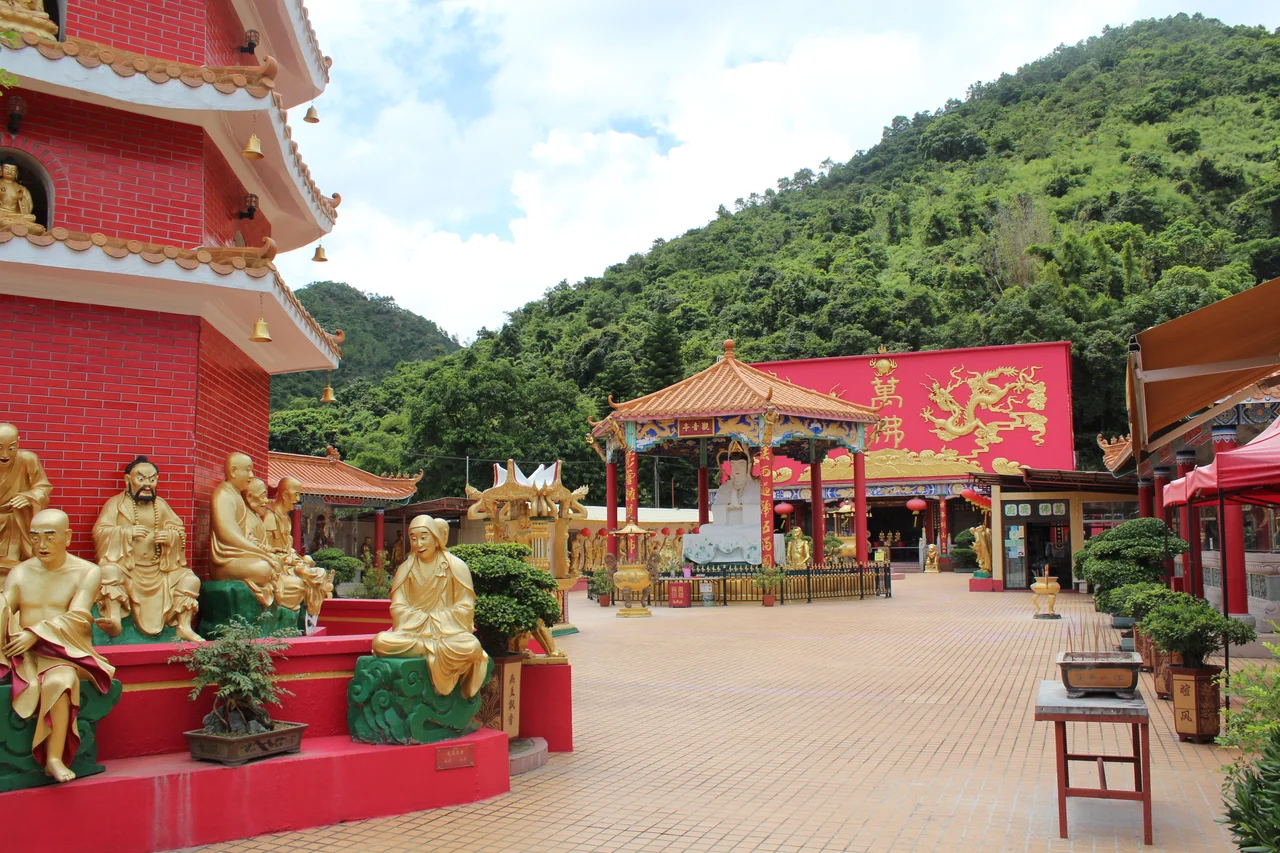

Ten Thousand Buddhas Monastery
Count them if you like. It will take a while — the Ten Thousand Buddhas Monastery (萬佛寺) contains not ten thousand but nearly thirteen thousand Buddha statues, each one unique, each one golden, lining the steep 431-step stairway that climbs the hillside above Sha Tin. The name was always more aspiration than arithmetic, a number chosen to suggest abundance beyond counting. And yet the figures are countable, produced by artists from Yunnan and Guangdong provinces, modeled on arhats — the Buddhist saints who have achieved enlightenment — at a temple in Kunming, the hometown of the man who built this place.
The Man Who Built It Brick by Brick
The Venerable Yuet Kai arrived in Hong Kong from mainland China in 1938, already in his fifties, with the intention of spreading Buddhist teachings. He would wait more than a decade before his ambitions took physical form. In 1949, the owner of a local tobacco company purchased a hillside site in Pai Tau Village — previously home to a temple to Kwun Yam where a nun had been killed during the Japanese occupation — and donated it to Yuet Kai for the purpose of establishing a Buddhist college. That college never materialized. A monastery rose instead.
Yuet Kai and his followers broke ground that same year. Construction took eight years, the monk reportedly carrying supplies up from the base of the hill himself. The complex opened in 1957. Yuet Kai died in 1965, eight years after seeing his life's work completed. His followers wrote that his body was found incorruptible eight months after his death, preserved by the lotus position in which he was buried. Today, gilded, his intact form is displayed in the main hall — the founder who became part of the collection.
The Stairway as Spectacle
Most visitors encounter the monastery not as a destination but as an ascent. The path up from Sha Tin is lined on both sides by golden arhat statues, each frozen in a different posture — laughing, meditating, gesturing, scowling. No two are alike. The figures crowd close to the narrow path, their expressions ranging from serene to grotesque, and the effect is less solemn than theatrical: you climb through a gallery of personalities, each one a different face of enlightenment.
The monastery itself is listed as a Grade III historic building by the Hong Kong Government. Its main temple and pagoda are the landmarks that anchors the complex on the hillside. Admission has always been free, a point of principle for the lay community that manages the site — the monastery never established a resident monk population and is run entirely by laypersons, another irony folded into its misleading name.
Mudslide and Recovery
In July 1997, four days of rainfall equivalent to nearly half Hong Kong's average annual total of 2.25 metres struck the hillside. The resulting mudslide buried the house of Ma Shuk-fong, the 73-year-old caretaker who had assumed her position exactly a year before. A helicopter carrying a small excavator was deployed, but the narrow path and unstable mud made rescue nearly impossible. Ma's body was recovered four days later. A coroner ruled her death accidental but pushed for stricter slope maintenance laws.
The Civil Engineering Department's subsequent investigation found the upkeep of the hillside inadequate. The monastery closed for three years while repairs were carried out in stages, each phase costing more than HK$1.5 million — covered entirely by public donations. The entire complex did not reopen until 31 July 2000. The closure tested the community's attachment to the place, and the donations that funded the repairs confirmed it.
Where Film Began with a Prayer
In 2002, the monastery provided the opening scene of Infernal Affairs, the Hong Kong crime thriller that would later be remade in Hollywood as The Departed. In that scene, triad boss Hon Sam — played by Eric Tsang, himself a devout Buddhist — prays before a statue of the Buddha. His young followers gather around him, toast their loyalty, then disperse with orders to infiltrate the Hong Kong Police Force as undercover moles. It is a scene about devotion and its perversions, and the monastery's thousands of watching faces make the perfect backdrop: earnest, numerous, impossible to read.
The choice of location was not incidental. The monastery sits at an intersection of the sacred and the everyday that defines much of Hong Kong's religious life — open to anyone, managed by lay volunteers, free to enter, perpetually busy. That quality, as much as its visual drama, made it the right place to open a film about double lives.
From the Air
The Ten Thousand Buddhas Monastery sits at approximately 22.3875°N, 114.1847°E on the hillside above Sha Tin in the New Territories, at an elevation of roughly 220 metres. Flying into Hong Kong International Airport (VHHH) from the northeast, Sha Tin's dense residential towers and the Shing Mun River channel are visible below. The monastery's pagoda is a small but distinct vertical element on the forested hillside above the town. Recommended viewing altitude is 3,000–5,000 feet. The nearest navigational landmark from the air is Sha Tin Racecourse to the south. ICAO: VHHH is 27 km to the southwest.
Nearby Stories
- Chapel of St. Francis Xavier 3.5 km away
- Cuiheng 4.1 km away
- 2015 Shenzhen Landslide 16 km away
- Shunde 31 km away
- Wanshan Archipelago 37 km away
- Nanxiong Formation 96 km away
- Heyuan 149 km away
- Checheng Fu'an Temple 629 km away