_(2013).jpg)
Tent House, Mount Isa
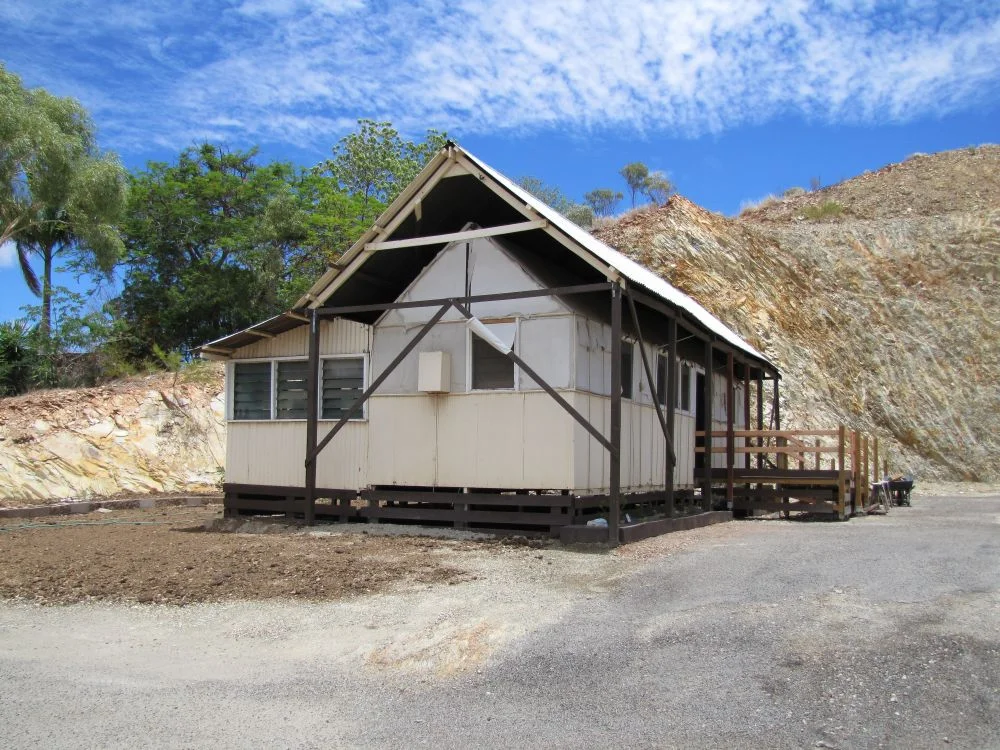
Pitch a tent in the Mount Isa summer and you will not last the night; the canvas turns the heat in like an oven. The early miners knew it, and they invented a fix that was equal parts ingenuity and desperation. They built a second roof over the tent, a frame of timber and corrugated iron raised about a meter above the canvas, with iron sheets standing off the fabric walls. The gap between let the air move, the metal threw off the worst of the sun, and the result was a dwelling that could be lived in through a North West Queensland summer. They called it a tent house. One of them still stands, the last of its kind, a humble survivor of the makeshift town that grew up around the richest lodes in Australia.
Hundreds of Tents in the Dust
When Miles found his ore, Mount Isa was nothing, perhaps 300 people living in dwellings of iron, canvas, and timber. Then the rush came. The population swelled from 1926 to 1930, and by 1929 hundreds of tents sprawled between the township and the mine, housing the railway gangs and construction crews who were racing to build a city from scratch. The housing shortage was acute and the climate merciless. The tent house was the practical answer: a long, narrow tent sheltered beneath a separate iron-clad roof, with board or ripple-iron cladding around the base to keep out the dust and the worst of the weather. It was never meant to be permanent. It was meant to keep a worker alive until something better could be built.
The Company's Calculated Kindness
The man behind the planned settlement on the other side of the hill was Leslie Urquhart, the Russian-experienced industrialist whose Russo-Asiatic Consolidated company took control of the mine in June 1927. Urquhart had learned in Russia that in a place this harsh, with a reputation for industrial unrest, looking after workers was not charity but sound investment. His company town was approached through a valley guarded by a gatekeeper, and by mid-1929 it offered cottages, dormitories, staff houses, even reticulated water and septic systems. It was called an 'interesting experiment,' because providing such accommodation was not the norm in 1929. But the company houses could not be built fast enough, and so the tent houses filled the gap for the men left waiting.
The House That Outlived Its Purpose
By 1937 this particular tent house stood at 16 Fourth Avenue, registered to Alfred Mills, a miner who worked for Mount Isa Mines from 1930 to 1953. A government description from that year is bracingly plain: a three-roomed house, walls of galvanized iron, partitions of iron and wood, a floor of boards and earth. As the city grew up and proper homes replaced canvas, the tent houses vanished one by one. By 1967 this was among the last, and the decision was made to keep it as a museum piece. The only other survivor was demolished in 1991. In 2013 the National Trust gifted this final example to the Mount Isa Underground Hospital and Museum Inc., which moved it to the Underground Hospital site, where it could be better protected and more easily visited. It had already been added to the Queensland Heritage Register in 1992 on the strength of its rarity.
A Link Worth Keeping
The tent house survives for a reason that has nothing to do with grandeur. It is plain, small, and was always temporary, the kind of structure that history usually erases without a second thought. But the people of Mount Isa wanted to hold onto a physical link to the hard early days, when their parents and grandparents made homes out of canvas and iron and sheer stubbornness in the spinifex. Stand inside it and you feel the genius of that double roof, the small pocket of moving air that made the unbearable bearable. It is a monument not to wealth but to endurance, to the ordinary people who built a city in one of the hottest, most remote corners of the continent.
From the Air
Tent House now sits at the Underground Hospital and Museum site in Mount Isa, near 20.73 degrees south, 139.49 degrees east (its original location was 16 Fourth Avenue, Parkside). It is a small structure best appreciated on the ground rather than from the air, but the city itself is easy to locate: look for the 270-meter lead smelter stack on the western bank of the Leichhardt River, visible up to 40 km out, with the museum precinct in the residential townside east of the river. Recommended overflight at 4,000 to 6,000 feet for context of the city against red-earth ranges. Mount Isa Airport (ICAO YBMA) is immediately northeast. Dry-season visibility is excellent; expect summer haze and heat shimmer.
Nearby Stories
- Mary Kathleen, Queensland 16 km away
- Quamby 38 km away
- Mount Cuthbert Township and Smelter 71 km away
- Kuridala Township site 73 km away
- Moonah Creek Hanging Tree 82 km away
- Camooweal Caves National Park 82 km away
- Community Hall, Camooweal 113 km away
- Glenormiston Station 222 km away