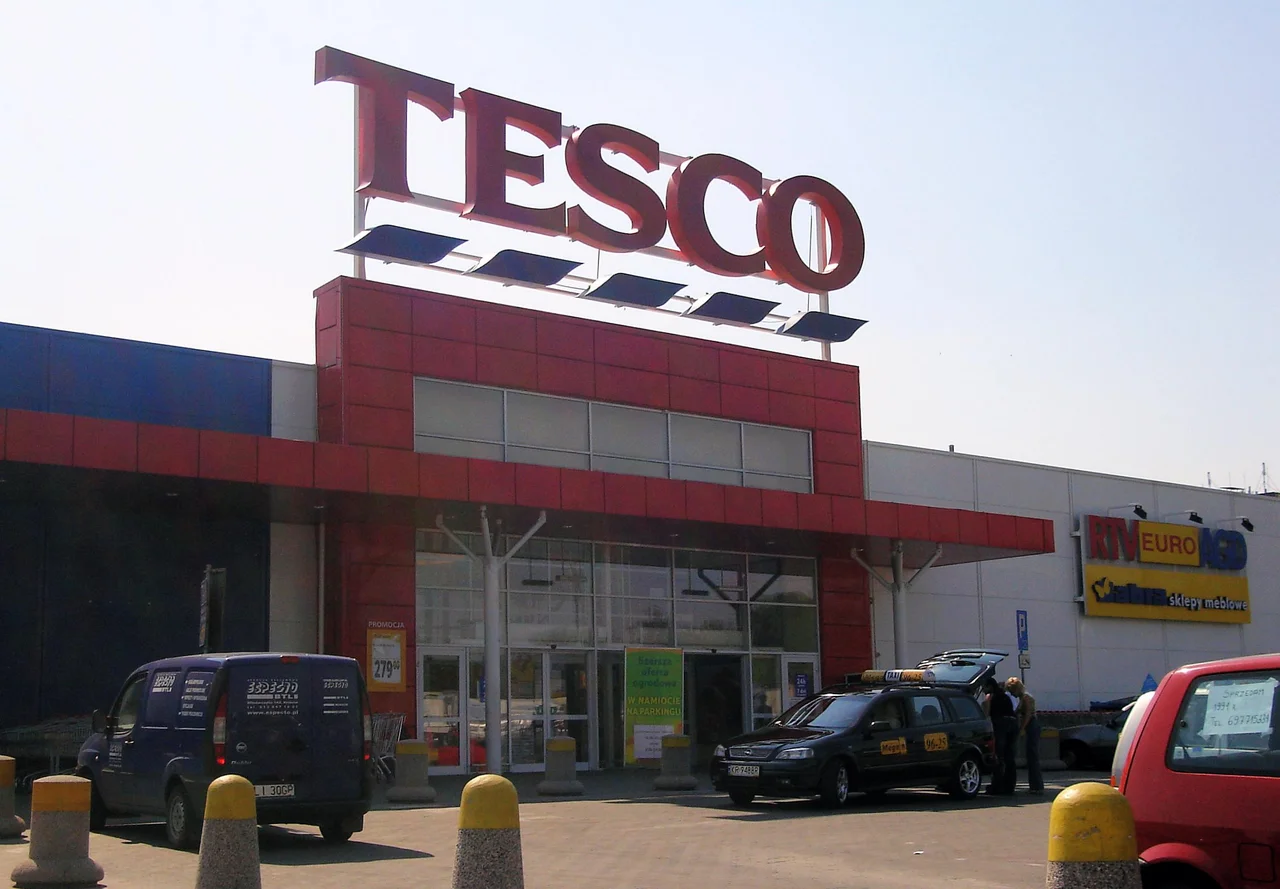

Tesco
The name is a portmanteau, not a Hebrew word. In 1924 a young East End trader called Jack Cohen bought a shipment of tea from a wholesaler named Thomas Edward Stockwell. To label his new own-brand product he took the first three letters of the supplier's name, TES, stuck the first two letters of his own surname on the end, CO, and printed the word on the packets: TESCO. The shop that would later own four-fifths of the British supermarket sector and operate stores from Slovakia to Mumbai began as a stall at Well Street Market in Hackney, run by the son of Polish-Jewish immigrants who had to make a living after a world war.
Pile It High
Jack Cohen opened his first proper indoor shop in November 1930, at Tooting in south London. The first Tesco-branded shop followed in September 1931, at 54 Watling Avenue in Burnt Oak, Edgware. His business motto, repeated to anyone who would listen, was "pile it high and sell it cheap." His internal motto, repeated to his staff with rather more force, was "YCDBSOYA: You Can't Do Business Sitting On Your Arse." The Cohen approach worked. Tesco floated on the London Stock Exchange in 1947. Through the 1950s and 1960s it grew by buying up the small chains that had survived the war: 70 Williamson's shops in 1957, 200 Harrow Stores in 1959, 212 Irwins in 1960, Victor Value in 1968. By the time Cohen retired the brand was a fixture of British high streets, with a distinctive blue-and-red logo and the cheerful, slightly downmarket atmosphere of the kind of shop you could shout in.
Welwyn Garden City
Tesco's head office sits in Welwyn Garden City, in a low complex of offices on the eastern edge of the town, surrounded by trees and parking. Welwyn was the second of Ebenezer Howard's garden cities, founded in 1920 after Letchworth twelve miles north. Tesco moved its headquarters there in the 1970s and has stayed despite repeated rumours of relocation. The location is significant because it places the company in the dense south-Hertfordshire economic belt that also hosts GlaxoSmithKline in Stevenage, Roche UK in Welwyn, and a string of pharmaceutical and electronics firms strung along the A1(M). In 2017 Tesco confirmed a major restructuring that would cut over 1,200 jobs, more than a quarter of them in Welwyn Garden City and Hatfield. The town has been growing around the company and the company has been shrinking back into it ever since.
Clubcard
In February 1995, Tesco launched a small loyalty programme it called the Clubcard. The idea was unfashionable; supermarkets had played with loyalty schemes before, with limited success. Tesco's version was different in a single critical way. The data collected on what customers bought, where they bought it, and how often they came back was actually used. Within two years the company had overtaken Sainsbury's to become the UK's largest grocer, a position it has never lost. Inside Tesco the saying was that the Clubcard had let the company "see what Sainsbury's was doing" before Sainsbury's knew itself. The Wall Street Journal credited the same data for blunting Walmart's attempts to compete in the UK market. Today the Clubcard programme has around 22 million members and the database it has built is one of the most valuable pieces of consumer intelligence in the country.
Empire and Retreat
By the 2000s Tesco had taken the supermarket model abroad: Hungary in 1994, Poland and the Czech Republic in 1995, Ireland in 1997, Thailand in 1998, Taiwan in 2000, Malaysia in 2002, Japan in 2003, China in 2004. In 2007 it opened Fresh & Easy in the American Southwest, a chain of small-format grocery shops in California, Arizona, and Nevada. The American venture lost roughly £1.2 billion. Tesco pulled out in 2013. Japan, Taiwan, China, Thailand, Malaysia, and Poland followed; over the next decade Tesco quietly retreated to a smaller international footprint: the UK, Ireland, the Czech Republic, Hungary, and Slovakia. The story everyone told inside the industry was that Tesco had grown faster than its ability to understand local markets, and the small-format Fresh & Easy concept, in particular, had been built for British shopping habits that simply did not translate to America.
The 2014 Accounting Scandal
In October 2014, Tesco announced that it had overstated its profits by £250 million. Eight executives were suspended. The number was later revised upwards to £263 million after an investigation by Deloitte. The mechanism was a familiar one in supermarkets: rebates from suppliers had been booked earlier than they should have been, creating the illusion of better margins than actually existed. The company's stock market value fell by £2.2 billion in a single day. The Serious Fraud Office opened a criminal investigation. Three executives were eventually charged with fraud and false accounting; all three were cleared between 2018 and 2019. Tesco itself agreed to pay a fine and compensation. The episode reshaped the company. A new CEO, Dave Lewis, took over and spent the next several years cutting costs, selling overseas operations, and trying to rebuild trust with both suppliers and customers.
One Pound in Ten
Today Tesco operates around 4,000 stores in the UK in five formats: Tesco Extra hypermarkets (some over 185,000 square feet), Tesco Superstores, Tesco Express convenience shops, the smaller One Stop brand, and large-format urban fulfillment centres for online delivery. Its market share of UK groceries hovers around 28 per cent. In broader retail terms, Tesco accounts for roughly one pound in every ten spent in British shops, which, depending on your politics, is either the inevitable result of a free market or a sign that British retail has become uncomfortably concentrated. Jack Cohen died in 1979. He never quite let go of the company; he ran it as chairman until 1970, then handed it to his son-in-law Hyman Kreitman, then watched it grow into something he could not have imagined from his Well Street stall. The shop's name still spells out the wholesale tea order that started it all.
From the Air
Tesco's headquarters are at Tesco House on Shire Park, Welwyn Garden City, England, at approximately 51.8073°N, 0.1948°W, about 22 miles north of central London. The complex sits east of the A1(M) motorway in a business park surrounded by green belt land. Recommended viewing altitude is 2,000 to 4,000 feet for clear sight of the headquarters set against the planned street layout of Welwyn Garden City (the second of Ebenezer Howard's garden cities, founded 1920). The original Jack Cohen market stall site at Well Street, Hackney, lies 21 miles south at approximately 51.5474°N, 0.0466°W. Nearest airports: Luton (EGGW) 11 miles northwest, Stansted (EGSS) 22 miles east, Heathrow (EGLL) 26 miles southwest, London City (EGLC) 23 miles southeast for the Hackney origin site. The Welwyn complex is within reach of Old Warden (EGTH) 21 miles north for general aviation.
Nearby Stories
- The Albert Memorial: A Nation's Grief Cast in Gold 0.2 km away
- Milton Keynes 4.4 km away
- Pleshey Castle 5.9 km away
- Chequers 6.1 km away
- Gravesend Blockhouse 6.8 km away
- Catharine Macaulay 8.9 km away
- Clare Priory 17 km away
- Fowlmere Airfield 17 km away