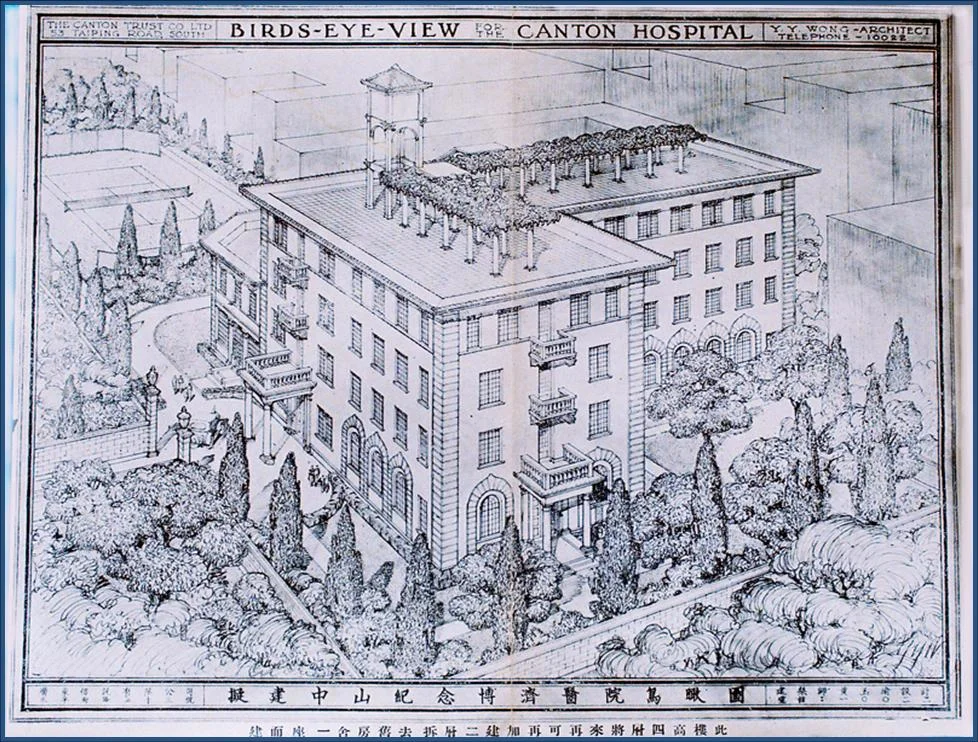

The Canton Hospital
Peter Parker came to China to save souls. He arrived in Canton in 1834 with a Yale degree in theology and medicine, a missionary appointment, and a conviction that Chinese people needed to be rescued from what he considered idolatry. He planned to preach. What happened instead is that he opened an eye clinic, treated over a thousand patients in his first three months, and found, to what seems to have been his own considerable surprise, that medicine brought him more joy than evangelism. Canton — now Guangzhou — was the only city in all of China where foreigners were permitted to live and work. That geographic accident made it the only possible location for what Peter Parker built on November 4, 1835: the first Western-style hospital in China.
Why Canton, and Why Eyes
The Canton System, enforced by the Qing dynasty, confined foreign traders and missionaries to the southwestern corner of Guangzhou, near the Pearl River. Foreigners could not enter the walled city. They could not travel inland. They operated in a carefully controlled enclave surrounded by walls, regulations, and the ever-present authority of the imperial customs superintendent, known as the Hoppo. Within those constraints, Parker identified the fastest path to Chinese trust: eye disease. Ocular illness was widespread in Canton at the time, and Western medicine had measurably better outcomes for conditions like cataracts and infections than available local treatments. Of the 1,061 patients treated in the hospital's first three months, 96.1 percent had eye conditions. Parker had been told that healing eyes would open doors. He found that it did. Within a year, 2,910 patients had come through.
From Eye Infirmary to General Hospital
Success in ophthalmology brought pressure to expand. Patients began arriving with tumors — Parker performed surgery on them, with what the records describe as nearly uniformly successful outcomes — and then with illnesses of every kind. By the end of its first decade, the Canton Hospital was a general medical institution treating the full range of what a nineteenth-century urban population suffered. Parker could not keep up alone. He trained three young Chinese men as medical assistants alongside his colleague Dr. E.C. Bridgman, which was Western-style medical education in China before a formal curriculum existed. The first proper Western medical school in China, the Boji Medical School, opened within the hospital in 1866. It survived the revolutions and reorganizations of the twentieth century and is now part of Sun Yat-sen University of Medical Sciences. Parker also depended financially on local merchants, particularly the prominent Hong merchant Howqua, because he charged patients nothing. The hospital's Chinese name, Pok Tsai, means Universal Helpfulness — a name that described both its reach and its financial model.
The Opium War and the Interrupted Hospital
In 1840, the First Opium War broke out between Britain and China. The port of Canton was blockaded. Every foreigner was ordered to leave. The hospital closed. Parker evacuated, and the institution that had treated thousands of patients simply stopped — caught in the geopolitics of a conflict driven by trade in a substance that was destroying the communities his patients came from. The irony was not small: Parker had built trust through healing while the larger Western commercial presence in Canton was built on selling opium. When the 1842 Treaty of Nanking ended the war and forced China to open its ports and borders to foreigners, Parker returned to Canton with his wife Harriet Webster, who became the first Western woman granted residence in China. The hospital reopened. It remained under the Medical Missionary Society until 1930, when it became part of Lingnan University.
The Student Who Changed Everything
Among the hospital's patients and eventual students was a young man from Guangdong named Sun Yat-sen. He studied there in the 1880s, taking the medical training that the hospital and its affiliated school provided. The source article identifies Sun Yat-sen as the hospital's most distinguished student — a man who went on to lead the revolution that ended imperial China and became the first provisional president of the Republic of China. The medical education he received in Canton shaped his understanding of reform, pragmatism, and the relationship between knowledge and power. Beyond Sun Yat-sen, the hospital's legacy includes the 1838 founding of the Medical Missionary Society in China, the production of China's first medical journal, and the first X-ray film taken in China. In 1898, Parker's successor John Glasgow Kerr founded the Asylum for the Insane in Canton — the first institution in China dedicated to mental health care. Today the institution continues as the Second Affiliated Hospital of Sun Yat-sen University, a tertiary referral center and still one of China's most prominent ophthalmic institutes.
From the Air
The Canton Hospital's historic site sits at approximately 23.112°N, 113.251°E in central Guangzhou, about 30 kilometers southeast of Guangzhou Baiyun International Airport (ZGGG). The area corresponds to the dense urban core near the Pearl River's northern bank, close to the former location of the Thirteen Factories trading district. Best observed at 1,500–2,500 feet on a clear day. The Pearl River is visible roughly 1 kilometer to the south.
Nearby Stories
- Shunde 12 km away
- 2015 Shenzhen Landslide 15 km away
- Mount Luofu 23 km away
- Qingyuan Maglev Tourist Line 32 km away
- Kaiping 56 km away
- Heyuan 90 km away
- Chikan, Kaiping 92 km away
- Erlitou Site Museum of the Xia Capital 1257 km away