
The Eagle, Cambridge
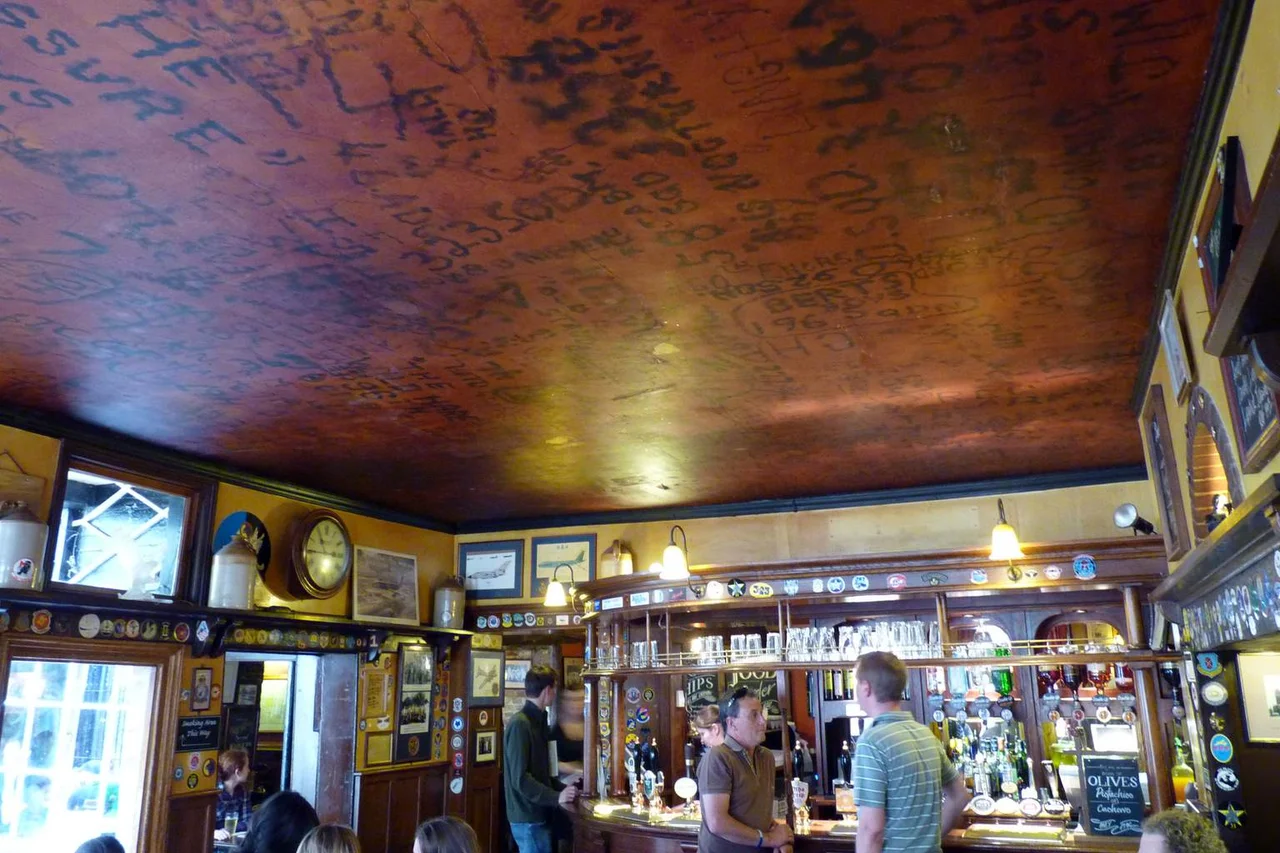
On 28 February 1953, two scientists walked into a Cambridge pub for lunch and Francis Crick announced, loud enough for the regulars to overhear, that he and James Watson had 'discovered the secret of life.' The pub was the Eagle on Bene't Street. The boast was, on this rare occasion, justified - they had just worked out the double-helix structure of DNA. A blue plaque beside the door commemorates the moment. Inside, at the table in the middle room where the two regularly took lunch, a second plaque marks the spot. The pub has been around since 1667 as a coaching inn, and on most days the press of tourists outnumbers the press of physicists, but the ceiling in the back bar still carries graffiti that predates the discovery and once nearly upstaged it.
Coaching Inn, 1667
The Eagle - originally the Eagle and Child - is a Grade II listed public house and the second oldest pub in Cambridge, after the Pickerel Inn on Magdalene Street. The street front on Bene't Street dates from around 1600, with a galleried 19th-century wing tucked behind, facing a small courtyard. For more than three and a half centuries the building has done what English pubs do: served students and shopkeepers, weathered fashions in food and beer, and absorbed the small dramas of everyday life. The galleried courtyard is one of the last surviving examples of its kind in Cambridge, a reminder of when coaches stopped here and travellers slept upstairs.
Names on the Ceiling
During the Second World War the back room became known as the RAF Bar. American and British airmen stationed nearby - the East Anglian airfields were thick with bombers and fighters - drank here on leave, and a tradition emerged: climb on a chair, take a lighter or a lipstick or a Zippo, and burn or write your squadron number and name on the low ceiling. Hundreds of names accumulated. After the war the ceiling was preserved deliberately, and it is still there - black candle-smoke letters and numbers crowding the plaster, a kind of overhead memorial to the airmen who passed through. Many of those signatures belong to men who did not survive their next mission. You order a drink, look up, and read.
The Secret of Life, Over Lunch
James Watson and Francis Crick worked at the nearby Cavendish Laboratory, and they ate at the Eagle often enough that the staff knew their table. On 28 February 1953 they walked in and Crick made his now-famous announcement. The anecdote is told in Watson's book The Double Helix and is the reason the pub today serves a special ale called Eagle's DNA. Also in 1953, at the same table, Watson and Crick drew up a list of the 20 canonical amino acids over lunch - one of the founding documents of molecular biology, sketched out on whatever napkin or scrap was to hand while the pints arrived. Science can happen in a laboratory. It can also happen between bites of a ploughman's.
Franklin, Wilkins, and the Plaque
The first blue plaque went up on the exterior wall in 2003. It named only Watson and Crick. From 2017 onwards, visitors began adding Rosalind Franklin's name in graffiti to the plaque - a public correction of the historical record, since Franklin's X-ray crystallography images had been crucial to the breakthrough. The graffiti was removed; it kept reappearing. In 2023 the plaque was finally replaced with a new one that names Franklin and Maurice Wilkins alongside Watson and Crick. The original plaque is now preserved in the Whipple Museum of the History of Science on Free School Lane, a few minutes' walk away - a small artefact of how scientific credit is given, taken, and eventually corrected by a public that refused to forget.
From the Air
Coordinates 52.20 N, 0.12 E, in the centre of Cambridge on Bene't Street, opposite Corpus Christi College and a short walk from King's College Chapel. Cambridge sits on the flat East Anglian fenland. From the air, the city is identifiable by the medieval college quadrangles and the green ribbon of the Backs along the River Cam. Cambridge Airport (EGSC) is on the eastern edge of the city, about 2 nautical miles from the pub. London Stansted (EGSS) lies 25 nm south. The pub itself is not visible from cruising altitude - this is a destination for ground exploration.
Nearby Stories
- Kentwell Hall 2.5 km away
- Thetford Hoard 2.8 km away
- King's Ely 6 km away
- Bedford 7.8 km away
- White House Farm murders 13 km away
- Oundle 14 km away
- Hemel Hempstead 14 km away
- North Weald Airfield 15 km away