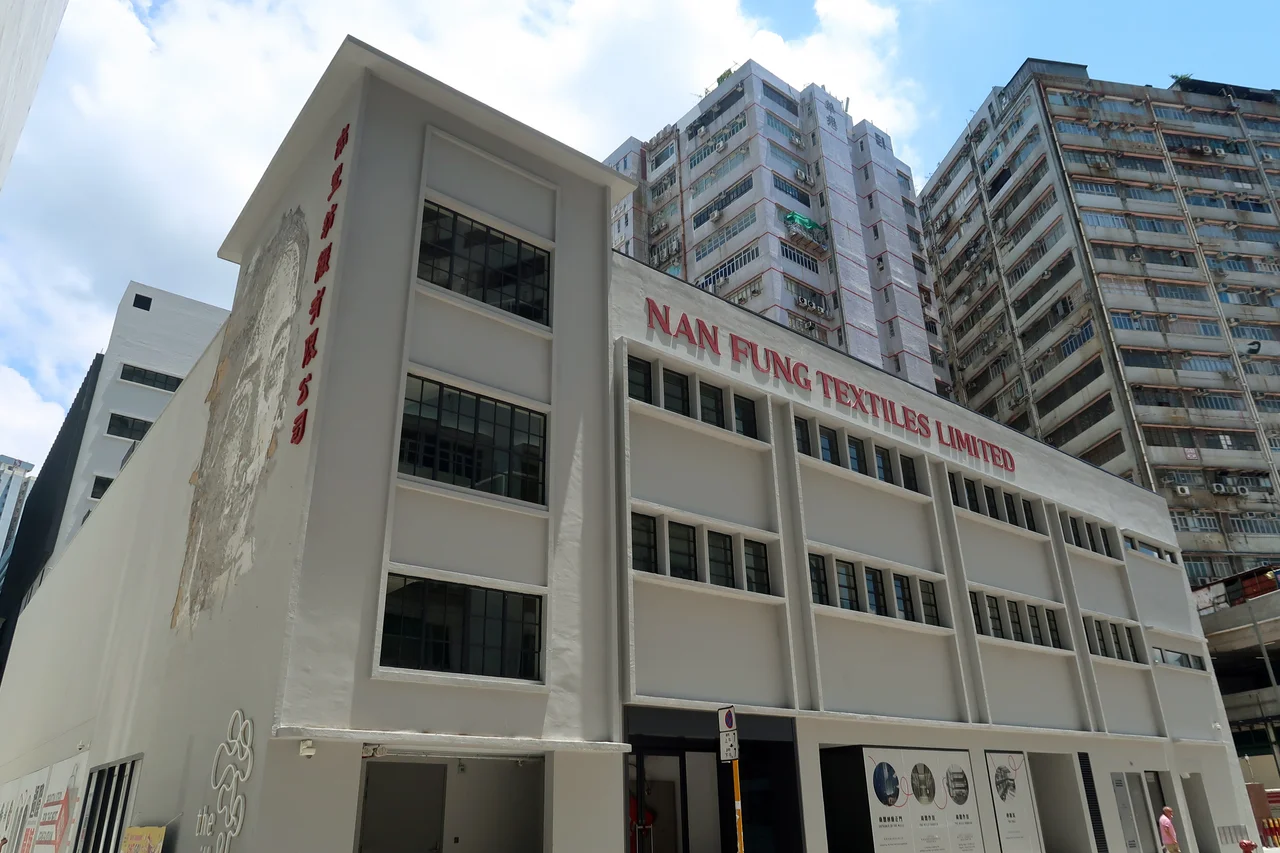

The Mills, Hong Kong
At its peak, the Nan Fung Cotton Mills in Tsuen Wan produced 30 million pounds of cotton yarn per year. The workers ran three shifts — eight hours each, around the clock — and when labor disputes broke out in July 1959 over whether the factory could sustain that pace, it was a sign that the engines were running hard. Chen Din Hwa, the Shanghai-born entrepreneur who founded it in 1954 and whom the industry called the "King of Cotton Yarn," had built the largest textile operation in Hong Kong. Now the looms are silent, the yarn is gone, and the place calls itself The Mills. But it has not tried to pretend the past away.
How a Cotton Empire Was Built
Chen Din Hwa founded Nan Fung Cotton Mills on Pak Tin Par Street in Tsuen Wan's industrial district in 1954 as part of his broader Nan Fung Group. Two years later the factory began production, turning out four hundred bales of cotton yarn per month. It grew quickly — too quickly, in the sense that labor shortages followed almost immediately. In the 1960s, the company expanded across six adjacent units, with Units 6, 4, and 5 completed in 1961, 1962, and 1970 respectively.
During Hong Kong's manufacturing peak, Nan Fung was a defining presence. But the economics of Asian industrialization shifted underneath it. By the late 1980s, Taiwan and Southeast Asian countries were competing on cost, Mainland China was opening its economy, and Hong Kong's labor and land costs were rising. The manufacturing sector's share of the territory's GDP fell below 20 percent by 1989. Units 1 through 3 were eventually demolished — not for reasons of preservation, but because a fire scene was filmed there for the 1997 Hong Kong film Lifeline, and the site became the private residential estate Summit Terrace. Units 4 through 6 ceased operation in 2008 and sat as warehouses.
Preserving the Stains
When Nan Fung Group began revitalization work in 2014, they made a specific choice: keep the evidence. The walls retained their green oil stains. The old-style iron-frame windows were reproduced using the same materials and craftsmanship as the originals. Structural reinforcements were added, glass curtain walls went in, and skylights now pour light through the atrium of Unit 6 — but the bones of the factory remained visible, not hidden behind new surfaces.
The project opened on December 6, 2018 as The Mills, a mixed-use complex incorporating co-working space, retail, restaurants, and the Centre for Heritage, Arts and Textile (CHAT) — Hong Kong's first textile culture and art center, housed on the second floor of Unit 6. Renowned engraver Wu Ding Keung created signage templates for the building, and the bright red "Tai Ping Buckets" once used for fire rescue were repurposed as decorative elements. Old wooden door panels became part of the signage. The factory that made textiles now hosts exhibitions about them.
Art on the Rooftop, Dolphins in the Archive
The revitalization did not stop at the walls. The rooftop of Unit 6 became Cotton Mill Park, home to "Traces of Weaving" — a large-scale art piece approximately 4 by 23 metres created by Lam Tung Pang and COLLECTIVE, tracing the story of fabric in a place that once produced it by the millions of pounds. Unit 4's rooftop was transformed into Cotton Mill Farmland. The private alley between Units 5 and 6 was widened into a public square called Pak Tin Par.
The building earned a LEED Gold Certification for energy and environmental design, a 2015 Hong Kong Institute of Planners Annual Award, and the MIPIM Asia Awards 2018 Bronze Award for Best Renovated Building. In May 2019, a 7,000-square-foot nature-themed family park called The Big Things opened on the second floor. A free shuttle minibus — its livery bearing the Mills name — runs every 20 minutes to and from MTR Tsuen Wan Station, announcing its route with signs reading "Come over, see things, buy things, eat things."
The Question the Building Asks
Hong Kong's manufacturing era lasted roughly from the 1950s to the late 1980s — about 35 years of cotton, electronics, and garments, before finance and services replaced them. The Mills sits at the edge of that memory, asking what it means to adapt a space without erasing what it was.
The answer the building gives is not purely nostalgic. The co-working space called Nan Fung Studios Lab, operated by the Hong Kong Research Institute of Textiles and Apparel, conducts prototype production experiments — meaning textile innovation still happens in the building, just at a different scale and with different tools. The Annex provides meeting rooms with movable soundproof walls. Restaurants occupy the ground floor. The white checkered brick wall near the restroom has become, improbably, a popular spot for photography. A factory that built Hong Kong's industrial identity is now a place where that identity is examined, celebrated, and occasionally photographed.
From the Air
The Mills sits at approximately 22.3751°N, 114.1102°E in Tsuen Wan, on the western edge of urban Kowloon. Flying into Hong Kong International Airport (VHHH) from the east, Tsuen Wan's industrial and residential skyline is visible to the right as aircraft track southwest over the New Territories. The factory buildings of Pak Tin Par Street are low-rise against the taller residential towers behind them. Recommended viewing altitude is 3,000–5,000 feet. Tsuen Wan sits roughly 12 km northeast of VHHH. The Tuen Ma line tracks visible from the air connect Tsuen Wan to the broader MTR network. ICAO: VHHH.
Nearby Stories
- Chapel of St. Francis Xavier 3.5 km away
- Cuiheng 4.1 km away
- 2015 Shenzhen Landslide 16 km away
- Shunde 31 km away
- Wanshan Archipelago 37 km away
- Nanxiong Formation 96 km away
- Heyuan 149 km away
- Checheng Fu'an Temple 629 km away