
The National Museum of Computing
When the war ended in 1945, Winston Churchill ordered that all ten Colossus machines at Bletchley Park be broken into pieces no larger than a man's hand. The drawings were burned. The people who had built and operated them - the world's first programmable electronic computers - were told never to speak of what they had done. They did not speak, for thirty years. So when in 1993 a former MI5 scientist named Tony Sale started trying to rebuild a Colossus from scratch, he had to work from a handful of partial photographs, the memories of a few aging engineers, and engineering instinct. It took him fourteen years. The result, in Block H at Bletchley Park - the first purpose-built computer centre in the world - is now the heart of The National Museum of Computing.
Block H
Block H was constructed in 1944 to house the production-line Colossus machines. It is therefore the oldest building in the world purpose-built for the operation of computers. By the late 1980s, with Bletchley Park abandoned and sliding into dereliction, the entire site was at risk of redevelopment. The Bletchley Park Trust formed in 1992 and saved the estate. Tony Sale joined the Trust as secretary and first curator of the museum. When in 2004 Block H itself came under threat of demolition, Sale and colleagues secured Grade II listed status for it. The Colossus rebuild already underway inside got a permanent home, and the building that housed six of the original ten wartime Colossi was preserved. The National Museum of Computing was established as a separate charity in 2007 and now occupies Block H and several neighbouring buildings on the Bletchley Park campus.
The Colossus Rebuild
Sale began in 1993 with eight black-and-white wartime photographs and a few sketches that had survived destruction. He gathered surplus thermionic valves from Britain's old telephone exchanges, hand-wound transformers, and rebuilt the entire panel of one hundred and ninety programming switches. By June 1996 he had a prototype that the Duke of Kent formally switched on, with Tommy Flowers - the Post Office engineer who built the original wartime Colossi - standing beside him. The full Colossus Mark 2 rebuild was completed in 2007. It weighs five tonnes. It contains 2,420 valves. It reads paper tape at 5,000 characters per second. Visitors can watch it run, the loop of punched tape clattering through the reader, the racks of valves glowing orange, the whole machine humming in the way that early computers physically hummed - not metaphorically but with a sound you feel in your chest.
The Witch
In another gallery sits the world's oldest original working digital computer. Its real name is the Harwell Dekatron, but it has been called the WITCH since 1957 - Wolverhampton Instrument for Teaching Computation from Harwell. It first ran in 1951 at the Atomic Energy Research Establishment at Harwell, where it was designed to take over from teams of bright young graduates doing tedious calculations with mechanical desk machines. The WITCH used 828 Dekatron storage tubes, glowing valves you can see through the front panel, and was deliberately slow but reliable: it once ran unattended for ten consecutive days over the Christmas and New Year holiday of 1954. When it was first pitched against a human mathematician for comparison, the human kept up for thirty minutes before retiring exhausted. The WITCH went to Wolverhampton in 1957 to teach computing students; ended up in storage at Birmingham City Council; was rediscovered by a museum volunteer in 2009; and was restored to working order at Bletchley by 2012, in public view, on the museum floor.
The Bombe Reborn
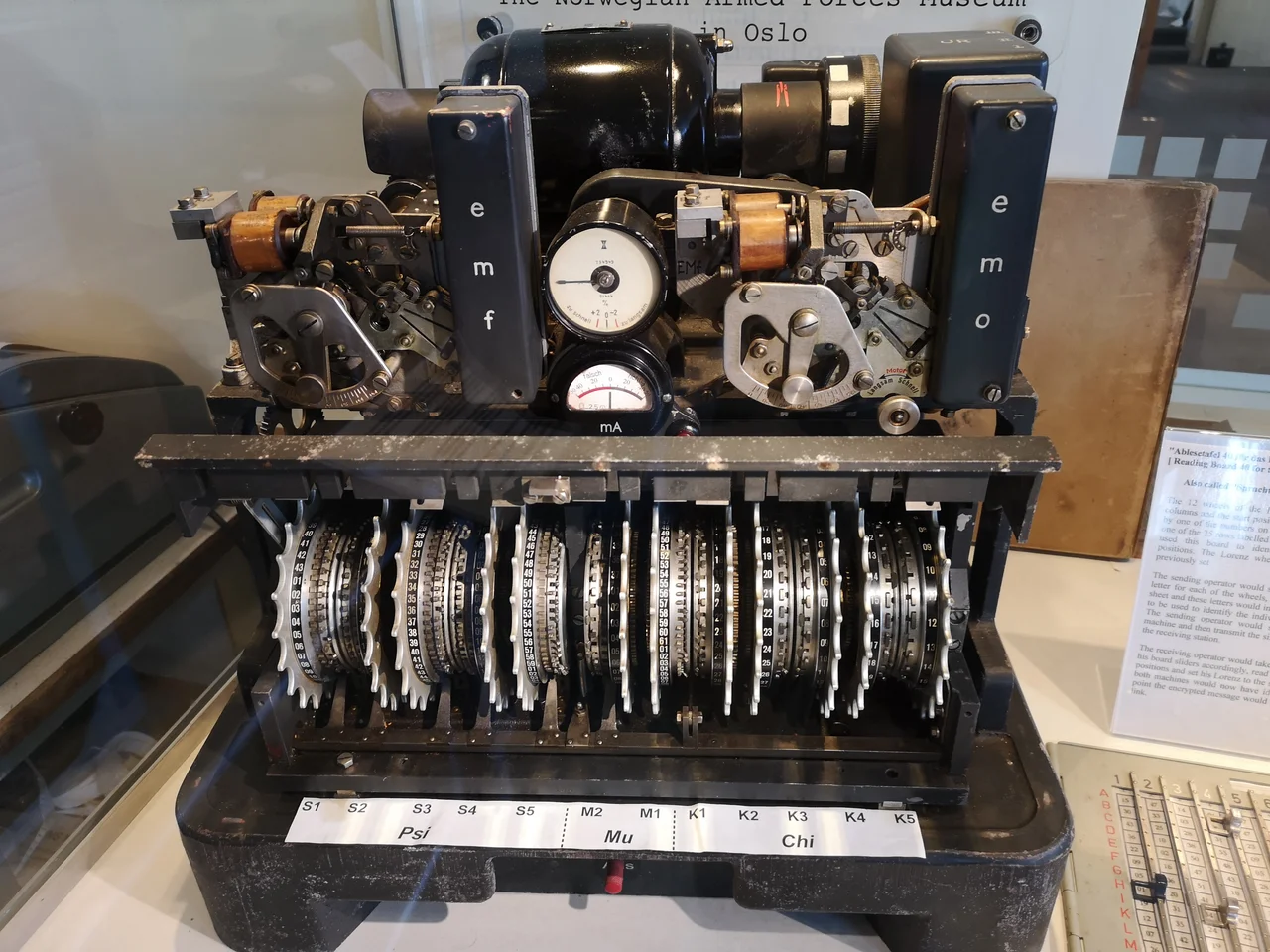
In a third gallery is a fully working replica Turing-Welchman Bombe - the electromechanical machine Alan Turing and Gordon Welchman designed to break the German Enigma cipher. When the original wartime drawings were finally declassified in 1995, John Harper and a team of volunteers spent thirteen years building this replica. It runs on schedule, several times a day, demonstrating to visitors how the rotors spin through every possible Enigma setting until a 'stop' shows that the day's daily key has been found. There is a wooden gantry, a wall of rotating drums, the clatter of relays. In the adjacent gallery is one of the very few surviving Lorenz SZ42 machines - the higher-grade German cipher attachment that Tommy Flowers's Colossi were built to break. Most Allied codebreakers never saw a Lorenz until after the German surrender in May 1945.
Everything That Came After
The museum is not only about the war. Successive galleries tell the story of British computing through the second half of the twentieth century: the EDSAC replica that contributed to three Nobel Prizes; the Marconi TAC that monitored Wylfa nuclear power station around the clock from 1968 to 2004; the ICL 2966 mainframe that took up a third of the floor and ran the operating system called George 3 - on which visitors can now play noughts and crosses and Colossal Cave. There is a classroom full of working BBC Micros - the machines that taught a generation of British schoolchildren to program in the 1980s, of which more than 1.5 million were sold. There is the Internet Gallery, where the story of Donald Davies at the National Physical Laboratory is told: in 1965 he invented packet switching, the idea that data should be broken into small chunks and routed independently. ARPA adopted his design. The internet that resulted is the reason you can read this sentence. It started in Buckinghamshire, in a research lab that does not have any monuments. The museum is the monument.
From the Air
The National Museum of Computing sits at 51.998°N, 0.74°W, in Block H on the Bletchley Park estate at the southern edge of Milton Keynes. From altitude, look for Milton Keynes's distinctive grid road pattern - parallel straight lines arranged in a near-perfect rectangular network unlike any other English city - and find the south-west corner near Bletchley railway station. Bletchley Park itself is a wooded estate of about fifty-five acres just east of the railway line, containing the Victorian mansion, the wartime huts, and the post-war blocks in concrete and brick. Nearest airports: Cranfield (EGTC) 8 nautical miles east, Luton (EGGW) 18 nautical miles south-east, Booker / Wycombe Air Park (EGTB) 22 nautical miles south. Milton Keynes lies within the Luton TMA - check current restrictions. Recommended viewing altitude is 3,000 to 4,500 feet AGL. Bletchley Park is open to visitors most days; both the National Museum of Computing and the Bletchley Park Trust museum charge separate admission.
Nearby Stories
- Battle of Northampton (1460) 1.8 km away
- Hitchin Boys' School 5.1 km away
- EastEnders 5.6 km away
- St Neots 6.2 km away
- Chesterton Windmill 6.4 km away
- Hellfire Caves 6.5 km away
- Battle of Edgehill 23 km away
- Littlecote Roman Villa 30 km away