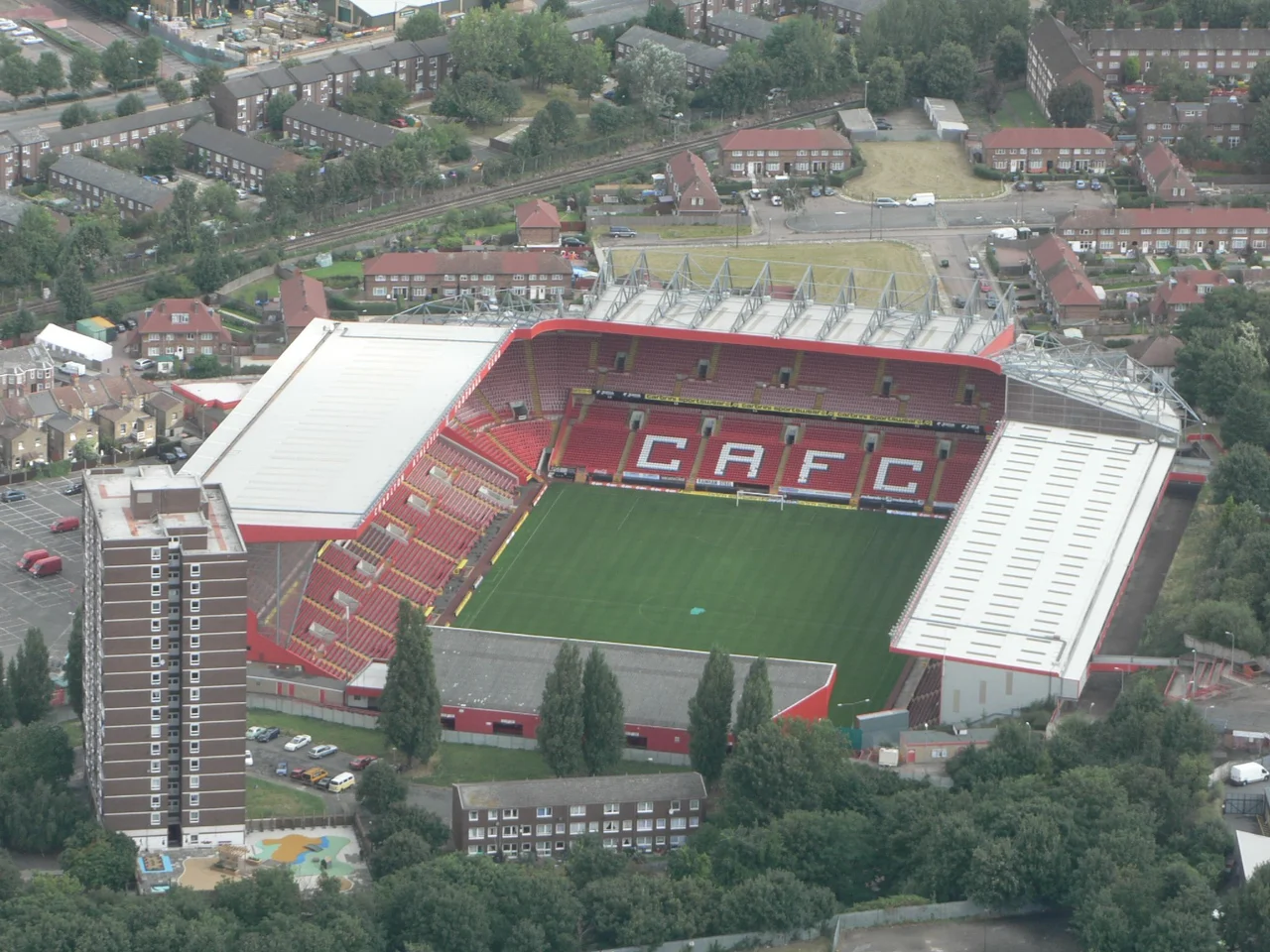

The Valley
Fred Barned found an abandoned sand and chalk pit in Charlton in 1919 and saw a football ground. He did not have the money to build one. So an army of Charlton Athletic supporters showed up with shovels. They dug out a flat pitch at the bottom of the chalk pit and used the excavated material to pile up makeshift terraces. When the first match kicked off, there were no seats and no terraces yet, just a roped-off pitch and a crowd standing on raw earthworks. The Valley has been Charlton's home, with two unhappy interruptions, ever since.
Built by Hands That Came Back to Sweep It
The ground's name comes from the obvious thing: it sits in an actual valley, gouged out of the Charlton hillside by people digging for sand and chalk. That is not the kind of origin story most football clubs can claim. Most grounds were laid out by railway companies or commissioned by wealthy owners. The Valley was scraped together by volunteers, and that bond would matter half a century later. When the club went broke in the 1980s and a new owner moved Charlton to share Crystal Palace's Selhurst Park in 1985, the supporters could not let go of the chalk pit. In 1988, after the club and ground came back into the same hands, thousands of fans turned up to clean the abandoned terraces and burned the debris in a huge bonfire on the pitch.
The Year a Football Club Ran for Council
Greenwich Borough Council turned down the plans to renovate the Valley. Charlton's supporters did the unusual thing of forming their own political party in response. The Valley Party stood candidates for almost every council seat in 1990, sparing only the two councillors who had voted in favour of the stadium. They were never going to win control, but they were not really trying to. They won almost 15,000 votes, the kind of result that registers as a slap, and the council that had blocked the stadium quietly began to reconsider. Charlton came home in 1992. The party folded its work done, the only football supporters' group in England that ever wrote itself into a local election.
Records the Place Still Holds
For decades the Valley was one of the largest grounds in the Football League. On 12 February 1938, an FA Cup tie against Aston Villa drew 75,031 people through the gates, a record that will never be broken because the modern all-seater stadium holds 27,111. In the 1948 to 49 season the average crowd was 40,216, putting Charlton among only thirteen English clubs to ever sustain that kind of attendance. Then there is the Who concert of 31 May 1976, measured at 126 decibels from 32 metres away, which held the record for loudest rock concert in the world for years. Sam Bartram, considered the finest player Charlton ever produced, stands in bronze at the entrance to the West Stand, looking out at a ground his supporters refused to let die.
The Stands That Tell the Story
Walk around the inside and the Valley's stop-start century is written in the architecture. The South Stand, now named after the manager Jimmy Seed who won Charlton the 1947 FA Cup, dates from the early 1980s and is the oldest surviving piece. The East Stand was built during the 1993 to 94 season as the first work after the long exile, replacing a terrace that had been closed since the Bradford City stadium fire. In 2021 it was renamed for Alan Curbishley, who managed Charlton from 1991 to 2006 through the club's modern rise. The Covered End and West Stand both date from the Premier League years around 2000. In 2024, with promotion ambitions stirring again, the club installed a safe standing area in the Covered End Upper, 1,064 seats in the back eight rows, the first official standing at the Valley since the cleanup bonfire.
A Pitch That Still Belongs to the Neighbours
In 2024 Charlton invested in a new GrassMaster hybrid pitch, helped by a £750,000 grant from the Premier League Stadium Fund. As part of the same package the women's team began playing every home match at the Valley for the first time, beating Southampton two to nil in front of 985 fans on 28 April 2024. The same club that ran a political party to come back home is now opening the home to more of its community, with one of the first Youth Specific Sections in the country for younger supporters. The chalk pit dug out by volunteers in 1919 is still, fundamentally, a neighbourhood project.
From the Air
The Valley sits at 51.49 degrees N, 0.04 degrees E in Charlton, southeast London, on the south bank of the Thames. London City Airport (EGLC) lies just across the river to the north. Heathrow (EGLL) is roughly 25 km west. From cruising altitude the stadium reads as a green rectangle in the dense grid of inner-southeast London, with the river bending past Greenwich just north.
Nearby Stories
- Hampton, London 1.1 km away
- Queenborough Castle 3.2 km away
- Groombridge Place 4 km away
- North Weald Airfield 4.9 km away
- Kings Langley Palace 8.3 km away
- White House Farm murders 11 km away
- Port Lympne Mansion 22 km away
- Amberley Museum & Heritage Centre 31 km away