
Thee Ain
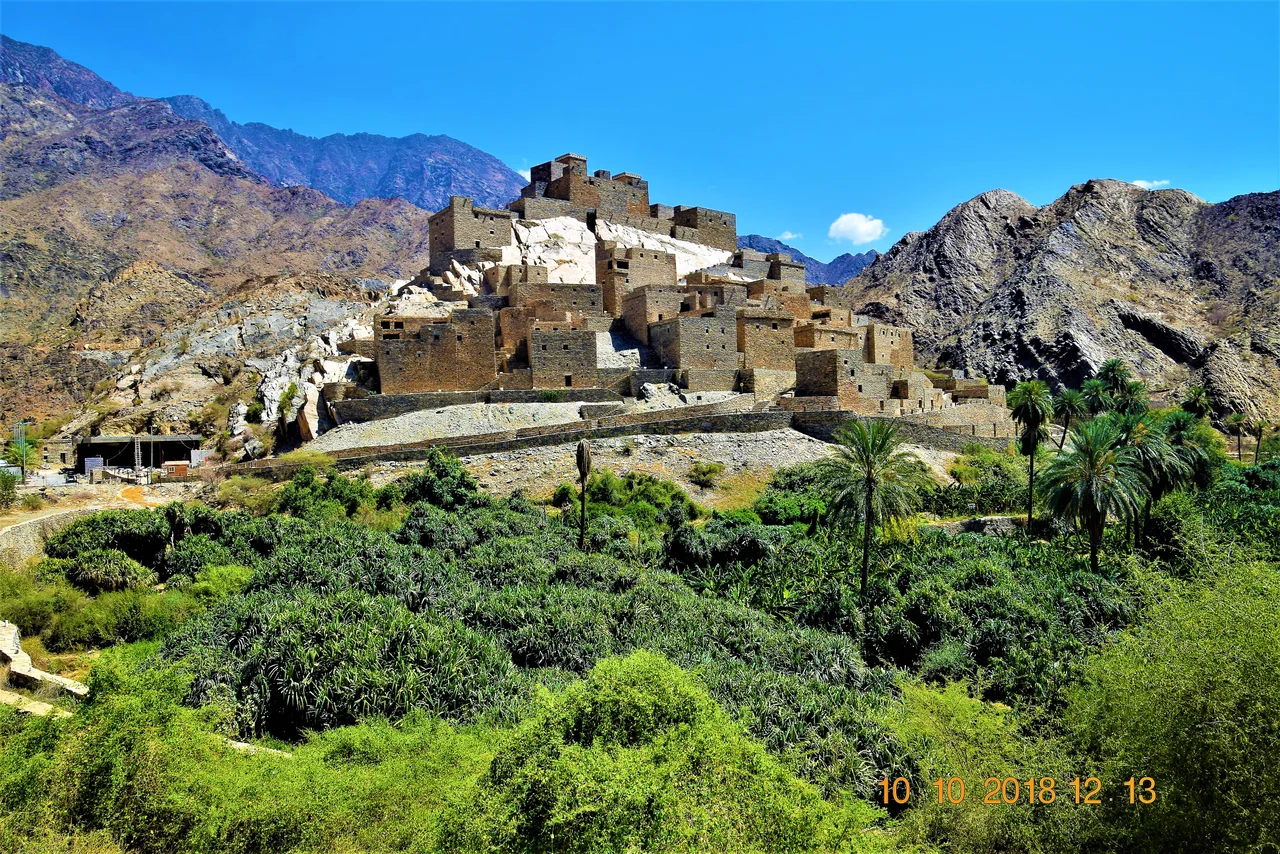
The village sits on a white hill. Forty-nine stone houses, built from polished slabs stacked on walls seventy to ninety centimeters thick, looking out across a valley where a spring has been running for longer than anyone can trace. The name Thee Ain means the one of the eye, eye being the Arabic word for a water source. A local legend tells of a man who lost his walking stick in one of the valleys upstream. He followed the river down, gathered the people of the village, and dug until he found his stick at the source of the spring. The stone houses, the spring, the white hill, and the story all still hold together in the Al-Baha mountains of southwestern Saudi Arabia.
Where the River Comes Out
Thee Ain is in the Al-Mikhwat province of the Al-Baha Region, about twenty kilometers southwest of the town of Al Makhwah. It sits in the Tihamah, the coastal plain's mountainous interior, at about 1,985 meters of elevation. The climate is hot in summer, mild in winter, with heavy rains in summer and moderate ones in winter. The village has its own spring, and the river flowing past has several branches, each with its own name. The 40-plus main houses and the mosque beside the water have given the village its character since the tenth century AH, roughly the 16th century CE. The site is a candidate for UNESCO World Heritage status and was submitted as one of ten sites recommended by the Saudi High Commissioner. Banana trees, basil, palms, lemon trees, and the fragrant kadhi plant grow in the fields around the stone houses.
The Madamek Walls
The village was built using the Madamek wall system, a local dry-stone technique where large flat stones are laid without mortar and then covered with mud. The walls reach 70 to 90 centimeters thick. Large rooms are decorated with columns called zafer. A particular kind of stone called prayer sits above the sidr wood. Lower floors are used for reception, sitting, and sleeping. The house count breaks down carefully: nine single-story houses, nineteen two-story, eleven three-story, and ten four-story. Some buildings date from the village's founding and have been continuously inhabited or maintained since. The stone of the white hill and the stone of the houses are the same color, so the village looks, from a distance, like a continuation of the hill itself.
Tribes and Invasions
Thee Ain's history before the unification of Saudi Arabia by King Abdul Aziz Al Saud was a history of intertribal conflict and of moments when outside armies arrived. The most consequential invasion involved the combined armies of the Zahran and Ghamd tribes meeting the forces of Muhammad Ali Pasha, the Wali of Egypt whose army reconquered the Hejaz for the Ottomans in the early nineteenth century. Tombs known locally as the graves of the Turks mark that period. Ottoman records from the same era note the presence of large deposits of high-quality marble and metals in the region. The marble was used during expansions of the Grand Mosque in Mecca. The tombs and the stories together mark a village that was not sealed off from the rest of Arabian history, even as it held its own form.
Restoration on the White Hill
The Saudi Tourism Authority allocated 16 million riyals for a multi-phase project to rehabilitate the village and reopen it as a cultural site. The plan was divided into three phases over five years. The first phase focused on the main corridor of the village, rebuilding seating along the route to the waterfall, reopening the mosque, restoring a number of buildings to house a museum, and adding a visitor center, restaurant, and public toilets. The restoration preserves the Madamek wall system and the original layout. The village has been a quiet point of pride for the Al-Baha region for a while, but the investment marks an intention to let visitors see what the stone-and-spring architecture of the Tihamah actually looks like, rather than just the modern Saudi Arabia that gets the postcards.
What the Stone Remembers
The houses on Thee Ain's white hill are older than most of the states that have passed through the region. Ottoman, Saudi, Hashemite claims came and went. The Madamek walls held. The spring kept running. The families that built the houses and farmed the nearby orchards used the same techniques their grandparents had used and their children would use after them. The village remains small, intimate, and specifically shaped by the landscape. It is not Petra. It is not even Al-'Ula. It is a local place, carefully built, carefully maintained, and with a legend about a lost walking stick that turned into the finding of a spring. Thee Ain is the village that grew from the water, named for the water, and still listening to it.
From the Air
Located at 19.93 N, 41.44 E in the Al-Baha Region of southwestern Saudi Arabia. Thee Ain sits at 1,985 m in the Tihamah escarpment, part of the Sarawat Mountains. Visible from altitude as a small white-hill settlement in rugged mountain terrain. Nearest airport: Al Baha Domestic Airport (OEBA), about 70 km northeast. Approach offers spectacular views of the Tihamah escarpment dropping toward the Red Sea coast.
Nearby Stories
- Battle of Kunfuda Bay 66 km away
- Bareq 85 km away
- Battle of Turubah 110 km away
- Siege of Ta'if 123 km away
- Dhorm Mountain 139 km away
- Ta'if 151 km away
- First and second battles of El Teb 347 km away
- Najd 488 km away