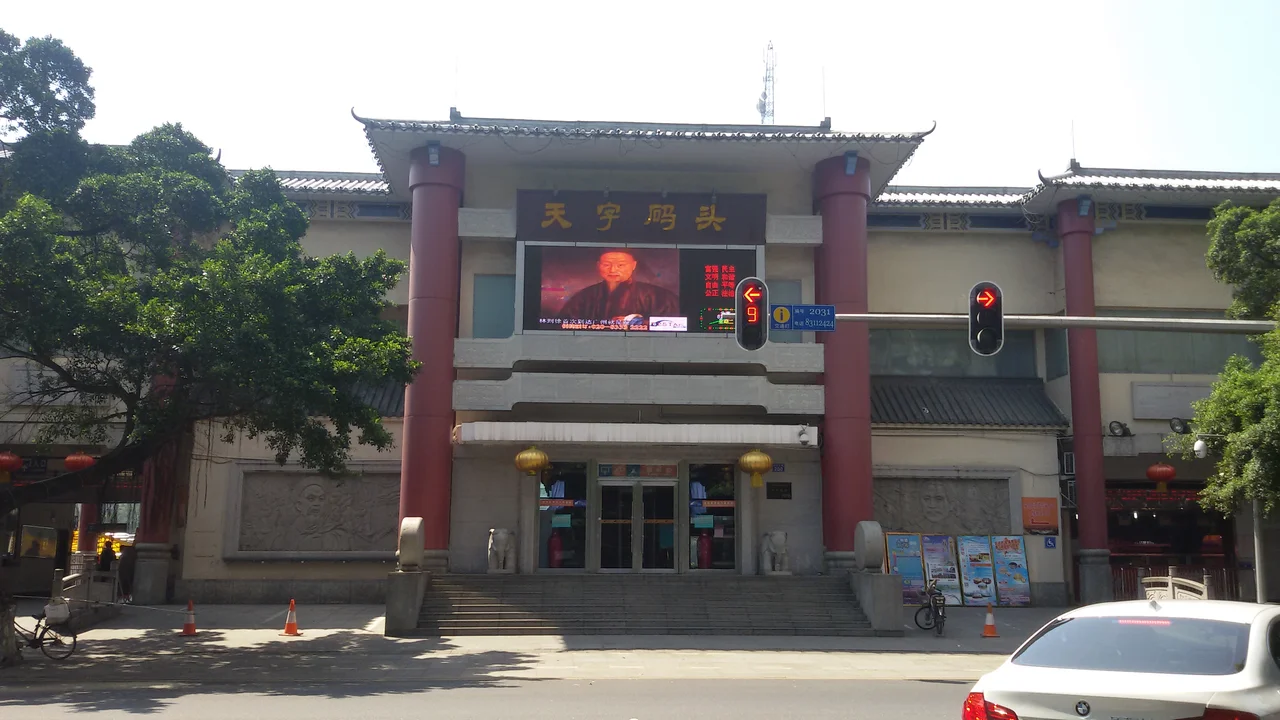

Tianzi Wharf
Canton's most consequential pier doesn't announce itself. Tianzi Wharf — known in Chinese as the Emperor's Wharf, and sometimes called the First Wharf of Canton — sits at the intersection of Beijing Road and Yanjiang Road Middle, where the Pearl River laps against stone that has felt the weight of imperial officials, confiscated contraband, and fleeing revolutionaries. For nearly three centuries it has been the place where history either departed or arrived by water, and the city hasn't quite let it forget that.
Reserved for the Emperor's Men
During the reign of the Yongzheng Emperor (1723–1735), Tianzi Wharf was set apart from the commercial chaos of Canton's riverfront and reserved exclusively for Qing officials. Dignitaries arriving by boat were met at the water's edge and escorted through a narrow alley on Beijing Road where a kiosk marked the formal boundary between the river and imperial ceremony. The wharf's name — tianzi, meaning Son of Heaven — reflects that enforced exclusivity. Common boats tied up elsewhere. This one belonged to the court.
That official character made it the stage for one of the nineteenth century's most consequential arrivals. In 1839, Imperial Commissioner Lin Zexu disembarked at Tianzi Wharf when he came to Guangzhou to carry out the Daoguang Emperor's order to suppress the opium trade. It was here that he stepped onto Canton soil to begin the campaign that would end with the destruction of over 20,000 chests of British-owned opium — not at this wharf, but at the beach at Humen, some seventy kilometers downstream, where workers mixed the seized opium with lime and salt water in open trenches and released it into the Pearl River. Tianzi Wharf was the beginning of that journey. Lin Zexu also departed from this same wharf years later when he was exiled — the commissioner who had defied the British trade sent away by the same imperial court he had served.
A Revolutionary's Last Boat
Decades later, Tianzi Wharf witnessed a very different kind of departure. Sun Yat-sen — the physician turned revolutionary who would become the founding father of the Republic of China — boarded a ferry here during his escape to Hong Kong, slipping away from Qing authorities who wanted to stop him. The details of exactly when this crossing occurred are part of the broader blur of his early career, but the wharf endures in accounts of his flight as the specific point where Canton and safety briefly separated him.
Those two moments — Lin Zexu's act of defiant destruction and Sun Yat-sen's fugitive crossing — compress a remarkable amount of Chinese history into a single stretch of Pearl River riverbank. The wharf was not a monument when those things happened. It was simply where you caught the boat.
The Pearl River at Night
Today Tianzi Wharf serves the Guangzhou Water Bus network, connecting Fangzhi Wharf and several other stops along the river, and functions as a terminal for the Pearl River Night Cruise — the tourist boats that work the illuminated cityscape after dark. The Pearl River Night Cruise has made this stretch of water one of Guangzhou's most recognizable experiences, with the lit towers of the city reflecting off black water as vessels pass between bridges.
The contrast between what the wharf has been and what it now does is sharp but not uncomfortable. Canton was always a trading city, always oriented toward the river, always moving people and goods from one bank to another. The Water Bus continues that tradition at street level, unpretentiously, while the cruise boats turn the same route into something approaching spectacle. Both versions feel true to a city that has never had much patience for standing still.
Stone and Memory at Beijing Road
The kiosk alley on Beijing Road still marks the place where Qing officials were formally received, preserved as a small historical footnote in a district that has otherwise been transformed beyond recognition. Beijing Road itself is one of Guangzhou's main commercial streets, loud and crowded with shoppers; finding the quiet alley marker takes a deliberate effort.
That effort is worth making. Tianzi Wharf is one of those places that carries more weight than its current appearance suggests. The stone steps at the water's edge, the ordinary ferry passengers waiting for the next water bus, the night-cruise boats idling nearby — all of it occupies the same coordinates where imperial China made a doomed stand against the opium trade, and where a future republic's founder slipped away to fight another day. The Pearl River keeps moving south toward the sea, indifferent to all of it, as it always has.
From the Air
Tianzi Wharf sits at approximately 23.117°N, 113.266°E on the north bank of the Pearl River in central Guangzhou. From the air, the Pearl River is the defining feature — a wide silver ribbon cutting through the urban grid. The wharf is near the intersection of Beijing Road and Yanjiang Road Middle, east of the Canton Tower area. Approach ZGGG (Guangzhou Baiyun International Airport) from the south and the Pearl River corridor leads directly into the heart of the old city. Recommended viewing altitude 2,000–4,000 feet gives a clear sense of the river's width and the density of riverside development. The Canton Tower (600 meters) to the southwest serves as the primary navigation landmark.
Nearby Stories
- Shunde 12 km away
- 2015 Shenzhen Landslide 15 km away
- Mount Luofu 23 km away
- Qingyuan Maglev Tourist Line 32 km away
- Kaiping 56 km away
- Heyuan 90 km away
- Chikan, Kaiping 92 km away
- Erlitou Site Museum of the Xia Capital 1257 km away