.jpg)
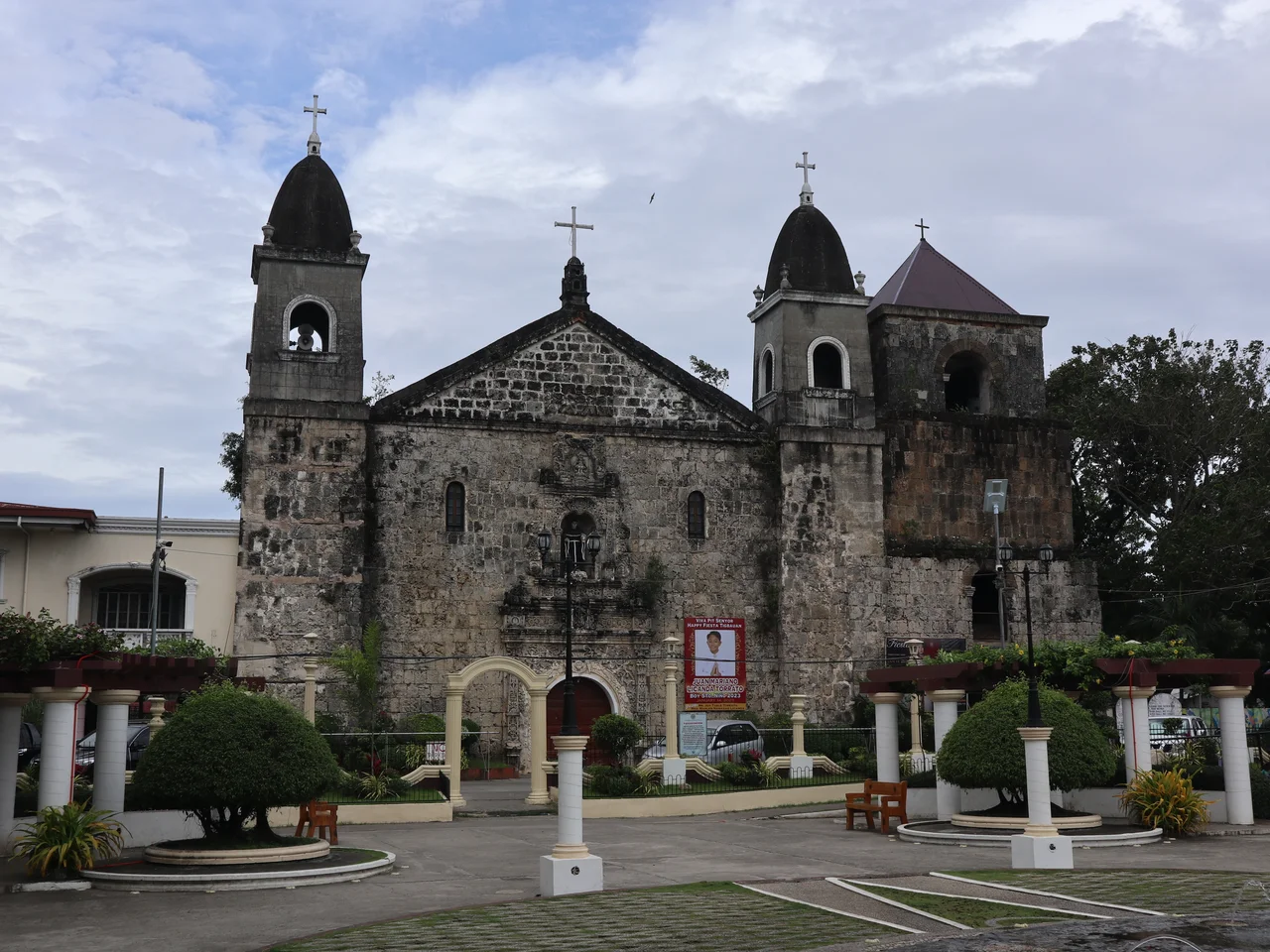
Tigbauan Church
The stone facade looks like two buildings fused together. Below, plain walls and thick pillars frame a simple entrance. Above, an eruption of carved scrollwork, foliage, and volutes surrounds the niche of St. John of Sahagun, as if the builders saved every ounce of decorative ambition for a single vertical strip of coral stone. This is Tigbauan Church, where restrained Spanish colonial architecture collides with Churrigueresque exuberance on a coastal hillside in Iloilo province, and where the Augustinian seal still watches over a parish that has been worshipping here since 1575.
Second Parish on Panay
Tigbauan's parish began as a visita, a satellite chapel dependent on the Immaculate Conception Parish in the neighboring town of Oton. Founded in 1575, it became the second church established by the Augustinian mission on the island of Panay. The early parish sat under the patronage of Our Lady of Grace before St. John of Sahagun, a Spanish Augustinian friar known for his peacemaking, was chosen as patron. Though the founding date is recorded as 1575, the parish had no resident priest until 1580, when Fr. Luis de Montoya was assigned. A year later, Fr. Alonso de Castro took over. The Augustinians eventually departed due to a shortage of friars, and secular clergy administered the parish from 1593 until 1617. In 1592, the Jesuits arrived at the invitation of the encomendero Esteban Rodriguez de Figueroa, opening what became the first school and dormitory on the island to offer religious and academic instruction to local children.
Coral, Limestone, and Earthquakes
The church that stands today was built in 1867 by Fr. Fernando Martin, likely replacing an earlier yellow limestone structure attributed to Fr. Fernando Camporedondo. That predecessor reportedly survived the 1787 earthquake that damaged many structures across the Visayas, but the 1948 Lady Caycay earthquake proved far less merciful. The tremor, which swept through the entire Panay region, inflicted significant damage on Tigbauan Church and destroyed Oton Church entirely. What survived in Tigbauan was the facade and a stout bell tower positioned on the epistle side, capped with a red roof. These original colonial elements form the backbone of the church visitors see today, though mosaics depicting the Stations of the Cross and a new retablo were added in 1994, and the bell towers on the roof are more recent additions.
Where Stone Becomes Theater
Churrigueresque architecture, named after the Spanish Churriguera family of sculptors, takes Baroque ornamentation to its decorative extreme. At Tigbauan, this style announces itself on the middle section of the facade, where intricate stone carvings burst from an otherwise austere wall. The pediment displays an elaborate finial adorned with an emblem of tassels and foliage carved in high relief. Two arched windows flank a high-relief image of the Santo Nino, and below the patron saint's niche, the Augustinian seal is set just above the entrance. Look closely at the arched entryway and you will find a carved putto, a chubby cherub, serving as the ornamental capstone. The contrast is deliberate and striking: plain walls channeling the eye upward to a concentrated explosion of detail, as if the masons wanted to prove that devotion could be carved into coral stone one volute at a time.
A Living Parish
Tigbauan Church is not a museum piece frozen behind velvet ropes. It remains an active parish under the Archdiocese of Jaro, serving a municipality that stretches along the coast southwest of Iloilo City. The church sits at the center of daily life in Tigbauan, a town whose name derives from a local tree species. Fishermen pass its facade on the way to the strait, and schoolchildren walk beneath its bell tower each morning. The 1994 renovations that added the mosaic Stations of the Cross were not academic restorations but practical improvements for a congregation that still gathers here for Mass. Nearly four and a half centuries after the Augustinians first celebrated the liturgy on this site, the carved face of the putto above the entrance continues to greet parishioners who, in all likelihood, never pause to notice it.
From the Air
Located at 10.674°N, 122.376°E on the southern coast of Panay Island, Iloilo province. The church sits near the shoreline in the town center of Tigbauan, visible as a cluster of structures along the coastal road. Nearest airport is Iloilo International Airport (RPVI), approximately 15 km to the northeast. Best viewed at 2,000-3,000 ft AGL. The Guimaras Strait lies to the south, and the green hills of southern Panay rise behind the town.
Nearby Stories
- Hacienda Rosalia 11 km away
- San Jose de Buenavista 13 km away
- Guimaras Oil Spill 17 km away
- Northern Negros Natural Park 19 km away
- Jalaur Dam 31 km away
- 2012 Negros Earthquake 50 km away
- Maniguin Island Lighthouse 84 km away
- Tubbataha Reef 281 km away