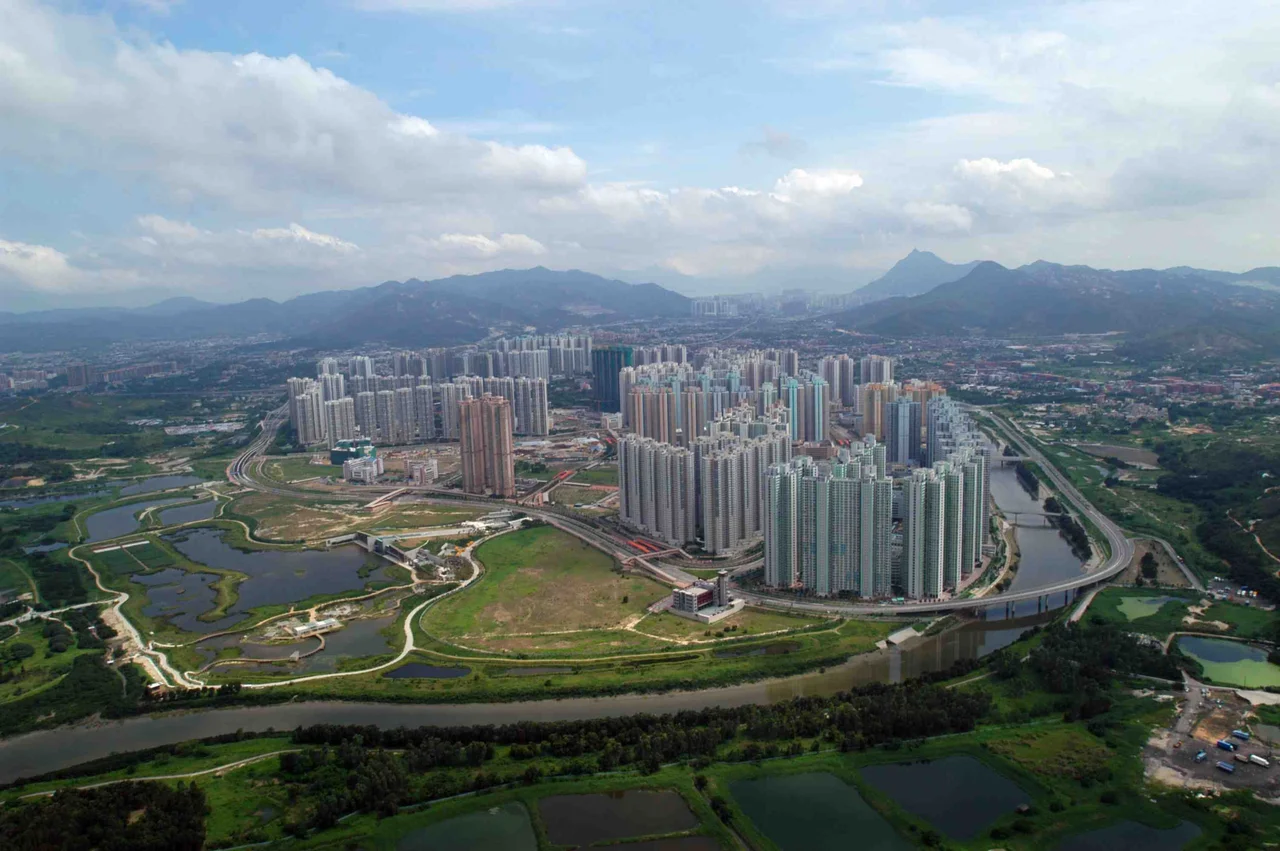

Tin Shui Wai
The land didn't exist a century ago. Where Tin Shui Wai now stands, the water north of Ping Shan gradually became marshland, which farmers converted into fish ponds — gei wai ponds fed by the tides, worked by families who pulled their livelihoods from brackish water. When aquaculture declined, the ponds were abandoned. The Hong Kong Government saw 2.4 square kilometres of flat, low-lying reclamable land and, in 1987, conceived a new town to house 140,000 people. By the time construction was complete and Governor Chris Patten officially opened Tin Shui Wai on 26 March 1993, some 30,000 people were already living there. That was only the beginning.
Built from the Water Up
The math of reclamation is staggering when laid out plainly: 20 million cubic metres of fill material required, an estimated cost of HK$820 million, a joint-venture company splitting ownership between China Resources (51 percent) and Cheung Kong Holdings (49 percent). There were delays — the government was accused of stalling land releases for political reasons, and Tin Shui Wai Development eventually sued for damages over promises that land would be handed over by 1985. It wasn't handed over until May 1989.
Construction proceeded quickly once it began. Modular public housing construction methods allowed rapid build-out, and the town grew in phases: first the southern zone in the early 1990s, characterized by lower residential density; then the northern zone after 1997, where taller and denser apartment towers were built to accommodate continued growth. Tin Wah Road marks the boundary between the two development eras. The population stabilized at roughly 280,000–292,000, with a 2021 census count of 283,595.
A Town With Real Infrastructure
Tin Shui Wai is 25 kilometres northwest of Central, but it is not cut off. The Tuen Ma line connects Tin Shui Wai station to Tuen Mun, Yuen Long, Tsuen Wan, Kowloon, and the wider MTR network via the 5.5-kilometre Tai Lam Tunnel. A network of 16 Light Rail stops rings the town in a circular route, feeding the rail station and connecting to the neighboring new towns. Buses run to most major destinations in Hong Kong.
The town is home to the Ping Shan Tin Shui Wai Public Library, which opened in 2013 and is the second-largest public library in Hong Kong after the Hong Kong Central Library. There are three public swimming pools, four indoor sports centres, and the Tin Shui Wai Sports Ground, a 2,500-seat stadium with a 400-metre running track. The Tin Shui Wai Hospital opened in January 2017, with its Accident and Emergency Department following in March 2017. These are the facts of a functioning community — schools, libraries, hospitals, parks — built for and by a population that now numbers close to 300,000 people.
The Wetland at the Edge of Town
Not everything in Tin Shui Wai is concrete and housing blocks. In the northeastern corner of the new town, a constructed wetland serves as a buffer between the residential development and the Mai Po Nature Reserve, one of East Asia's most significant wetland ecosystems. Over time, this buffer zone was expanded into the Hong Kong Wetland Park, which opened to the public in May 2006.
The wetland park offers something unusual for a satellite town: quiet, biodiversity, birds that arrive from across the flyway. Light Rail routes 705 and 706 stop at Wetland Park stop, making it accessible without a car. Tin Shui Wai Park, in the centre of the town, provides gardens and activities closer to the residential core. These green spaces exist because the planners thought to include them — and because the former fish ponds made them possible.
Telling Its Own Story
Tin Shui Wai has attracted attention over the years for the structural challenges that came with rapid development: cramped housing, isolation, insufficient employment close to home. A label — "city of sadness" — circulated in Hong Kong media for a period, drawn from the real social strains that rapid and distant development can create. It was never the whole picture, but it stuck.
The residents have told different stories. Filmmaker Ann Hui set two films in Tin Shui Wai — The Way We Are (2008) and Night and Fog (2009) — portraying ordinary people navigating their lives with complexity and dignity, not as abstractions of social policy. In 2020, a Cantonese hip-hop song called "Tin Shui Wai Gang Gang" by TomFatKi and Billy Choi reached 5 million views on YouTube; the artists performed a version at Chill Club Awards on ViuTV in 2022. That same year, the ViuTV drama We Are the Littles — starring Stephy Tang, Zeno Koo, Ian Chan, and Anson Lo — was set there. Culture made by and for people who live in Tin Shui Wai, claiming the place on their own terms.
From the Air
Tin Shui Wai sits at approximately 22.4603°N, 114.0030°E in the northwestern New Territories, roughly 25 km northwest of Central and about 18 km northeast of Hong Kong International Airport (VHHH). Flying into VHHH from the north or northeast, the town's distinctive grid of housing towers and the green pocket of the Hong Kong Wetland Park are visible on approach. Deep Bay — the shallow inlet marking the border with Shenzhen — is prominent to the north. The area sits below the Tuen Ma line corridor. Recommended viewing altitude 3,000–5,000 feet. ICAO: VHHH.
Nearby Stories
- Chapel of St. Francis Xavier 3.5 km away
- Cuiheng 4.1 km away
- 2015 Shenzhen Landslide 16 km away
- Shunde 31 km away
- Wanshan Archipelago 37 km away
- Nanxiong Formation 96 km away
- Heyuan 149 km away
- Checheng Fu'an Temple 629 km away