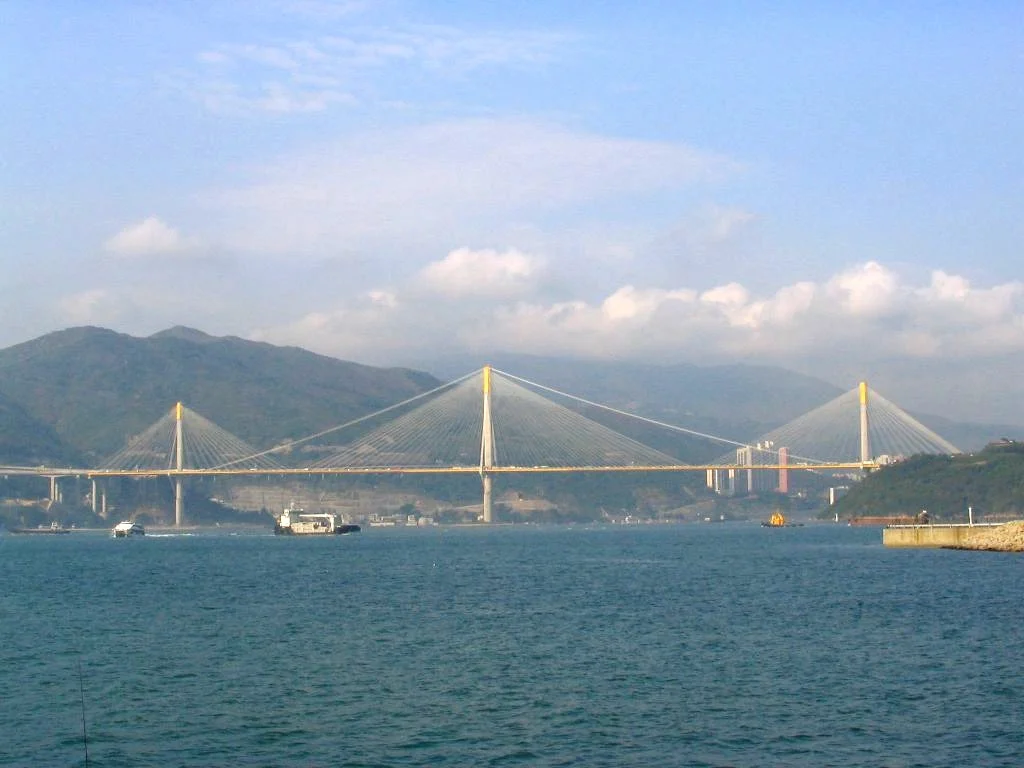

Ting Kau Bridge
The problem was one that bridge engineers had never solved at this scale: four spans, three towers, and no way to stabilise the middle tower without the kind of cable arrangement that existed only on paper. When the Ting Kau Bridge opened on 5 May 1998, it became the world's first major four-span cable-stayed bridge, threading 1,177 metres across Rambler Channel between Tsing Yi Island and the Ting Kau headland near Tsuen Wan. The solution — the longest cable stays ever used in a bridge at the time, reaching 465 metres — is hidden in plain sight, tensioned taut above six lanes of traffic that haven't paid a toll since the day it opened.
A Problem Worth Solving
Four-span cable-stayed bridges present an engineering paradox. In a conventional three-span design, the outer towers anchor their cables against solid ground, giving each tower something to push back against. Add a fourth span and the middle tower floats, supported only by the cables it carries. At Ting Kau, the solution came from a Stuttgart engineering firm, Schlaich Bergermann and Partner, who proposed stabilising the central tower longitudinally using 465-metre cable stays — a length that had never been used before. The towers themselves are single-leg structures, braced by transverse cables in a configuration that the engineers compared to the masts of a sailboat. Three towers rise to heights of 170 metres, 194 metres, and 158 metres above the channel. Together they carry 384 stay cables holding decks that can flex vertically at mid-span by up to 1.6 metres under extreme loads — a controlled flexibility that helps the structure survive typhoon winds rather than fight them.
Built by a World
The consortium that built Ting Kau Bridge between 1995 and 1998 was itself an international exercise in collaboration. Ting Kau Contractors Joint Venture brought together two Spanish firms — Cubiertas Y Mzov and Entrecanales Y Tavora, both now part of Acciona — alongside Germany's Ed. Züblin, Australia's Downer and Co, and Hong Kong's Paul Y Engineering. The HK$1.94 billion project required 8,900 tonnes of structural steel deck, 29,000 tonnes of concrete panels, and 2,800 tonnes of cable steel. A chromatic study and custom architectural lighting scheme were commissioned to ensure the bridge read well against the harbour's backdrop at night. The result is a structure that looks almost delicate from a distance — the separate decks on either side of each tower give it a slender profile — while carrying the heaviest container truck traffic of any bridge on the Lantau Link.
Watching It Work
Since opening, the Ting Kau Bridge has been under continuous electronic surveillance as part of Hong Kong's Wind and Structural Health Monitoring System (WASHMS), which it shares with the Tsing Ma and Kap Shui Mun bridges nearby. The system logs wind speed, cable tension, deck movement, and structural stress in real time — a dataset that has made the Lantau Link bridges among the most studied cable-stayed structures on Earth. The bridge is toll-free, which helps explain why it carries the densest container traffic of the three crossings: trucks bound between the Kwai Chung container port and the warehouses of Guangdong Province roll across it around the clock. Looking at it from the water, the towers seem almost still. The decks flex, the cables hum at frequencies that vary with wind speed, and the channel below keeps its own rhythm, indifferent to the 29,000 tonnes suspended above it.
Route 3 and the Region It Links
Ting Kau Bridge is part of Hong Kong's Route 3, the expressway spine that binds the western New Territories to the city centre. From here the road threads through the Tai Lam Tunnel, past the Cheung Tsing Bridge and Cheung Tsing Tunnel, and eventually reaches Hong Kong Island via the Western Harbour Crossing. In the other direction it connects to the Lantau Fixed Crossing on Tsing Yi Island, just 500 metres away from the Tsing Ma Bridge — the famous suspension bridge that carries both road and rail to Hong Kong International Airport. Ting Kau sits at the junction of all these threads, overlooked by most travellers who cross it simply because the engineering problem it solved so elegantly has become invisible in daily use. That invisibility, perhaps, is the highest compliment a bridge can receive.
From the Air
Ting Kau Bridge sits at approximately 22.364°N, 114.080°E, spanning Rambler Channel between Tsing Yi Island and the Ting Kau headland near Tsuen Wan. Approaching from the south at 2,000–3,000 feet, the three asymmetric towers are the clearest landmark — they stand 170, 194, and 158 metres tall and carry a web of 384 stay cables visible in oblique light. The nearby Tsing Ma Bridge suspension towers and the Kap Shui Mun Bridge form a recognisable cluster 500 metres to the southwest. Hong Kong International Airport (VHHH) is on Lantau Island approximately 10 nautical miles to the southwest. Visibility in typhoon season (May–October) can drop rapidly; the bridge's monitoring system records gusts that can reach 50 knots at deck level.
Nearby Stories
- Chapel of St. Francis Xavier 3.5 km away
- Cuiheng 4.1 km away
- 2015 Shenzhen Landslide 16 km away
- Shunde 31 km away
- Wanshan Archipelago 37 km away
- Nanxiong Formation 96 km away
- Heyuan 149 km away
- Checheng Fu'an Temple 629 km away