
Ting Kok
The village existed before its name did. Originally called Ting Kai, the settlement on the northern shore of Plover Cove in the New Territories was established before 1688 by Punti families whose surnames are no longer traceable in a single lineage — a multi-clan community at a time when most Hong Kong villages were defined by clan allegiance. By the nineteenth century, the place now known as Ting Kok had acquired a second identity: the nerve centre of the San On Roman Catholic missionary district, a transit point for priests heading into mainland China. In 1866 the mission established itself here formally, and 19 residents became the first local converts. Those two histories — indigenous Punti community and unexpected missionary waystation — make Ting Kok something more layered than it first appears.
Older Than the Records
The founding date 'before 1688' is itself a telling absence. Colonial-era records often struggle to establish when New Territories villages first appeared, and Ting Kok predates the documentation system that might have recorded it more precisely. What is clear is that the Ting Kok Yeuk — a traditional alliance of villages in the area — bound Ting Kok together with nearby Hakka communities including Shan Liu, Lai Pik Shan, Lo Tsz Tin, Lung Mei, and Tai Mei Tuk. Yeuk alliances were mutual-aid agreements that helped villages manage shared resources, resolve disputes, and present a unified front against outside pressure. That Ting Kok led such an alliance suggests it held some local standing, even if that standing has faded from the historical record. By the time of the 1911 census, the village had 669 residents — 301 of them male — a population large enough to support its own temple and ancestral hall.
A Gateway for Missionaries
In the nineteenth century, Catholic missionaries in southern China faced a practical geography problem: the easiest routes into the mainland ran through the New Territories, and those routes needed rest stops. Ting Kok became one of them. The San On district — centred on what is now Shenzhen and surrounding counties — was one of the more challenging postings for the Paris Foreign Missions and later the Milan Foreign Missions, and priests passing through Ting Kok on their way north left behind more than footprints. The mission formally established itself here in 1866. Nineteen villagers were baptised as the first local Catholics. Whether that number grew substantially in the following decades is harder to trace, but the missionary connection added a layer of contact with the outside world that most New Territories villages of the era never experienced.
Stones and Timber That Last
Two buildings anchor the village's built heritage. The Mo Tai Temple, dedicated to Kwan Tai — the deity of war, righteousness, and brotherhood — was built before 1785 and received Grade III historic building status in 2010. It has stood through colonial handover, the Japanese occupation, and the postwar development boom, surviving by virtue of local reverence rather than official protection. The Lee Ancestral Hall, built in the late nineteenth century, has not been formally graded but continues to serve its function as a place of clan memory. Together these two structures represent the duality that defined Ting Kok: the local religion of the Punti community on one side, and the family bonds that held village life together on the other. Walking through the village, both buildings feel genuinely old in a way that restorations sometimes eliminate.
Where the Land Is Alive
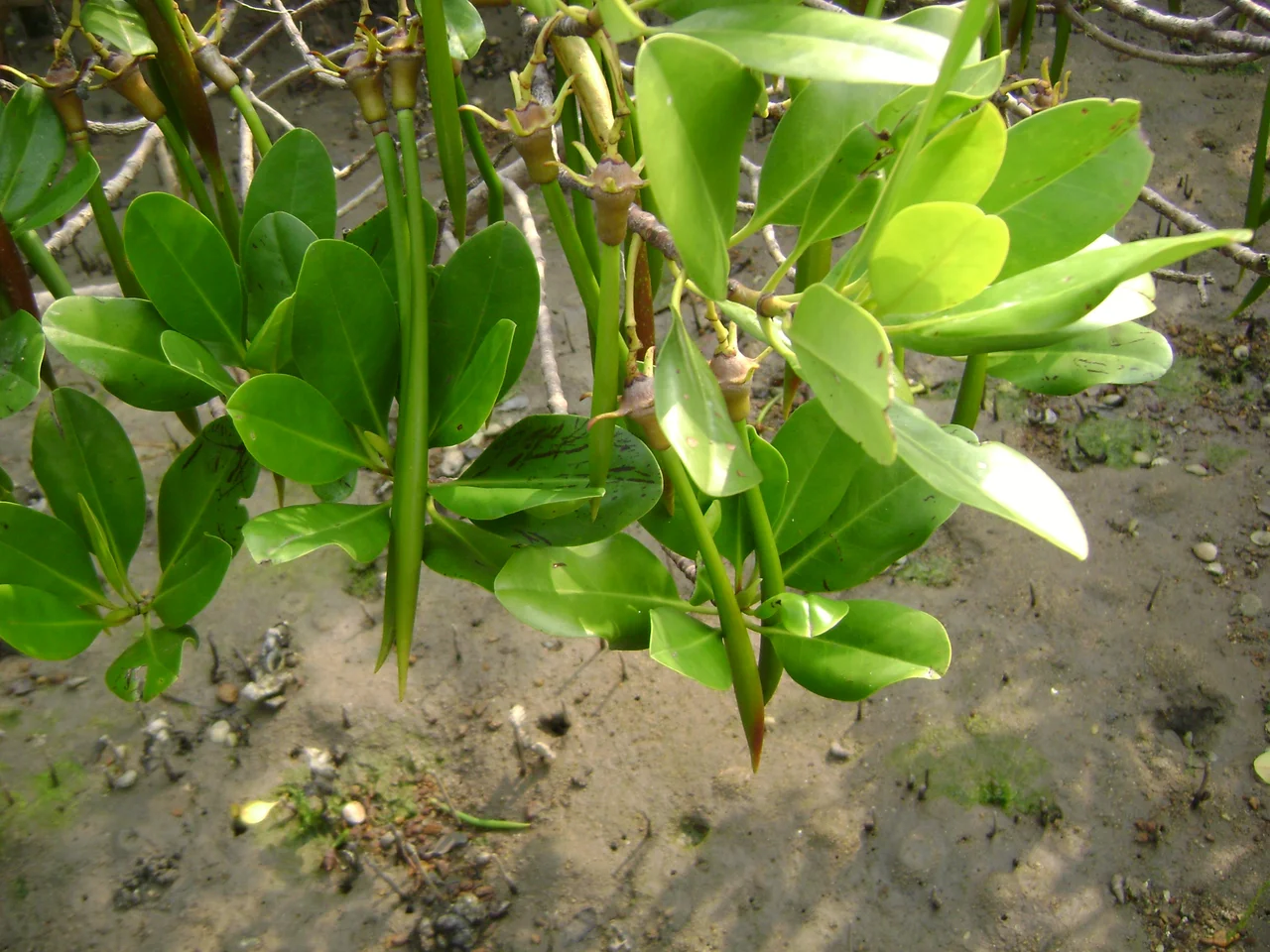
The most ecologically significant part of Ting Kok is not the village itself but the wetland at its edge. The Ting Kok wetlands were declared a Site of Special Scientific Interest in 1985, recognising the mangrove communities that fringe the Plover Cove shoreline here. Mangroves in Hong Kong are not common; the combination of sheltered water, low salinity gradients, and the protection afforded by Plover Cove creates conditions that support a functioning intertidal ecosystem close to one of Asia's densest urban agglomerations. Part of the area also falls within Pat Sin Leng Country Park, which extends across the hills inland from the village. The result is an unusual geography: a village that is simultaneously a recognised settlement under the New Territories Small House Policy, a Site of Special Scientific Interest, and a gateway to a country park — three different land-use designations converging on the same few square kilometres of northeastern Hong Kong.
From the Air
Ting Kok sits at approximately 22.472°N, 114.220°E on the northern shore of Plover Cove, in the Tai Po District of Hong Kong's New Territories. At 1,500–2,500 feet, the reservoir and its surrounding hills are the defining landmark — Plover Cove Reservoir, the world's first offshore freshwater reservoir, fills the bay to the east and south. The Pat Sin Leng ridge running northeast provides a clear ridge line for orientation. Tolo Harbour opens to the west. The nearest major airport is Hong Kong International Airport (VHHH) on Lantau Island, approximately 30 nautical miles to the southwest. The coastal wetlands at the village's southern edge may be visible in low-sun conditions as a darker band of vegetation against the water.
Nearby Stories
- Chapel of St. Francis Xavier 3.5 km away
- Cuiheng 4.1 km away
- 2015 Shenzhen Landslide 16 km away
- Shunde 31 km away
- Wanshan Archipelago 37 km away
- Nanxiong Formation 96 km away
- Heyuan 149 km away
- Checheng Fu'an Temple 629 km away