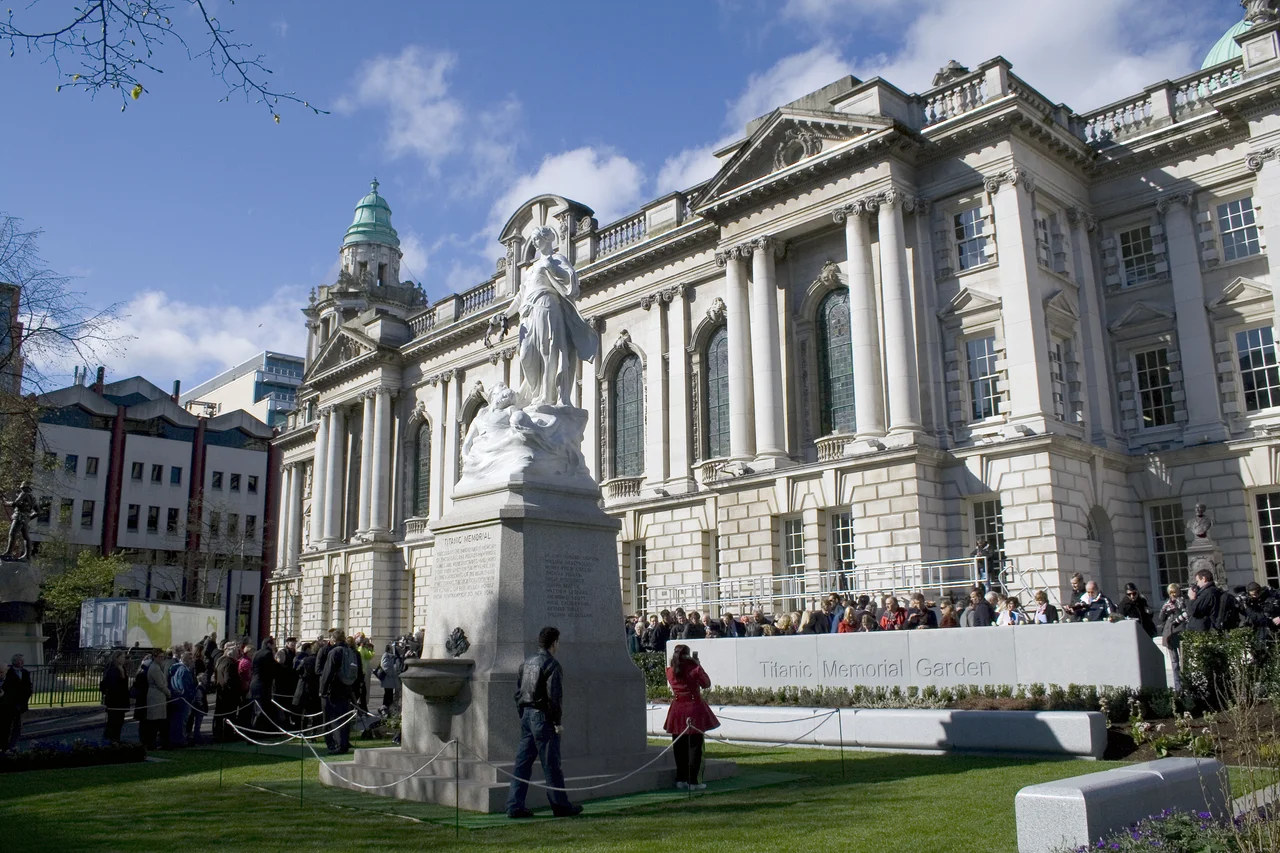

Titanic Memorial, Belfast
On Donegall Square, in the gardens that wrap the eastern side of Belfast City Hall, a woman in white marble holds a black laurel wreath above the head of a drowning sailor. Two mermaids lift him from waves that emerge, frozen, from the top of the plinth. The figures stand twelve feet high on a plinth of another ten. The whole composition was carved by Sir Thomas Brock from Carrara marble in the years after the disaster, and to walk around it today is to read, on bronze plaques arranged in alphabetical order, the names of every one of the 1,512 passengers and crew who died when the Titanic went down on 15 April 1912. It is the only memorial in the world to do that.
A City Decides to Remember
Within days of the sinking, Belfast was already arguing about how to commemorate it. The city had built the ship. Harland and Wolff's draughtsmen had drawn her lines, her riveters had driven her hull plates, and many of the men who went down with her had come from Belfast streets. On 1 May 1912, just two weeks after the wreck, Belfast City Council declared that it "recognises with unbounded pride that in the hour of trial the fortitude of her sons failed not." Two days later, Julia McMordie, wife of the Lord Mayor, chaired a meeting at City Hall that formally proposed a memorial. She and her husband had attended Titanic's launch the previous June and watched the hull slip into the Lagan. They wanted something to set against that memory.
Funding the Marble
The money came in fast, and from people who had reason to care. By the end of May, £1,035 had been raised. About a third was from ordinary members of the public; £231 from employees of Harland and Wolff, who had built the ship; £105 from the White Star Line, who had owned her; and £360 from the family of Thomas Andrews, the ship's designer, who had personally inspected her on the maiden voyage and gone down with her trying to save lives. Sir Thomas Brock was the obvious sculptor. He had already given Belfast its Queen Victoria and its Sir Edward Harland - the very Harland of Harland and Wolff - and was finishing the Victoria Memorial in London. He took the commission on 2 January 1913. Then the First World War broke out and everything stopped.
The 1920 Unveiling
It took until 26 June 1920 to finish the memorial. The dedication ceremony, held on a hot sunny Saturday, was led by Field Marshal Viscount French, the last Lord Lieutenant of Ireland - already by then a political anachronism, since the Irish War of Independence was raging and Ireland would be partitioned within a year. The marble central figure has been variously read as Fame, or as a female personification of Thanatos, the ancient Greek god of death. She holds her wreath out over the figures below: two mermaids supporting the body of a sailor lifted clear of the waves. The plinth's front bears an inscription about heroism. The sides list twenty-two Belfast men who died. They are listed not alphabetically but by shipboard rank, the practice of the time - Thomas Andrews at the top as Managing Director, the firemen and trimmers at the bottom.
Twenty-Two Names, Twenty-Eight Dead
The list on the plinth is incomplete. When the names were chosen, the count of Northern Ireland casualties stood at twenty-two. Later research established that twenty-eight people from Northern Ireland died on the Titanic - four more crew members, one Second Class passenger, and one Third Class passenger whose names never made the marble. Nine of the twenty-two men listed had been part of Harland and Wolff's "guarantee party", a team that sailed on a new ship to fix problems noticed during her maiden voyage. They had expected to come home with notes for the dockyard. Instead, William Campbell the apprentice joiner, Ennis Watson the apprentice electrician, Francis Parkes the apprentice plumber - boys still learning their trades - died in cold water far from the slipway where they had worked.
The Wheel and the Garden
For decades the memorial stood awkwardly in the middle of the road on Donegall Square North, where drivers kept failing to see it and crashing into it. In 1960, exhausted by the accidents, the council moved it a few hundred yards into the City Hall grounds. The little fishing village of Portavogie in County Down had bid to take it altogether, hoping for tourists, but Belfast kept its memorial. Worse came in 2007, when the Belfast Wheel - a giant Ferris wheel - was erected directly on top of it. The Belfast Titanic Society objected; the wheel left in 2010. On the centenary of the sinking, 15 April 2012, a new memorial garden opened around the original sculpture. Five bronze plaques, set on a nine-metre plinth, name every passenger and every crew member alphabetically. The flowers planted around them are magnolias, roses, forget-me-nots, and rosemary, in colours intended to evoke water and ice.
From the Air
The memorial stands at 54.60°N, 5.93°W, in the gardens of Belfast City Hall on Donegall Square, in the city centre. Belfast City Airport (EGAC) is 2 nm east; Belfast International (EGAA) is 12 nm northwest. The huge copper-domed City Hall is the most prominent landmark from low altitude; the Titanic Memorial sits in its east garden. Belfast's Titanic Quarter slipway where the ship was built lies 1 nm to the east-northeast on the River Lagan.
Nearby Stories
- Larne 1.2 km away
- Ahoghill 3.5 km away
- Castleskreen 4.9 km away
- Lough Neagh 6.1 km away
- Kingsmill Massacre 14 km away
- Pasages (steam trawler) 23 km away
- Ballantrae Lifeboat Station 34 km away
- St Patrick's Isle 39 km away