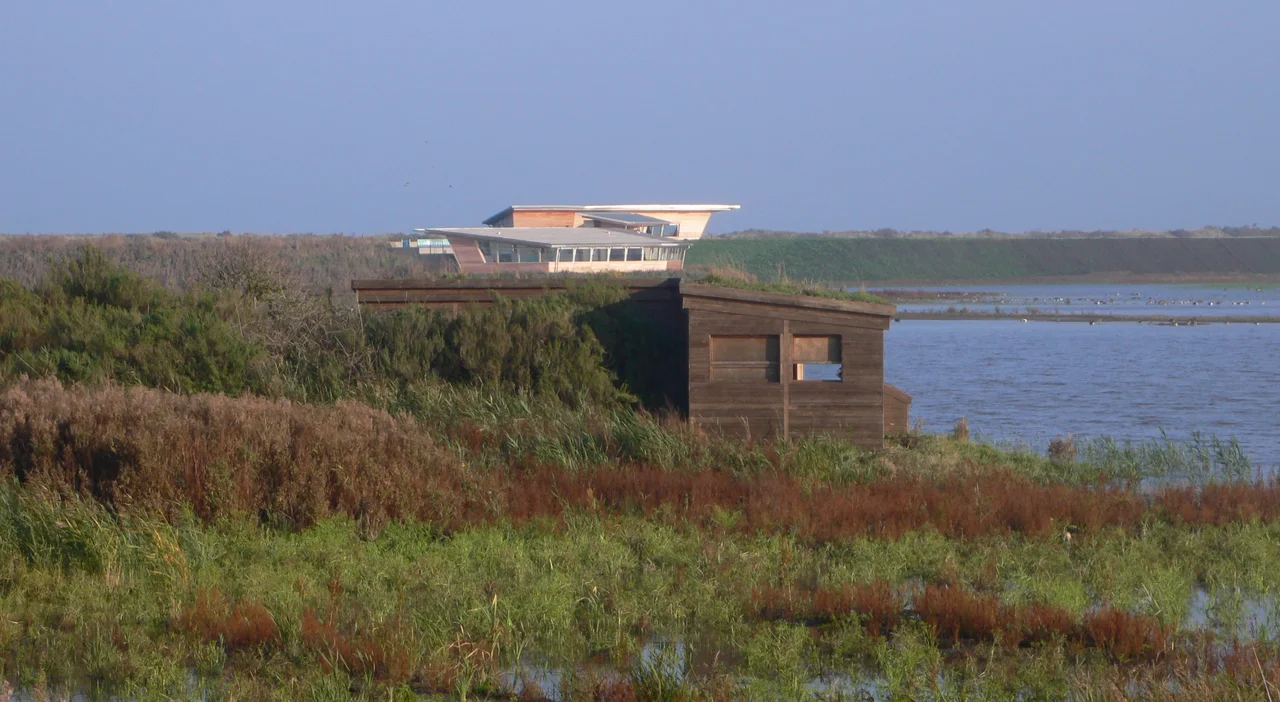

Titchwell Marsh
Walk north through Titchwell Marsh toward the sea and the layers accumulate beneath your feet. Stone Age long blades were found here, dated to a time when the coastline was 60 kilometers further north and this ground was far from any shore. Polished Neolithic axes have turned up in the peat, blackened by centuries of exposure. Bronze Age timber platforms may be preserved in the marshland below. Medieval pottery. Post-medieval plough marks. And then, closer to the surface, the brickwork of a First World War military hospital, concrete from a building used as holiday accommodation until the army returned in 1942, and the remains of Second World War tanks that emerged from the eroding dunes in 1991. Time is not hidden at Titchwell. It surfaces.
A Landscape Made and Remade
The landscape of Titchwell Marsh is not natural in the sense of being untouched. It has been made, unmade, and remade repeatedly by human action and natural force, sometimes in concert and sometimes in conflict.
The marshes were drained for farmland before the Second World War. During the war the drainage was stopped, reflooding the land to create obstacles for any invasion; zigzag ditches were cut, and pillboxes built into Old Lord's Bank. After the war the marshes were drained again and returned to farming. Then the North Sea flood of 1953 breached the bank and returned the whole area to tidal saltmarsh, dominated by sea aster. A new sea wall built across the reserve created a shallow freshwater lagoon with a reed bed on its northern side. And so it went — human intention meeting tidal force, each intervention creating conditions for the next.
The RSPB acquired the site and manages it today as one of the most intensively watched nature reserves in Britain, with about 92,000 visitors annually.
The Birds That Define the Place
Ask a birdwatcher what Titchwell is for, and the answer comes immediately: bitterns, marsh harriers, avocets, bearded reedlings. These are the species the reserve was built around — reed-bed specialists that require exactly the mosaic of habitats that the reserve provides.
Bitterns, famously secretive and extraordinarily difficult to see, stopped breeding on the reserve in 1989 when habitat degradation reduced the fish population the birds depend on. The RSPB intervened systematically: water levels were managed, sections of reed bed excavated to create open pools, and the lagoon stocked with common rudd. Breeding recommenced in 2004. By 2011, two pairs of Eurasian bitterns were nesting.
Avocets — the RSPB's own symbol, an elegant black-and-white wader — nest on the lagoon islands. In 2011, 80 nests were counted. Marsh harriers quarter the reeds on broad wings. Bearded reedlings, tiny birds that spend their lives in the reed stems, flick through the vegetation. And across the seasons, the reserve pulls in rarities: a Pacific golden plover in 2016, a great knot the same year, species far outside their normal range drawn to this convergence of habitats on the Norfolk coast.
The Changing Shore
Titchwell's northern edge has been under attack for decades. The soft rocks of the North Norfolk coast erode; storm surges push further each time; the sea that created the beach and dunes is also consuming them. In 1991 the sea broke through the dunes near the former Tern Hide. In February 1996, storms removed most of the dunes east of the boardwalk.
Rather than reinforce an outer bank that the sea would eventually overcome regardless, the RSPB adopted a policy of managed realignment: allowing the sea to take the outer margin, while strengthening the banks protecting the freshwater lagoon. Between 2010 and 2011, a major project rebuilt the Parrinder bank on its former line, replaced the old hides with two new ones designed by HaysomWardMiller — which won a RIBA architectural award — and deliberately breached the east bank of the former brackish marsh to create what is now called Volunteer Marsh, a new area of tidal saltmarsh that will slow erosion of the rebuilt bank behind it. Climate change is making the calculations harder; the projected outcomes keep shifting. But the reserve continues, adapting as it has always adapted.
Everything That Lives There
The headline birds draw the visitors, but the reserve holds more. Water voles — endangered across Britain, largely due to predation by American mink — remain common at Titchwell, which is now one of a number of East Anglian sites of national importance for the species. Both common and grey seals appear off the beach. European eels move through the waterways. Common toads and three-spined sticklebacks live in the ditches and pools.
On a warm July day in 2010, 90,000 silver Y moths were recorded on the reserve feeding on sea lavender — a single-day count that illustrates the scale of insect migration that moves through this coastal location in summer. The saltmarsh contains its own succession of plants: glassworts in the most exposed areas, then sea aster, then sea lavender, with sea purslane in the creeks and sea plantain in drier spots. The reedbeds are dominated by common reed, with saltmarsh rush and brackish water crowfoot filling the margins. All of it is visible from the boardwalks, the bird hides, and the seawatching platform — a reserve built for looking, where the looking always rewards.
From the Air
Titchwell Marsh lies at 52.963°N, 0.604°E on the north Norfolk coast, between the villages of Titchwell and Thornham, approximately 8 km east of Hunstanton. The nearest airports are King's Lynn (EGYL) to the south-west and Norwich International Airport (EGSH) roughly 70 km to the south-east. From the air, the reserve's distinctive landscape is visible: the patchwork of reed bed, open lagoon, and saltmarsh behind the dune line, with the main access track running north from the A149 to the beach. The managed realignment zone — Volunteer Marsh — sits on the seaward side of the rebuilt Parrinder bank. Best viewed from medium altitude on a clear day, when the color differentiation between reed bed, freshwater lagoon, and saltmarsh is apparent.
Nearby Stories
- Maud Foster Windmill 2 km away
- Cley Marshes 4.3 km away
- Narborough Bone Mill 6.2 km away
- RAF Attlebridge 6.5 km away
- Crowland Abbey 13 km away
- HMS Cobra 19 km away
- Alford Windmill 23 km away
- RAF Binbrook 25 km away