
Tomb of Kha and Merit
When the archaeologists finally cut through the wooden door in February 1906, the lock was so well made that Ernesto Schiaparelli called to his servant for the key. The servant, quite seriously, replied that he did not know where it was. The joke lands because the tomb really did feel that fresh. Behind the door lay the burial chamber of Kha and his wife Merit, an Egyptian foreman and his lady, sealed away beneath the cliffs of the workmen's village of Deir el-Medina for some three thousand four hundred years. The room was packed with their beds and stools, their folded clothes, their food and tools and cosmetics, all of it carefully arranged by mourners who had loved them. Almost every other tomb in Egypt was robbed in antiquity. This one, by sheer luck, was not. It is the most complete glimpse we have of how ordinary, well-off Egyptians actually lived.
The Man Who Built Tombs for Kings
Kha was not royalty. His father, a man named Iuy, held no titles at all, which tells us Kha rose on his own ability. He became the foreman who directed the workmen carving and decorating the royal tombs in the Valley of the Kings, "the Great Place," serving three pharaohs in succession: Amenhotep II, Thutmose IV, and Amenhotep III, across roughly the mid-fourteenth century BC. He earned real recognition for it. One king gave him a gilded measuring rod, a cubit covered entirely in gold leaf; another awarded him a bronze bowl. His greatest honor was the "gold of honor," a collar of heavy gold disc beads given personally by the king for distinguished service, the kind of reward usually reserved for the highest nobles. Kha was wearing it, beneath his bandages, when modern scientists scanned his wrapped body.
Merit
We know less about Merit, as is so often the case with the women of antiquity, but the tomb tells us what mattered. She bore the title "lady of the house," and she and Kha had three children: two sons, Amenemopet and Nakhteftaneb, and a daughter who carried her mother's name. Merit died first, and apparently without warning, sometime in her late twenties or thirties. We can read the shock of it in the burial itself. She was laid in a coffin that had clearly been made for her husband, much too large for her, the inscriptions still naming Kha. There had been no time to prepare her own. Most telling of all, Kha's fine funerary mask was placed not on his face but on hers. He seems to have given his wife his mask, and gone to his own grave, years later, without one.
A Household Packed for Eternity
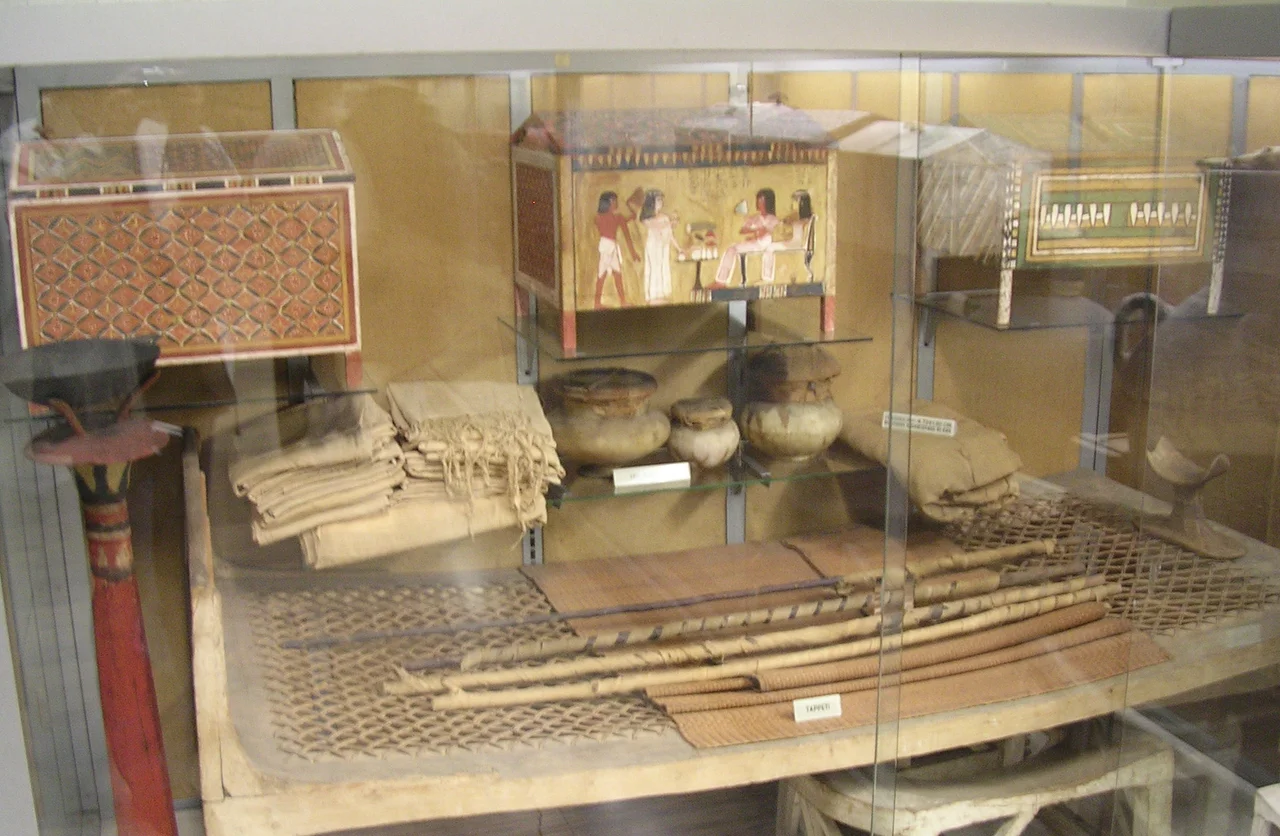
The tomb held more than four hundred and forty objects, and the wonder is how everyday most of them are. Here is Merit's wig, still styled into tight crimped waves, that Schiaparelli said still shone with the perfumed oils worked into it. Here is Kha's folding wooden measuring rod in its own leather case, his razors, his chisels and adze and scribal palettes, the tools of a working life. Their beds were made up with sheets and blankets and headrests. There were stools and chests and lamp stands, a board game, even what appears to be the only surviving wooden toilet seat from ancient Egypt. The Egyptians believed the dead needed what the living needed, so the couple's own furniture was carried from their house and arranged around them, some of it given a fresh coat of paint for the occasion.
Bread, Wine, and the Smell of Three Thousand Years
They were not sent hungry into the afterlife. The tomb was stocked with food piled on tables, in bowls, and sealed in jars: loaves of bread in a greater variety than has been found in any other tomb, some shaped like triangles, some like trussed animals. There were salted meats and roasted birds, salted fish, vegetables seasoned and bundled, garlic and onions, grapes, dates, figs, almonds, juniper berries. The wine jars were labeled with their vintage and vineyard, like any good cellar. Modern researchers, using non-invasive chemical analysis rather than breaking the seals, have detected oils, fats, beeswax, and resins still inside. One recent study even reconstructed the scent of the tomb, the faint, complex perfume of an ancient pantry, so that visitors might smell what the excavators smelled when the door first opened.
Turin, and the Couple Who Were Never Unwrapped
Almost the entire contents went to Italy. Gaston Maspero, who ran Egypt's antiquities service and had been Schiaparelli's mentor, allowed the find to leave, and since 1906 it has filled an entire gallery of the Museo Egizio in Turin, redesigned several times as the most complete non-royal burial Egypt has yielded. Kha and Merit themselves have never been unwrapped. Schiaparelli chose to leave them undisturbed, and modern Egyptologists have honored that, studying them only with X-rays and CT scans. The images reveal a robust man who died in his sixties with worn teeth and arthritic knees, and a slighter woman who died young, both still wearing the gold jewelry of their station. They lie in Turin today, a husband and wife who managed, against three thousand years of odds, to stay together, and to keep almost everything they owned.
From the Air
The Tomb of Kha and Merit (TT8) lies at the northern end of the Deir el-Medina necropolis on the Theban west bank, near 25.728N, 32.601E, west of the Nile across from Luxor. There is little to pick out from the air, just the ruined remains of the workmen's village of Deir el-Medina tucked in a small desert valley between the Valley of the Kings to the north and the Valley of the Queens to the southwest. Use the Ramesseum (about 1.5 km northeast) and the line of mortuary temples at the desert's edge as visual anchors. Best appreciated from 1,500 to 3,000 feet AGL over the Theban Necropolis. Luxor International Airport (HELX / LXR) is roughly 9 km east across the river. Skies over Upper Egypt are typically clear, with possible spring dust haze during khamsin winds.
Nearby Stories
- Temple of Seti I (Abydos) 20 km away
- Dendera Temple complex 21 km away
- Esna 22 km away
- Abydos, Egypt 49 km away
- Mersa Gawasis 116 km away
- Kharga Oasis 147 km away
- Hurghada 184 km away
- Wadi El Gemal National Park 238 km away