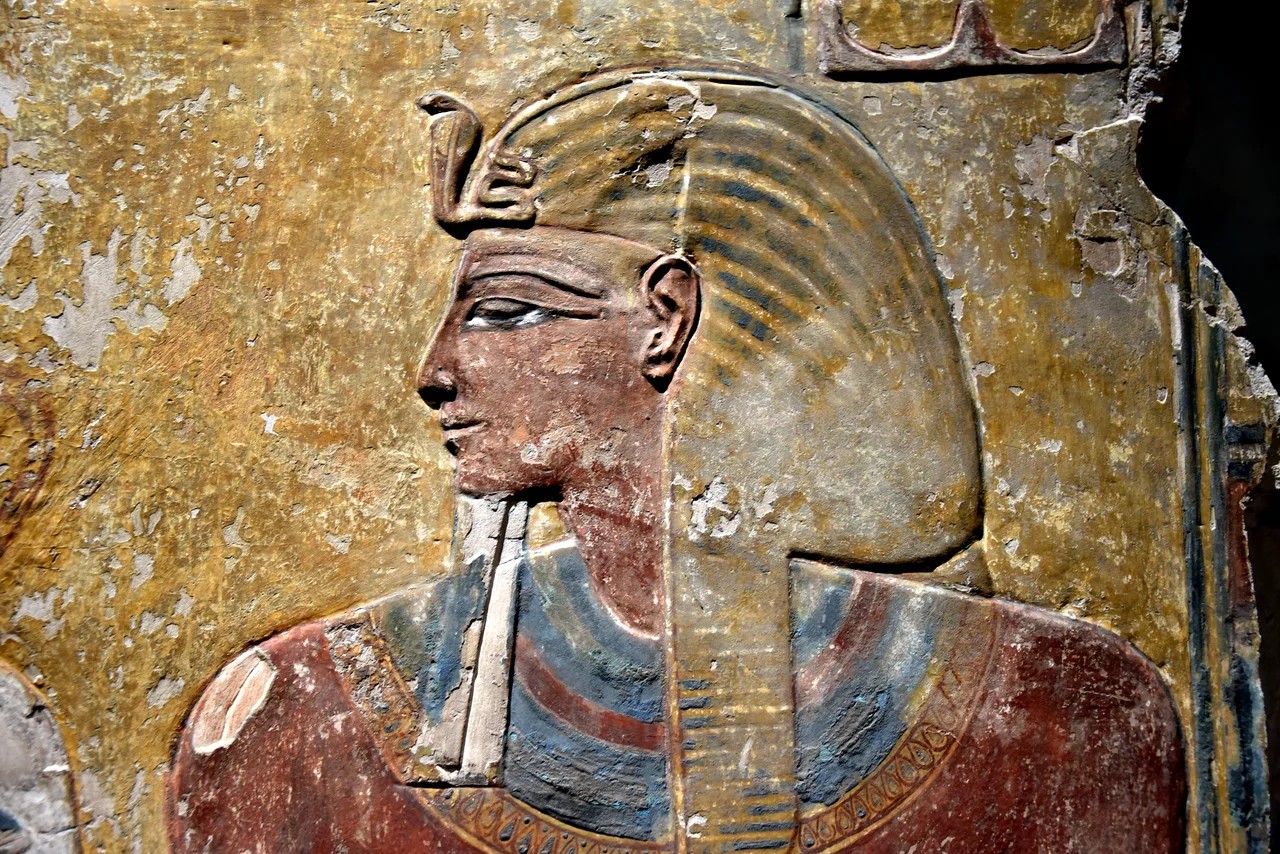

Tomb of Seti I
On 16 October 1817, a six-foot-seven Italian who had once performed as a circus strongman in London squeezed through a gap in the Theban hills and into the most beautiful tomb anyone had ever found. Giovanni Belzoni called it "a fortunate day," and he was not exaggerating. The paint on the walls still looked fresh. Some of the ancient artists' brushes and pigments lay where they had been set down more than three thousand years before, as though the decorators had stepped out for a moment and never returned. This was KV17, the tomb of the pharaoh Seti I, and it remains the longest, deepest, and most lavishly decorated royal tomb in the entire Valley of the Kings.
A Staircase Into the Mountain
KV17 plunges 137 meters into the bedrock, descending through corridor after corridor along an axis that wiggles before it steepens, then opens into hall after carved hall. Reliefs cover nearly every surface in all but two of its chambers. Seti stands before Ra, before Hathor, Horus and Neith, his figures cut in delicate raised relief and washed in color. The ceiling of the burial chamber bears a vaulted astronomical sky, mapping the circumpolar stars and constellations. Beneath the spot where the sarcophagus once stood, a mysterious tunnel slopes still deeper into the rock. Excavators have chased it down 174 meters, through two staircases, only to find it stop abruptly at the bottom of the second. No one knows for certain why it was cut.
The Showman From Padua
Belzoni was no trained scholar. Born in Padua, he had worked English fairgrounds as "the Patagonian Samson," lifting platforms full of men, before turning his strength and showmanship toward Egypt on behalf of the British consul Henry Salt. He had a genius for moving enormous objects, and an equal talent for damage. To copy the reliefs he made "squeezes," pressing wet wax and plaster against the carvings; when they dried, they pulled the ancient color away with them. He hacked whole sections of relief off the walls to ship to Europe. He cleared rubble that had been holding back flood water, and in later years the tomb flooded, ruining stretches of the entrance decoration he had so admired. The hands that opened the finest tomb in the valley also helped to scar it.
Scattered Across Europe
Seti's tomb was dismembered piece by piece and carried to the museums of the West. The pharaoh's sarcophagus, carved from a single block of translucent alabaster and covered inside and out with the spells of the Book of Gates, was offered first to the British Museum. They balked at the price. In 1824 the architect Sir John Soane bought it instead for 2,000 pounds and installed it in the basement of his London house, where it still glows when lit from within and remains one of the museum's treasures. Champollion, who had cracked the hieroglyphic code on the Rosetta Stone, cut a painted panel from a corridor wall during his 1828 expedition. Other fragments went with his colleagues. Today pieces of KV17 sit in the Louvre in Paris, the Egyptian Museum in Florence, and the Neues Museum in Berlin.
The Empty Coffin
When Belzoni reached the burial chamber, the alabaster sarcophagus was there, but the king was gone. Seti's mummy had been moved long before, by ancient priests trying to protect their rulers from the wave of tomb robbery that swept Thebes at the end of the New Kingdom. They eventually hid him, along with three dozen other royal mummies, in a cliff cache at Deir el-Bahari, where he was rediscovered in the nineteenth century with his face remarkably preserved. The tomb that had been built to keep him for eternity could not, in the end, hold him. Modern conservators have laser-scanned its walls and built full-scale facsimiles of two of its halls, an attempt to preserve in copies what the original has slowly lost. As of 2025 the real tomb is open again to visitors willing to make the long descent.
From the Air
KV17 lies in the main East Valley of the Valley of the Kings, on the west bank of the Nile at Luxor, near 25.750 N, 32.614 E. The tomb is deep underground and not visible from the air, but the barren limestone amphitheater of the royal necropolis, ringed by the pyramid-shaped peak of al-Qurn, is an unmistakable landmark, with the cultivated Nile valley and Luxor a few kilometers to the east. Recommended viewing altitude is 3,000 to 6,000 feet AGL. The nearest airport is Luxor International (ICAO HELX, IATA LXR), roughly 10 km east across the river. Expect clear skies and long visibility almost year-round, with afternoon dust haze the most common limitation.
Nearby Stories
- Temple of Seti I (Abydos) 20 km away
- Dendera Temple complex 21 km away
- Esna 22 km away
- Abydos, Egypt 49 km away
- Mersa Gawasis 116 km away
- Kharga Oasis 147 km away
- Hurghada 184 km away
- Wadi El Gemal National Park 238 km away