
Tout Quarry
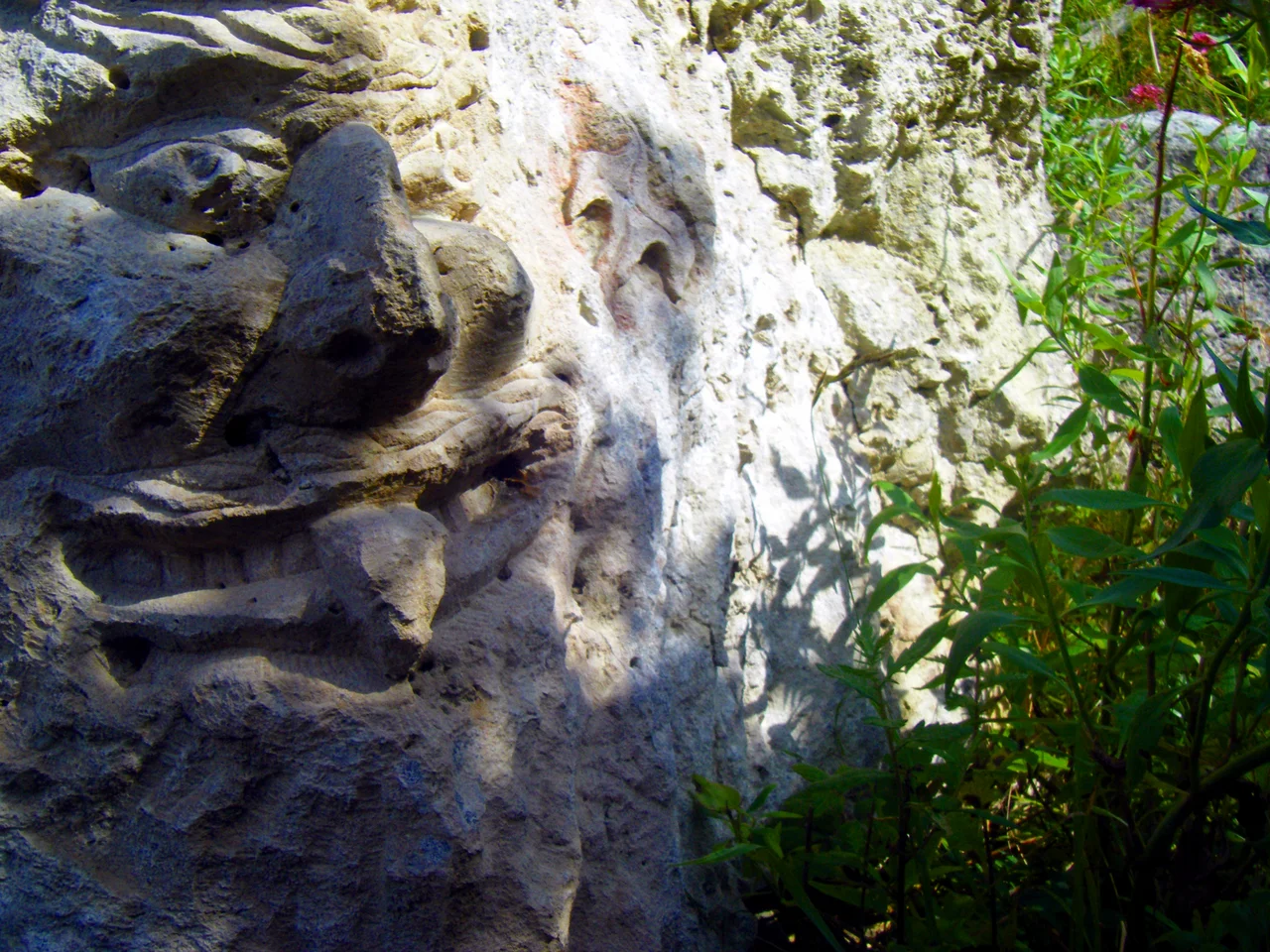
A man is falling out of the cliff. Carved straight into the living rock, head-down, arms still trailing - Antony Gormley's Still Falling has been in mid-descent since 1983, when the sculptor cut it directly into the limestone face of Tout Quarry. He never lands. Walk the path another few minutes and you find Stephen Marsden's Fallen Fossil, a stone creature half-emerging from its bed. Then Hearth, where Timothy Shutter has carved a fireplace into a chunk of Portland stone as if the rock itself were a Cotswold cottage. The quarry once shipped its stone across the world. Now it keeps the stone, and what artists have done with it.
The Quarry Stops Quarrying
Tout Quarry was worked commercially through the 18th and 19th centuries, sending block stone down the Merchant's Railway to Castletown for ships waiting at the quay. The last working contract came in 1982: thirty thousand tons hewed out of the ground and dropped into the sea as defences against the very erosion that the cliffs are subject to. After that the quarry was scheduled for further extraction, which would have meant the disappearance of the place altogether. In 1983, the Portland Sculpture and Quarry Trust intervened. Sculptors would come in, work directly on the limestone, and turn the abandoned workings into a park. The park opened that same year, and the bulldozers never came back.
Carving in Situ
The trust's working philosophy is summarised in its motto: to preserve knowledge and understanding of stone and the landscape from which it comes. That means the carving happens here, on the rock, not in a studio. An outdoor workshop sits within the quarry, and from May to September each year the trust runs courses in stone carving, direct carving, lettercutting, relief carving and architectural detail. Students arrive in shorts and dust masks and leave covered in pale Portland limestone, which is the same stone Sir Christopher Wren ordered shipped up the Thames to face St Paul's Cathedral in the 17th century. The Drill Hall down the road serves as the indoor headquarters when the weather turns. In 2008 the trust was runner-up in the British Urban Regeneration Association awards for community-inspired regeneration.
Over Seventy Sculptures
There are more than seventy works scattered through the quarry, and the joy of the place is that you don't get a map at the gate. You walk, and you find them. Some are obvious - Gormley's falling figure, Justin Nicol's Window cut straight through a free-standing wall of stone, Shelagh Wakely's Representation of a Baroque Garden carved into a flat slab. Others appear only when the light is right. Patrick Howett's A Homage to Lichen rewards a close look at a rock face you might otherwise walk past. Phillip King of the Royal College of Art brought students here to make a Zen Garden. Groupe 85 from the Netherlands built a Cirkel van Stenen, a stone circle. Dhruva Mistry's Woman on Rock simply sits in the landscape. The arrangement is not curated in any conventional sense - sculptures sit where their makers found stone to use.
Tramway Lines and Cliff Edges
The bones of the working quarry are still here, and they tell their own story. Old tramway lines run through the ground, the channels they cut still legible where they once carried stone waste to the cliff edge to be tipped into the sea, or block stone to Priory Corner for the journey to Castletown and the ships. Ravines drop suddenly to the western cliffs - the same west-facing edge of Portland where Chesil Beach begins its eighteen-mile run toward Abbotsbury. The trust has left these working scars in place. A sculpture park that pretended its site was virgin landscape would be missing the point entirely. The point is that this is what an industrial site can become when a culture decides to do something other than fill the hole back in.
Walking the Paths
Entry is free, the gates are always open, and the place is governed by nothing more than the goodwill of visitors not to climb on the sculptures. Around 2004 the site picked up an additional designation as a nature reserve, and on a still summer evening you can hear larks above the limestone. The quarry sits at Tophill in the northwest corner of the Isle of Portland, just inland of the western cliffs, and on a clear day the view from the upper paths reaches across Chesil Beach and Lyme Bay all the way to Devon. Bring sturdy shoes - the ground is uneven, the stones are loose in places, and you will want to climb a little to find the works tucked into the corners. Bring time, too. You can spend an hour here and miss most of what is on offer.
From the Air
Tout Quarry at 50.5531 N, 2.4446 W on Tophill in the northwest of the Isle of Portland. The quarry shows from above as an irregular cluster of pale limestone excavations just inland of the western cliffs, where the long curve of Chesil Beach begins its run toward Abbotsbury. Nearest controlled fields are Bournemouth (EGHH) about 50 km east and Exeter (EGTE) roughly 95 km west. Portland Heliport lies just east on the harbour side of the island, so monitor for rotary traffic. Recommended cruise 2,500-4,500 ft for a view that takes in the quarry, the breakwaters of Portland Harbour, and the start of the Chesil tombolo.
Nearby Stories
- Needles Lighthouse 18 km away
- Lyme Bay Canoeing Disaster 19 km away
- HMS Formidable (1898) 19 km away
- National Motor Museum, Beaulieu 22 km away
- Sherborne Castle 22 km away
- Muchelney Abbey 24 km away
- German Submarine U-672 29 km away
- Battle of Cherbourg (1864) 58 km away