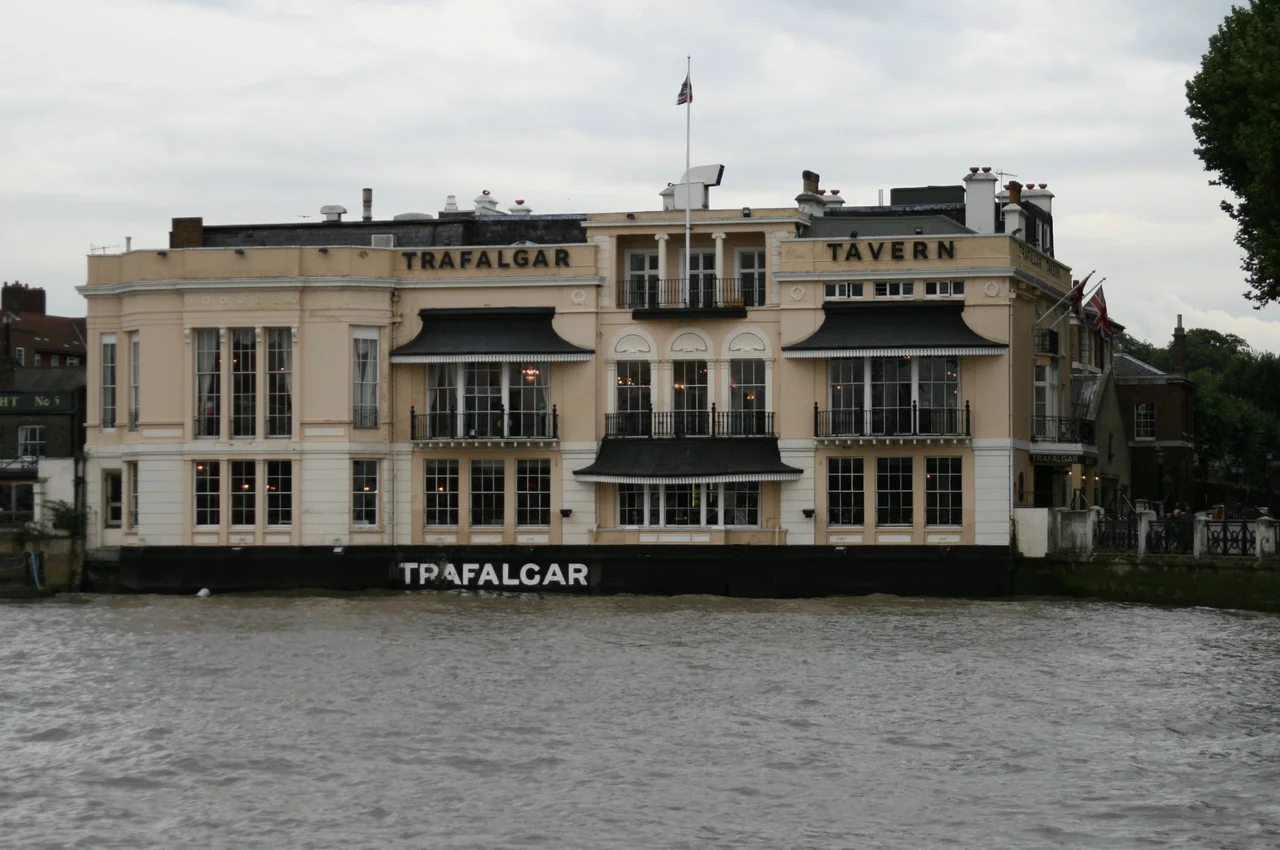

Trafalgar Tavern
When the tide comes in on the Thames at Greenwich, the river laps directly against the wall of the Trafalgar Tavern. Step out the front door and the water is right there - close enough that on a stormy evening you can taste it on your lip. The pub has stood at this spot since 1837, two years after Nelson's body passed through Greenwich on its way upriver to Westminster, and the building has been collecting maritime memory ever since.
The Whitebait Dinner
Whitebait - the tiny silvery fish that swarm in the Thames estuary in summer - was the pub's nineteenth-century calling card. Cabinet ministers came down from Westminster by river to eat them. Charles Dickens hosted dinners here, ordering whitebait by the platter and finishing the evening with rolling speeches. He set a scene in Our Mutual Friend at a Greenwich tavern that readers have argued about ever since - was it the Trafalgar, or the rival Ship next door? Dickens declined to settle the question, but the Trafalgar has not. Generations of landlords have hung the pub with reminders of the connection, and the bow-windowed first-floor dining room still looks out across the same river to the same Isle of Dogs Dickens knew.
A Pub Pretending to Be Older Than It Is
The building you see today is Georgian in style but early Victorian in date - 1837, the year Victoria came to the throne. The bow windows and the recessed riverside loggia are part of a deliberate maritime grand gesture, designed to draw the carriage trade from the West End down to the river. Then came war. German bombs in the early 1940s gutted much of the interior. When the Trafalgar was put back together after 1945, the work was done in what the official Grade II listing later called 'the style of 1780' - a careful fake of a period the pub had never actually lived through. The result is one of London's more elaborate architectural lies, and one of its most affectionate. Outside, a bronze Horatio Nelson stares out at the river. The sculptor had access to Nelson's life mask and the archives of the National Maritime Museum just up the lane, and worked for two years in a studio behind the pub itself.
The Biggest Purpose-Built Pub in Britain
At 35,000 square feet, the Trafalgar has been called the largest purpose-built pub in the United Kingdom. The space has done many jobs. During the First World War, parts were repurposed for war work. In the 1920s it became a working men's club. In 1933, in the depths of the Depression, it served as a centre for the unemployed. For a time it was a fire station. None of these incarnations stuck for long - the building's vocation has always been hospitality. Today's interior is hung with maritime paintings and historic seafaring artefacts: a private collection grown over decades, displayed not in glass cases but among the drinkers.
Greenwich at the Door
Step outside the Trafalgar and the rest of Maritime Greenwich opens up. The Old Royal Naval College and the painted hall lie a short walk west. The Cutty Sark, restored in dry dock, marks where the river bends. The National Maritime Museum sits behind, and Greenwich Park rises south to the Royal Observatory and the Prime Meridian. All of this together makes a UNESCO World Heritage Site, and the Trafalgar Tavern sits, almost cheekily, at its eastern edge. The Curlew Rowing Club premises next door round out a small Grade II listed group that has been quietly holding this stretch of river for nearly two centuries.
Modern Frictions
Heritage buildings make difficult businesses. The Trafalgar's recent history has been marked by ownership disputes, fines, and planning rows. In 2013 the owners were fined nearly twenty thousand pounds for serious food hygiene breaches. In 2019 a wall inside the listed building was removed without planning permission, opening up the floor plan in a way conservation experts condemned. Plans for upper-floor nightclub use in 2021 drew loud objections from local residents. None of which has dimmed the view. Stand on the river terrace at high tide on a clear evening, with Canary Wharf's towers glinting across the water and the bronze Nelson at your shoulder, and you understand why this corner of London has resisted being anything other than itself for two hundred years.
From the Air
Trafalgar Tavern lies at 51.4846 N, 0.0043 W on the Thames at Greenwich, just east of the Old Royal Naval College. View from 1,500-2,500 ft AGL with the river bend at the Isle of Dogs to the north. Nearest airports: London City (EGLC) 3 nm north-northeast, Biggin Hill (EGKB) 10 nm south, Heathrow (EGLL) 20 nm west. Note the controlled airspace around London City.
Nearby Stories
- Battle of Britain, Northfleet 1.1 km away
- Bayham Old Abbey 5.4 km away
- Catharine Macaulay 6.4 km away
- Hatfield rail crash 8.8 km away
- Chequers 8.9 km away
- Chelmsford Cathedral 10 km away
- Queen Victoria Hospital 13 km away
- Fishbourne Roman Palace 36 km away