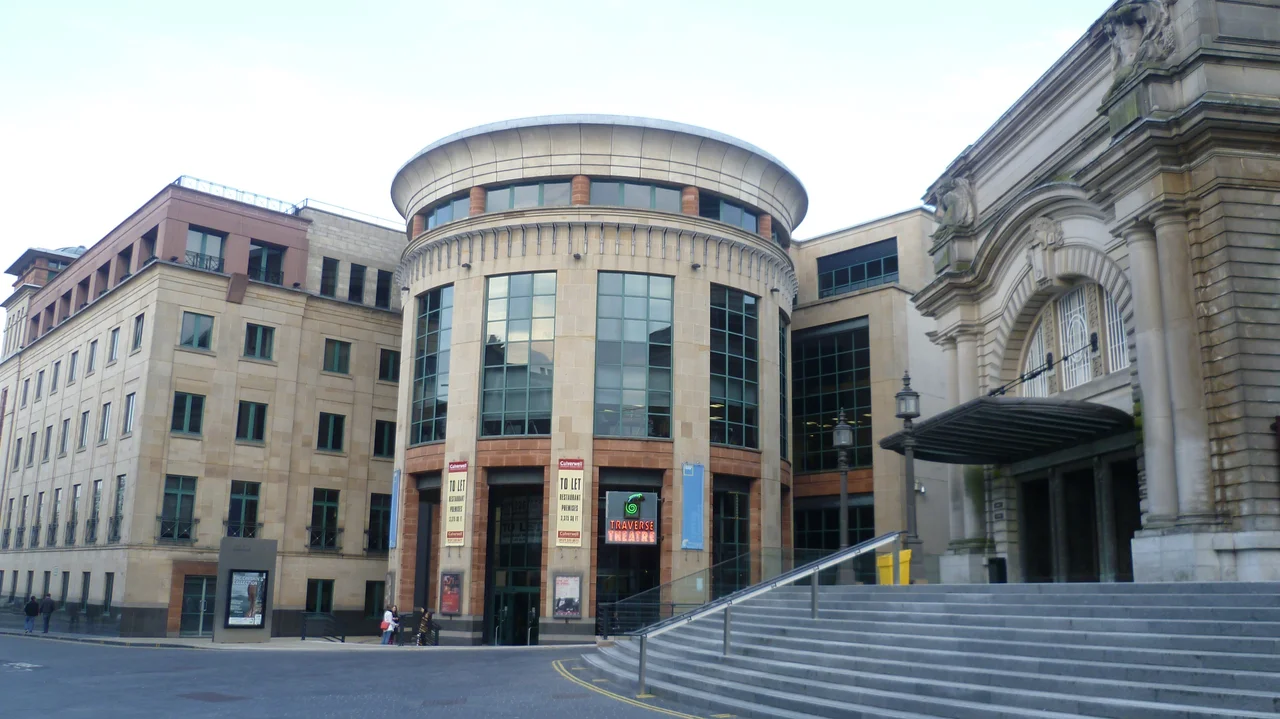

Traverse Theatre
The first venue was a long, low-ceilinged room barely fifteen feet wide and eight feet high on the first floor of 15 James Court in Edinburgh's Lawnmarket. Before the Traverse Theatre Club rented it in 1962, the building had been a doss-house and a brothel known locally as Kelly's Paradise and Hell's Kitchen. Sixty seats salvaged from the Palace Cinema were arranged in two blocks on either side of a strip of floor that served as the stage. The founder Terry Lane mistakenly believed that this kind of staging arrangement was called traverse, which is how the theatre got its name. He later realised the correct term was transverse. By then the name had stuck.
Eight Founders, One Mission
The Traverse Theatre Club was founded in August 1962 by John Calder, John Malcolm, Jim Haynes, Richard Demarco, Terry Lane, Andrew Muir, John Martin, and Sheila Colvin. Edinburgh already had a Festival, but the Festival happened in August and disappeared for the rest of the year. The Traverse's mission was to continue the spirit of the Edinburgh Festivals all year round. The first performance opened on 2 January 1963: Fernando Arrabal's Orison, in a room scarcely larger than a generous living room. The audience sat close enough to see the actors sweat. The Traverse was, from the start, a place for new writing and difficult theatre, not for the polished and the safe.
An Accidental Stabbing
On the second night, 3 January 1963, the lead actress Colette O'Neil was accidentally stabbed on stage. The knife was real. It had caught in the folds of her costume and gone into her side. O'Neil continued through the rest of the performance. A doctor in the audience saw to her at the end, and she was then taken to hospital. The real knife was used because the audience sat so close to the stage, John Martin later said, that a fake knife would have been visible as a fake. Richard Demarco offered a different explanation: they had no money and could not afford a paper one. Either way, the Traverse's commitment to authenticity arrived in its second performance and stayed.
From Sailmaker's Loft to Saltire Court
By 1969 a surveyor's report declared the internal floors of James Court unsafe. The Traverse moved to a former sailmaker's loft at 112 West Bow in the Grassmarket, a larger space with a 100-seat theatre and flexible seating. The first performance there came on 24 August 1969. In its early years the theatre had also included exhibition space for visual arts, run partly by Richard Demarco, who left in 1966 to establish what became the Richard Demarco Gallery. The current Traverse building, a purpose-built theatre on Cambridge Street that cost 3.3 million pounds, opened on 3 July 1992. It has two performance spaces and a bar-cafe, and it sits within the Saltire Court development on Castle Terrace. Lyn Gardner, the theatre critic, has described the Traverse's programme as the backbone of theatre on the Edinburgh Fringe.
The Names That Launched Here
John Byrne. Gregory Burke. David Greig. David Harrower. Liz Lochhead. These are five of the Scottish playwrights whose careers the Traverse helped launch. As an acting venue, the Traverse hosted Tilda Swinton and Forbes Masson in the 1980s, Alan Cumming in a 1988 production of The Conquest of the South Pole directed by Steve Unwin, and Robbie Coltrane in John Byrne's Slab Boys, directed by David Hayman in 1978. Through the 1960s and 70s the actors included Richard Wilson, Timothy Dalton, Billy Connolly, Ann Mitchell, Simon Callow, Bill Paterson, and Steven Berkoff. Bill Nighy and Ashley Jensen both began their careers here. Many of the sponsored seats carry personalised plaques. Robbie Coltrane's reads This is a no farting zone. Tom Conti's says In memory of my longest dry.
Filth on the Fringe
The Traverse was for years a touchstone for what could and could not be staged in Britain. Throughout 1965, when homosexual conduct between adult men was still illegal in Scotland, the Traverse Theatre Club was threatened with police raids because of homosexual themes in its productions and fraternisation among its audience. At the 1967 Edinburgh Festival the Traverse staged 22 shows including Rochelle Owens's Futz, which the Daily Express labelled Filth on the Fringe, and Alfred Jarry's Ubu in Chains, which featured Ma and Pa Ubu costumed as 6-foot-tall sexual organs. In 1971, at a meeting with the Edinburgh Corporation, the Traverse's artistic director Michael Rudman persuaded the city to increase the theatre's grant while refusing to give any assurance about the decency of future productions. The Corporation paid up anyway.
Still the Engine
The Traverse is still home to Imaginate, the Edinburgh International Children's Festival, and still acts as a host venue for Fringe shows each August. Sixteen artistic directors have run it across more than six decades, from Terry Lane through Jim Haynes, Max Stafford-Clark, Mike Ockrent, Philip Howard, Dominic Hill, Orla O'Loughlin, and most recently Gareth Nicholls. The mission has not changed since 1962: continue the spirit of the Edinburgh Festivals all year round, and stage the new work that other theatres will not. Six decades of careers and controversies, knife wounds and giant Ubu organs, all of it traces back to that low-ceilinged room above a former doss-house in the Lawnmarket.
From the Air
The Traverse Theatre sits at 55.95 deg N, 3.20 deg W, on Cambridge Street in central Edinburgh, just south of Princes Street and a short walk from the Usher Hall. From the air, look for Edinburgh Castle a quarter-mile to the east and the green of Princes Street Gardens immediately north. Edinburgh Airport (EGPH) is six miles west. Best viewed from 2,000 to 4,000 feet, using the castle rock, Salisbury Crags, and the Forth bridges as orientation references.
Nearby Stories
- Ardoch Roman Fort 2.2 km away
- Craignethan Castle 3.1 km away
- Haddington 3.8 km away
- Balvaird Castle 4.3 km away
- Battle of Kilsyth 9.4 km away
- Siege of St Andrews Castle 9.9 km away
- Neidpath Castle 11 km away
- Melrose Abbey 15 km away