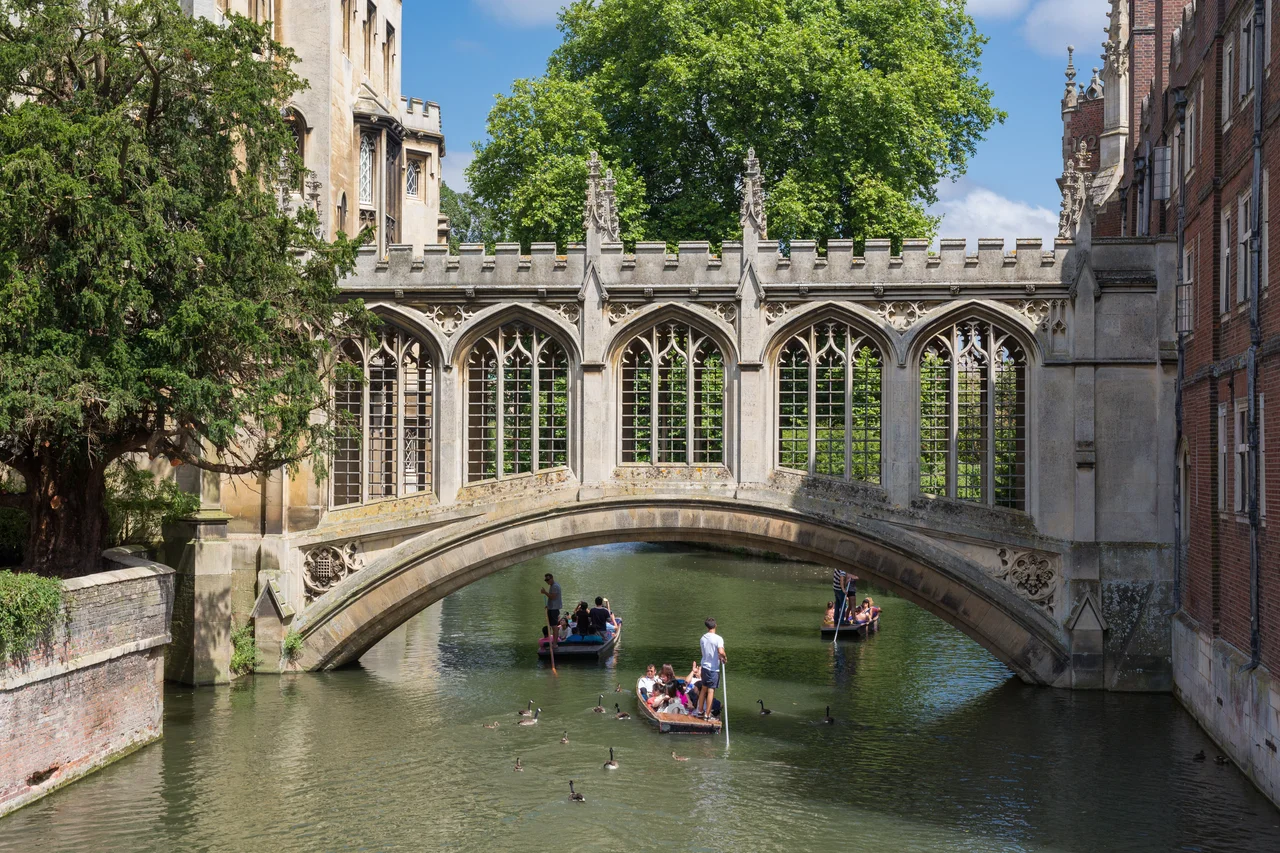

Trinity College Bridge
There have been bridges here for centuries. Parliamentarian forces destroyed one during the English Civil War; the college built a replacement between 1651 and 1652. That replacement served for over a hundred years before the current bridge was built in 1764–65. Stone from the 1651 bridge was reused in the new construction. The new bridge — a triple-arch road bridge of Portland and Ketton stone, designed by the architect James Essex — connected the main buildings of Trinity College with its Fellows' Garden across Queen's Road, and it still does. It carries two coats of arms in stone: that of Trinity College, and that of the man whose money built it.
Three Bridges and a Civil War
The story of Trinity Bridge is, in miniature, a story about continuity and destruction. The original bridge was torn down by Parliamentary forces during the English Civil War — a practical military decision, since bridges controlled movement and Parliamentary and Royalist forces were operating in close proximity throughout the region in the 1640s. Trinity College rebuilt the crossing between 1651 and 1652. For over a century this second bridge served students, fellows, and visitors crossing the River Cam's middle stream. When the current bridge was designed in 1764, the college chose not to waste the old materials. Portland stone and Ketton stone from the 1651 structure were incorporated into the new construction. Trinity Bridge is now the eleventh bridge overall across the Cam and the seventh over its middle stream through Cambridge.
James Essex and the Hooper Bequest
James Essex was the Cambridge architect most closely associated with the university in the mid-18th century. He designed the bridge in 1764, and construction was completed in 1765. Essex was a meticulous craftsman with a deep interest in Gothic architecture; he documented medieval buildings across England and published observations on their construction techniques. The Trinity Bridge commission was one of his civic works — simpler than his more elaborate ecclesiastical projects, but built to last. The money came from the estate of Dr. Francis Hooper, who died in 1763. Hooper had been a Senior Fellow of Trinity College. His bequest paid for the bridge, and in return his family's coat of arms — a triple-turreted shield — was carved into the stone alongside the arms of Trinity College. Both heraldic panels remain in place today.
The Avenue and the Fellows' Garden
Trinity Bridge is not just a crossing but part of a designed route. The bridge connects to the Avenue — a tree-lined path that runs from the main college buildings across Queen's Road and into the Trinity College Fellows' Garden. The garden occupies ground on the far side of the road, separated from the college's main site by the traffic that now flows along Queen's Road. Without the bridge and the Avenue, fellows would have to navigate the road to reach their garden. The arrangement is typical of the way Cambridge colleges have managed the urban expansion of the city around them: by building private passages, gates, and bridges that maintain continuity of the college's world even as the public city presses in. Trinity Bridge is Grade I listed.
Stone Upon Stone
Walk across Trinity Bridge today and you are crossing a structure made partly of materials that have been here since 1651. The triple arches that carry the road are a form that goes back to Roman bridge-building. The Portland and Ketton stone used here — Portland from Dorset, Ketton from Rutland — has been the material of English architecture for centuries: Portland stone also faces St Paul's Cathedral; Ketton stone built many of the Cambridge colleges. The bridge's modest proportions fit the scale of the river and the setting. This is not a monument designed to impress from a distance. It is functional, well-proportioned, and old. The coat of arms above it — of the college and of Francis Hooper, who died the year before the bridge was built — is a reminder that most buildings are built by someone, and funded by someone, and that both facts are worth recording.
From the Air
Trinity College Bridge crosses the River Cam at approximately 52.207°N, 0.114°E, on the western edge of Trinity College's main site where Queen's Road crosses the river. From the air, the triple arches of the bridge are visible at low altitude on the approach from the west; the River Cam and its bridges form a clear navigational line through Cambridge's city centre. Cambridge City Airport (EGSC) is approximately 2 nautical miles to the northeast. The bridge and the tree-lined Avenue connecting it to the Fellows' Garden are best seen at 500–1,000 feet in clear conditions.
Nearby Stories
- Kentwell Hall 2.5 km away
- Thetford Hoard 2.8 km away
- King's Ely 6 km away
- Bedford 7.8 km away
- White House Farm murders 13 km away
- Oundle 14 km away
- Hemel Hempstead 14 km away
- North Weald Airfield 15 km away