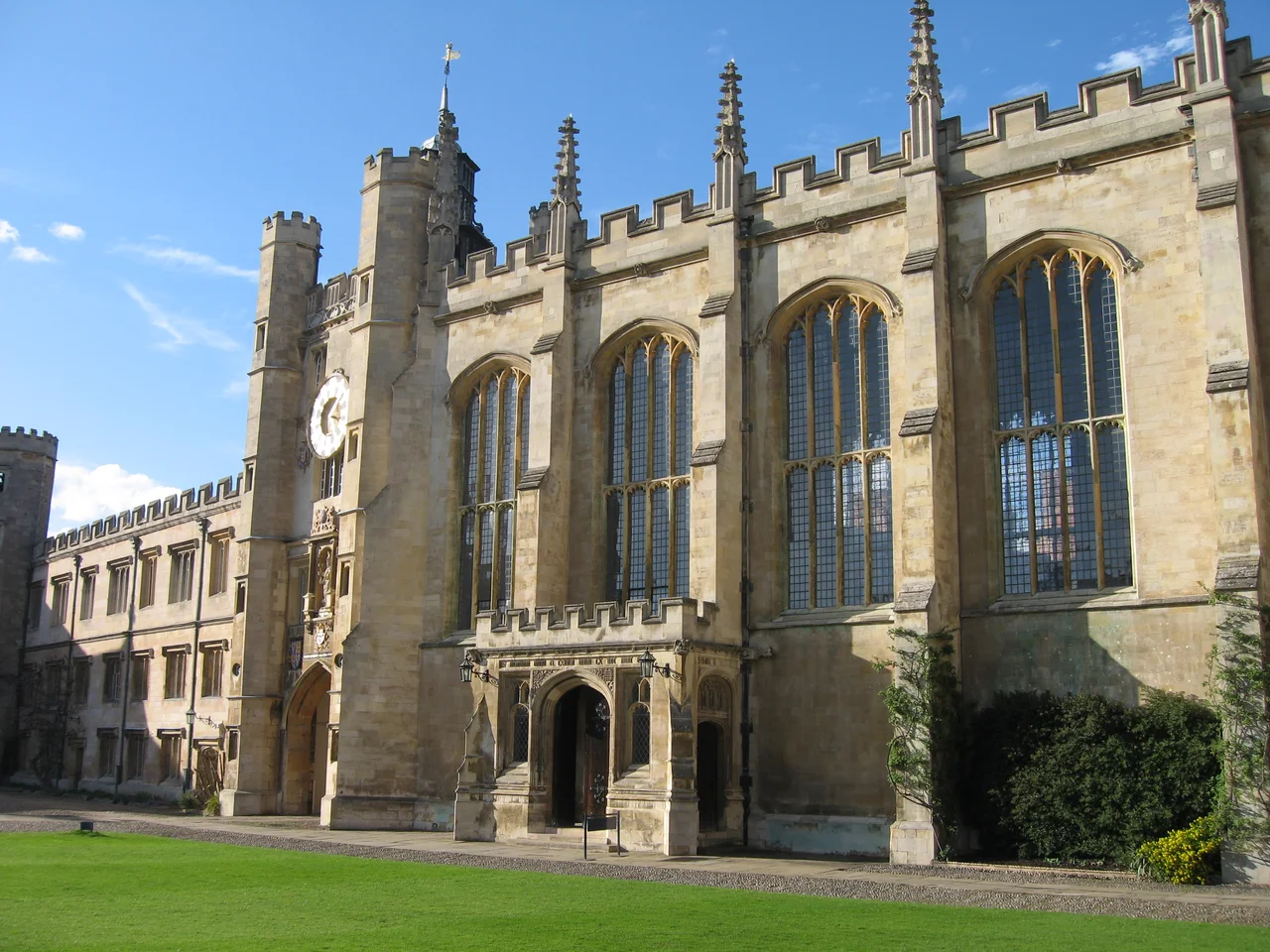

Trinity College Chapel, Cambridge
Two monarchs built Trinity College Chapel — rivals in faith, sisters in blood. Queen Mary ordered its construction in 1554-55, pressing ahead with a Gothic design in the years of England's Catholic restoration. She died in 1558 without seeing it completed. Her half-sister Elizabeth I, who had returned England to Protestantism, saw the work finished in 1567. The chapel's architectural style is Tudor-Gothic with Perpendicular tracery, its pinnacles visible across Great Court. Its Grade I listed status reflects what it contains: centuries of accumulated memory, including statues of some of the most consequential minds in the history of human thought.
Mary's Commission, Elizabeth's Completion
The chapel replaced an earlier structure, inheriting its roof — which may have been re-used from the chapel of King's Hall, the medieval institution that preceded Trinity on this site when Henry VIII merged several colleges to found Trinity in 1546. The original Tudor walls and roof remain, though the walls were refaced in ashlar in the 19th century and the present slate roof is modern. Edward Blore restored the whole chapel in 1832. Arthur Blomfield carried out further work between 1868 and 1873, adding a vestry, choir room, and porch, and reroofing, painting, and glazing the building. The windows installed during Blomfield's era line the north and south walls of the quire: eight windows on the north side, seven on the south, each depicting eight figures arranged in historical sequence — a survey of centuries of Trinity alumni in stained glass.
The Statues in the Antechapel
The antechapel functions as a gallery of stone memory. Francis Bacon, Viscount St Alban — philosopher of empiricism, whose Novum Organum helped lay the foundations of scientific method — stands here, sculpted by Henry Weekes. Isaac Barrow, mathematician and theologian, who recognized Newton's genius and stepped aside to let it develop, is represented by Matthew Noble. Isaac Newton himself is present, in a marble by Louis-François Roubiliac; the statue portrays Newton with a prism in hand, in reference to his experiments with light. Thomas Babington Macaulay, the historian and politician whose History of England shaped how the Victorians understood their own past, was sculpted by Thomas Woolner. Alfred Tennyson stands here too. William Whewell, mathematician, philosopher of science, and Master of Trinity, looks out from the antechapel he helped administer. To stand among these figures is to stand in the accumulated weight of what Trinity considers worth remembering.
The Choir's Long Service
The Choir of Trinity College, Cambridge has been singing daily services in this chapel since the 1670s. It is currently composed of around thirty male and female Choral Scholars and two Organ Scholars, all students at the university. The choir sings Evensong six days a week during term, along with Sung Eucharist on Sunday mornings. Its programme extends beyond the chapel: concerts, recordings, and performances elsewhere. The choir is directed by Steven Grahl. The Anglican tradition it serves — in the Anglo-Catholic strand — has been continuous in this building for over three and a half centuries, threading through the political upheavals, restorations, and revolutions that transformed England in that time. The building that Mary began and Elizabeth completed has outlasted both their dynasties many times over.
Memorials and a Burial Ground
The chapel holds many memorials to former fellows of Trinity — statues, brasses, and commemorative plaques, including two memorials to graduates and fellows who died in both World Wars. Several graves from earlier centuries are also present. The Ascension Parish Burial Ground associated with Trinity contains the graves or interred cremations of twenty-seven fellows, including three Vice-Masters. The Dean of Chapel holds responsibility for the chapel and its clergy; the position has been held continuously since at least 1873. The current Dean is Michael Banner, who has held the post since 2006. The chapel's list of memorials reads like a catalog of contributions to British intellectual, scientific, and public life across five centuries — a record not of a single moment of brilliance but of the sustained output of a community that has existed in the same place, under the same stone, for the same purpose, since the mid-16th century.
Inside a Living Landmark
The windows of Trinity College Chapel are among its less-discussed glories. The fifteen windows that line the quire each depict eight figures from Trinity's history, arranged in rough historical sequence and funded by alumni in memory of alumni. They constitute a visual narrative of the college's self-understanding: who it was, who it produced, what it valued. The whole chapel was restored in the 19th century with enough care that the transition from Tudor original to Victorian intervention is mostly seamless. The roof may carry timbers older than the building itself. The walls carry centuries of names. The choir carries a sound unchanged in essential character since the 17th century. Trinity College Chapel is, in the most literal sense, a place where history is an ongoing practice rather than a past condition. The services continue. The statues stand. The windows illuminate the same stone they have always illuminated.
From the Air
Trinity College Chapel sits at the north end of Great Court at approximately 52.207°N, 0.117°E, at the heart of Trinity College in central Cambridge. Cambridge City Airport (EGSC) is about 2.5 miles to the east. The chapel is identifiable from the air by its position within Trinity's Great Court, the largest enclosed court in any Oxbridge college. The distinctive pinnacles and Gothic roofline are visible alongside the Cam. Approach at 1,500 feet from the east for a clear view of the college complex.
Nearby Stories
- Walden Abbey 4.6 km away
- Bury St Edmunds 5.5 km away
- RAF North Pickenham 8.1 km away
- Ampthill 9.5 km away
- RAF Wittering 10 km away
- Murder of Una Crown 12 km away
- Colchester Community Stadium 18 km away
- John Bunyan Museum 19 km away