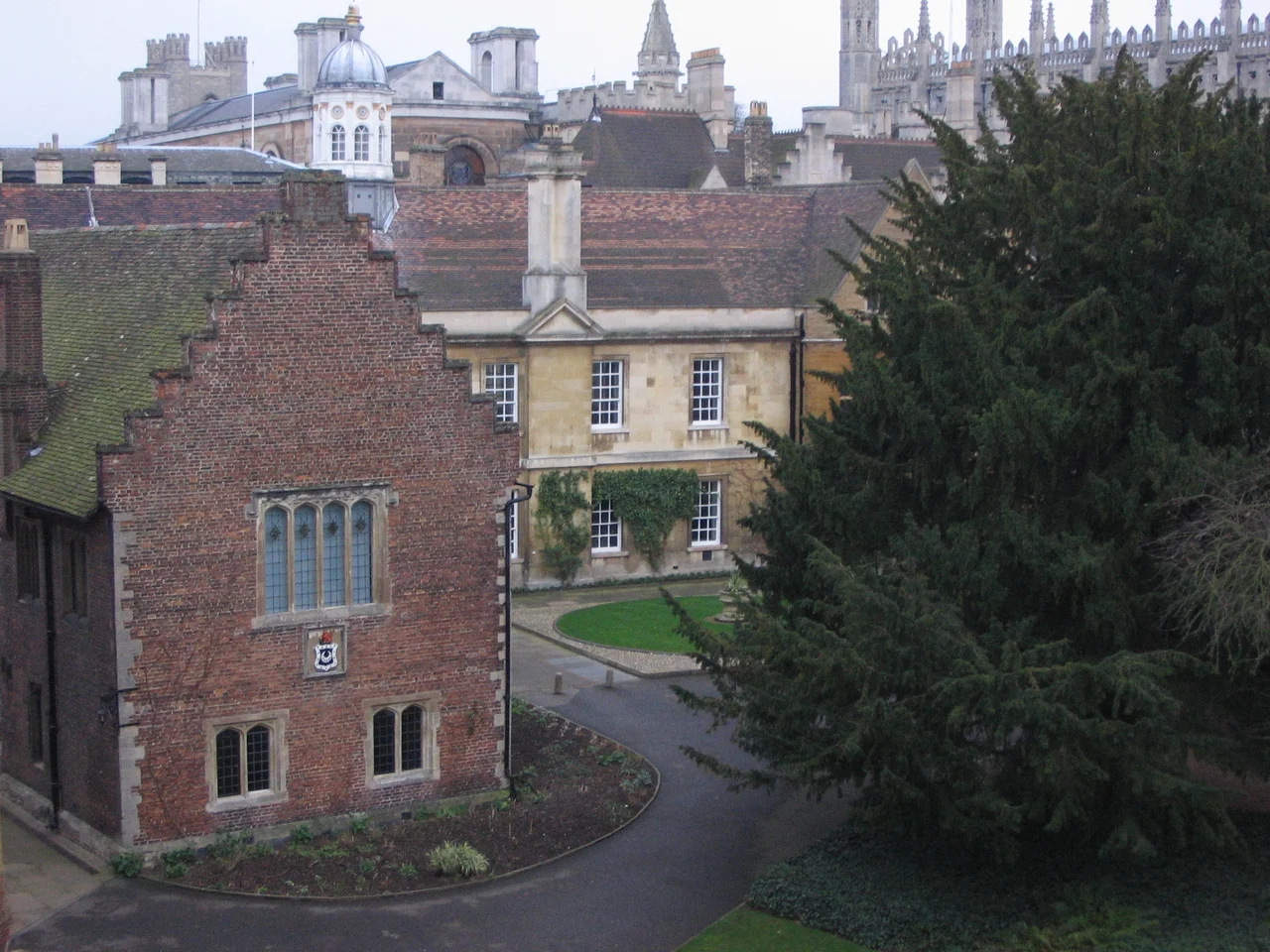

Trinity Hall, Cambridge
The Black Death killed nearly half of England in the 1340s. Bishop William Bateman of Norwich lost almost 700 of his parish priests. His response was to found a college. In 1350, on a stretch of Cambridge riverbank that an earlier college had failed to keep, Bateman established Trinity Hall with a very particular mission: train clergymen in canon law, rebuild the priesthood, and save the diocese. It was an act of institutional grief that became one of England's great academic homes.
Born of Plague
Bateman's founding charter declared the college's aim to be "the promotion of divine worship and of canon and civil science and direction of the commonwealth." The site he chose had belonged to Gonville Hall, which had been struggling financially after its own founding just three years earlier. Bateman purchased a house from John de Crauden, Prior of Ely, and within a few decades Front Court had been built — the medieval structures that still stand today, though their façades were reshaped into baroque elegance during the eighteenth century. The legal focus Bateman embedded into Trinity Hall's bones endured. For nearly seven centuries, the college has produced lawyers, judges, chancellors, and Lords Chief Justice in numbers disproportionate to its modest size. When you walk through its quiet courts, you are walking through ground shaped by one man's determination to recover something from catastrophe.
A Name Worth Keeping
There is a wrinkle in this college's story that students delight in explaining to bewildered visitors. Its formal name is Trinity Hall. Not Trinity Hall College — that would be wrong. But the reason it kept "Hall" rather than adopting "College" like most of its peers involves Henry VIII, royal spite, and a master who made the wrong political choice. When Henry founded the enormous Trinity College next door, the name left Trinity Hall permanently boxed in. The story goes that the college's master at the time, Stephen Gardiner, had opposed the king's remarriage — and the naming of that vast, royal institution next door may have been a kind of punishment. Trinity Hall was left with its medieval title while a far grander neighbour claimed the more prestigious word. Small college, complicated history.
Libraries, Chapels, and Hidden Rooms
Trinity Hall's Elizabethan library, built with the permission of Queen Elizabeth I in the late sixteenth century, is one of the few remaining chained libraries in England — books literally fastened to their shelves to prevent theft, an entire theology of knowledge-as-property. The chapel was licensed in 1352 and built by 1366; its current interior dates from a 1729–30 renovation in which master Nathaniel Lloyd had old graves relocated to the Ante-Chapel and decorated the walls with wainscotting. When the chapel was extended eastward in 1864, workers discovered the original piscina behind a secret door. The Jerwood Library, opened in 1999, sits at the opposite end of the college's history — a glass-and-stone structure overlooking the River Cam beside Garret Hostel Bridge, stores the modern collection where the chained books once held secrets.
The People Who Passed Through
The alumni list of a college this size should perhaps not contain a theoretical physicist who redefined cosmology, a Canadian media theorist who predicted the internet, an Oscar-winning actress, two Soviet spies, and a future Australian prime minister. But Trinity Hall's does. Stephen Hawking read physics here before his postgraduate work; Marshall McLuhan shaped his ideas about media in these courts; Rachel Weisz prepared for an acting career; Donald Maclean attended the Hesperides literary society before becoming one of the Cambridge Five. The Hesperides itself, founded in 1923, hosted T.S. Eliot and J.B. Priestley in its early years, and counted the spy Maclean among its "old Hesperideans" before disbanding in 1976. It was re-founded in 2020. Trinity Hall Boat Club, meanwhile, held the Head of the Mays for 33 consecutive days from 1890 to 1898 — the longest continuous defence of the bumps headship in Cambridge history.
A Small College with Long Reach
Trinity Hall's compactness is part of its identity. Between the river and the old courts, between the Elizabethan library and the modern Jerwood, between the plague-era founding and today's students punting on the Cam — everything feels within reach of everything else. Other Cambridge colleges may have grander chapels or more famous quads. Trinity Hall has continuity. The wainscotted dining hall still displays the unmovable portrait of Nathaniel Lloyd, who allegedly had it fixed permanently into the wood panelling so his likeness could never be removed. The painting behind the communion table — Maso da San Friano's Salutation, on loan from the Fitzwilliam Museum since 1957 — still hangs where it was placed. Some things in this college are fastened down on purpose.
From the Air
Trinity Hall sits on the west bank of the River Cam in central Cambridge, at approximately 52.206°N, 0.116°E. From the air, look for the distinctive riverside cluster of medieval and baroque buildings just south of Trinity College's great courts. Cambridge Airport (EGSC) is about 3 miles to the northeast. At 2,000–3,000 feet the full layout of the Cambridge colleges along the Cam becomes clear, with the green strip of The Backs providing a strong visual reference. Best viewed in morning light when the river catches the sun.
Nearby Stories
- Kentwell Hall 2.5 km away
- Thetford Hoard 2.8 km away
- King's Ely 6 km away
- Bedford 7.8 km away
- White House Farm murders 13 km away
- Oundle 14 km away
- Hemel Hempstead 14 km away
- North Weald Airfield 15 km away