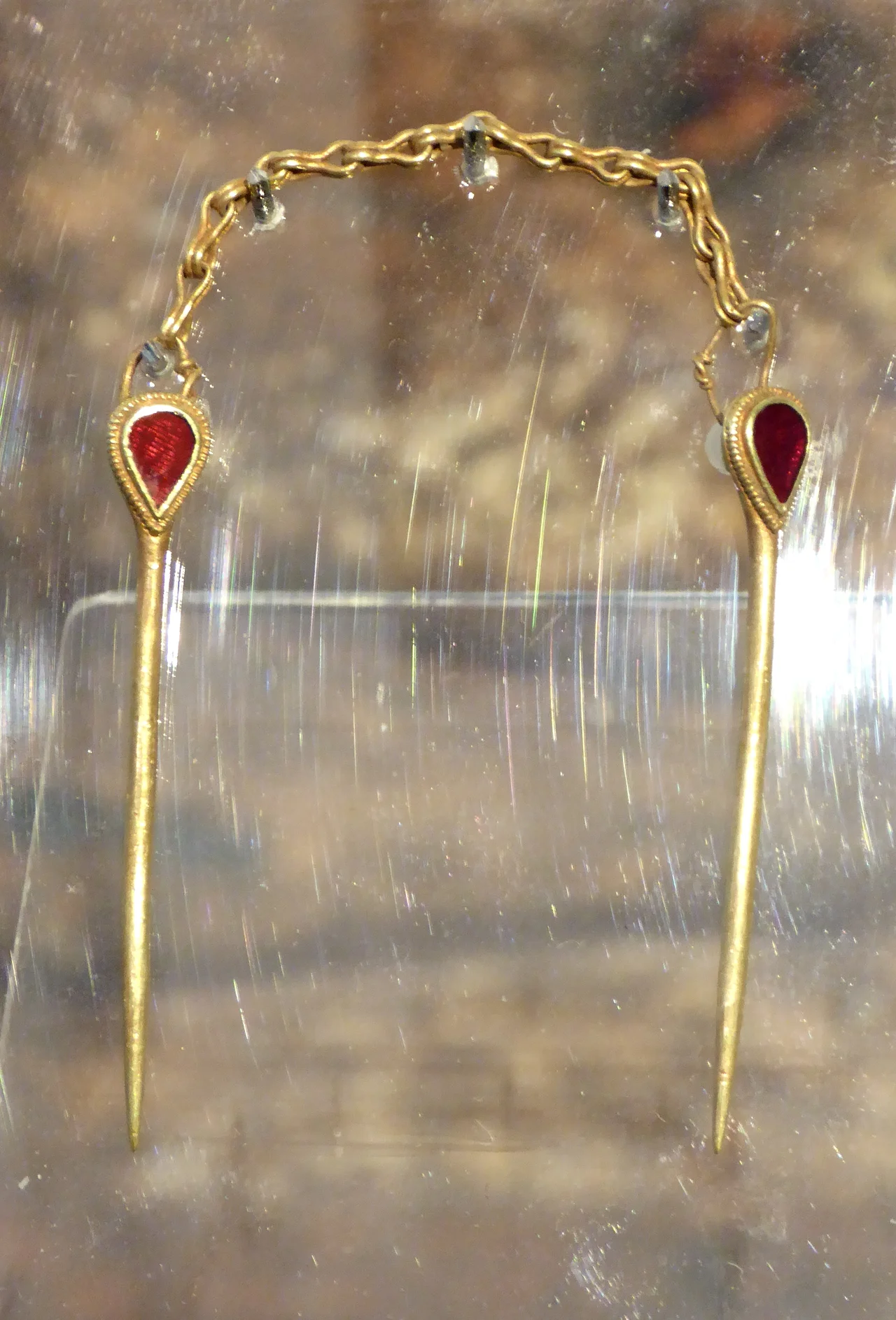

Trumpington Bed Burial
She was about sixteen years old. She had come a long way — isotope analysis of her bones suggests she grew up near the Alps, in what is now southern Germany — and she died not long after arriving in what the Anglo-Saxons called Trumpington. Someone laid her on a wooden bed, dressed in a robe, and placed across her breast a tiny gold cross inlaid with deep red garnets, just 3.5 centimetres wide. Then they buried her. Thirteen centuries passed. In the summer of 2011, archaeologists from the Cambridge Archaeological Unit broke ground in Trumpington Meadows ahead of a housing development and found her.
The Cross That Changes Everything
The gold pectoral cross is the centrepiece of this discovery, and its significance is hard to overstate. Anglo-Saxon jewelled crosses of this kind are extraordinarily rare — only five comparable examples are known, including one found on the coffin of Saint Cuthbert. The loops on the back of each arm of the cross confirm it was sewn directly onto the girl's robe rather than hung on a chain. Whoever she was, she wore her faith stitched into her clothing. A cross like this, in this period, could only have been owned by someone of the highest social rank — nobility, possibly even royalty. The precise location of whatever family or court she came from remains unknown, but the object in her grave speaks volumes about power, faith, and the movement of elite women across early medieval Europe.
Buried on a Bed
The burial itself — known as a bed burial — is almost as rare as the cross. No more than a dozen examples are known from the entire Anglo-Saxon period, most of them women. The wooden bed has long since decayed, but its iron brackets survive, tracing the ghost of its shape in the earth. She lay with an iron knife, a chatelaine, and glass beads that may have decorated a purse. The site where she was found, north of the Trumpington Meadows, also yielded three other Anglo-Saxon graves — all young women, none with grave goods or bed burials — along with the foundations of sunken-floored buildings suggesting a settlement. The working theory is that this may have been a monastic community for women of high status, comparable to seventh-century royal foundations like Barking Abbey or Minster in Thanet. No early Anglo-Saxon settlement had previously been documented at Trumpington.
A Site Through the Ages
The girl and her companions were not the first to be buried in this ground. The same excavations uncovered two Neolithic long barrows and a Bronze Age double burial — a man and a woman whose DNA analysis revealed they were likely maternal cousins, or perhaps half-siblings. An Iron Age settlement lay beneath that. Trumpington Meadows is, in this sense, a palimpsest: layer upon layer of human presence in a landscape where the River Cam curves south of the city. The housing development that prompted the dig is now built. But what it disturbed — and what it revealed — has permanently altered understanding of this corner of Cambridgeshire.
Where She Rests Now
The finds from the Trumpington bed burial are displayed at the Museum of Archaeology and Anthropology at the University of Cambridge. The cross has been valued at more than £80,000. In 2023, Cambridge researchers published a facial reconstruction of the young woman — a teenager's face, looking out from the seventh century with dark eyes — based on new analysis of her remains. She has no name. She left no text. But she left a cross, a bed, and a set of iron brackets in the earth, and those have been enough.
From the Air
The excavation site lies in Trumpington Meadows, on the southern edge of Cambridge, at approximately 52.172°N, 0.105°E. The area is visible from low altitude as the southern suburban fringe of the city where housing estates meet open countryside. Cambridge Airport (EGSC) is roughly 4 miles to the northeast. The River Cam runs along the western edge of the area. At 1,500 feet, the transition from urban Cambridge to the open Fenland south becomes clearly defined.
Nearby Stories
- Kentwell Hall 2.5 km away
- Thetford Hoard 2.8 km away
- King's Ely 6 km away
- Bedford 7.8 km away
- White House Farm murders 13 km away
- Oundle 14 km away
- Hemel Hempstead 14 km away
- North Weald Airfield 15 km away