.jpg)
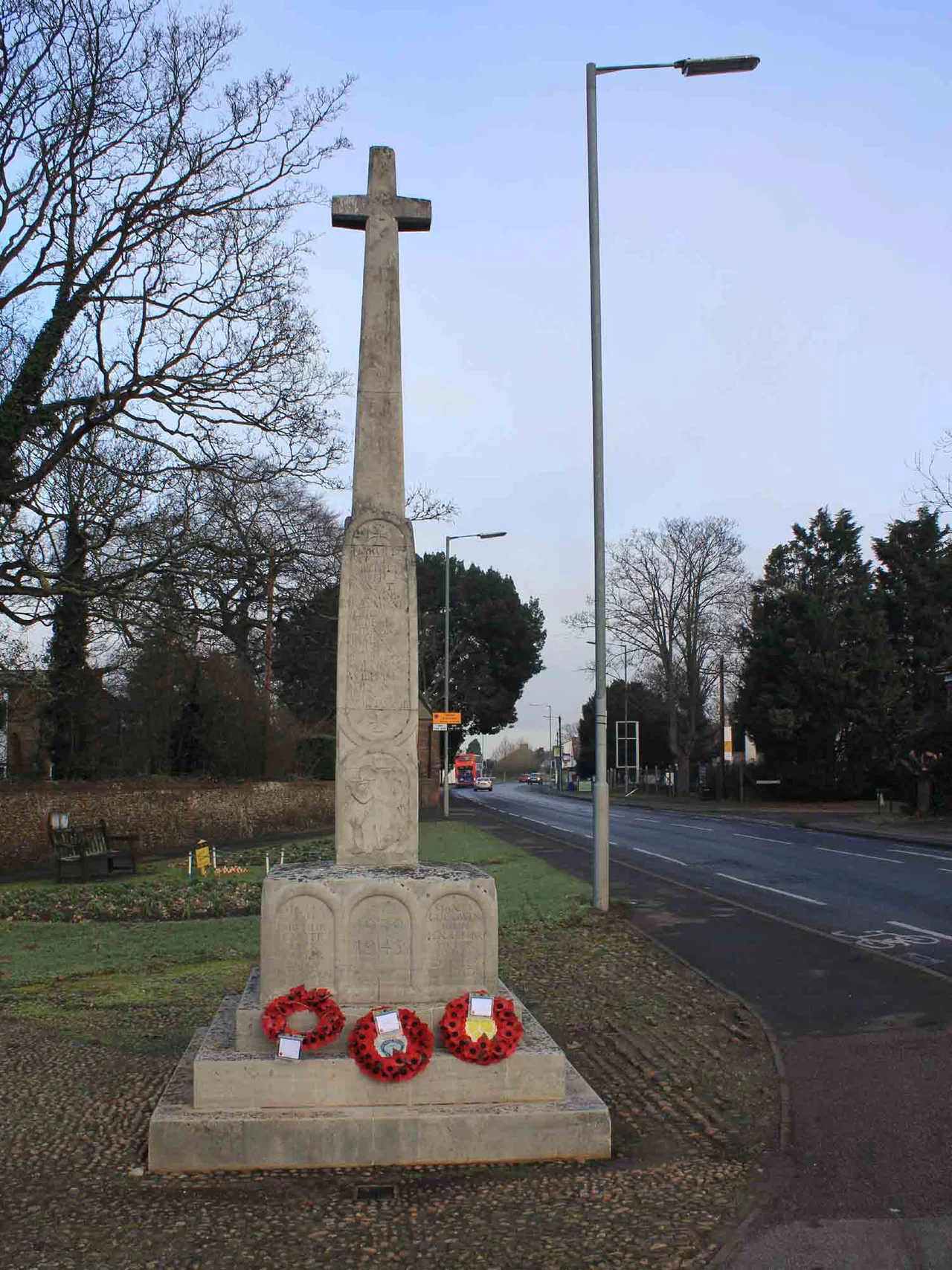
Trumpington War Memorial
There was a stone already in the ground at Cross Hill before the memorial was built. When workmen dug the foundations in 1921, they found a large square piece of Barnack stone with a socket, inscribed for a John Stockton and his wife Agnes — the base, it is believed, of a thirteenth-century wooden roadside cross. The village of Trumpington had been marking this spot for seven hundred years. The new cross went up in the same place.
Eric Gill's Work
The Trumpington War Memorial was designed by Eric Gill, one of the most distinctive artists and letterers of the twentieth century, whose sculptures and typefaces remain widely recognizable. He had already carved an inscription for the Pemberton family at the nearby parish church of St Mary and St Michael, which is how the connection was made. The committee that commissioned him had considered other options — a memorial garden with tennis courts, a clock tower, an obelisk — before settling on a cross. Gill produced a 14.5-foot Latin cross in Portland stone on a four-foot square plinth, itself standing on three square steps. The carving is meticulous: high-relief panels on the lower sections of the cross shaft show the Virgin Mary, Saint Michael slaying a dragon, Saint George with a figure also slaying a dragon, and a fourth panel — based on a design by the artist David Jones — depicting a tired soldier.
36 Names
The upper panels of the cross shaft are elongated ovals, each inscribed with nine names. Thirty-six men from Trumpington died in the First World War. Their names are arranged around the cross, nine to a face, small crosses marking each end. The plinth's east side, facing the High Street, bears the dates 1914 and 1918 in the side arches. The inscription in the centre reads: "MEN OF TRUMPINGTON WHO GAVE THEIR LIVES IN THE GREAT WAR." The west side carries the words "FOR LIBERTY AND JUSTICE." Added later to the south side are the dates 1939–1945 and the names of eight more who died in the Second World War. In 2014, during a renovation, a further name was added: Lieutenant Jack Neville Creek of the Argyll and Sutherland Highlanders.
Cross Hill
The memorial stands at what was historically called Cross Hill, at the junction of High Street and Church Lane, where the road west toward Grantchester begins. Originally the cross occupied the middle of the roadway, with carriageways passing on either side. It now stands in a paved area with traffic routed to the south. The village has grown around it; Cambridge has grown around the village. But the spot where the memorial stands has been a place of marking and memory since at least the thirteenth century. The Barnack stone found beneath it — the medieval base for a wooden cross long gone — is now preserved inside the church. The old resting place became the foundation of the new one.
Unveiled and Listed
The memorial was unveiled on Sunday 11 December 1921, with a service led by the Reverend Arthur Christopher Moule — himself a former Professor of Chinese at Cambridge University, and one of the committee members who had overseen the design process. The cost was raised by public subscription, with the Pemberton family of Trumpington Hall contributing £200. In 1999, the memorial was designated a Grade II* listed building, recognising both its architectural significance and the quality of Gill's carving. Grade II* status is given to particularly important structures — fewer than six percent of all listed buildings achieve it.
From the Air
Trumpington War Memorial stands in the centre of Trumpington village, at approximately 52.175°N, 0.113°E, on the southern outskirts of Cambridge. The village high street and church are visible from low altitude, situated about 2 miles south of central Cambridge. Cambridge Airport (EGSC) is roughly 4 miles to the northeast. At 1,500–2,000 feet the historic village core, including the parish church of St Mary and St Michael, is clearly distinguishable from the surrounding residential development.
Nearby Stories
- Kentwell Hall 2.5 km away
- Thetford Hoard 2.8 km away
- King's Ely 6 km away
- Bedford 7.8 km away
- White House Farm murders 13 km away
- Oundle 14 km away
- Hemel Hempstead 14 km away
- North Weald Airfield 15 km away